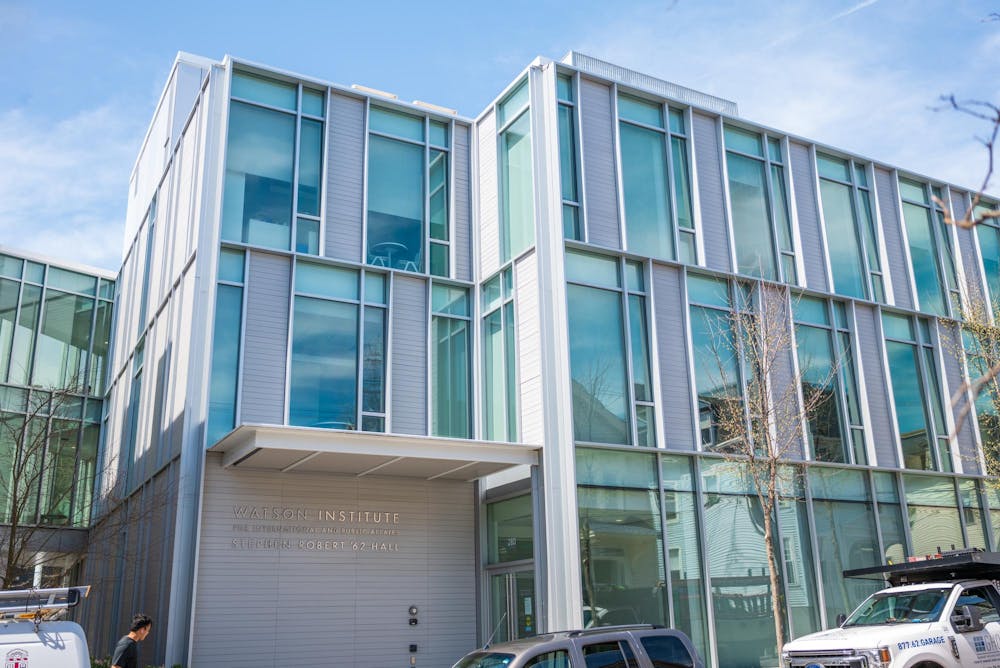
The United States spent an estimated $3.4 trillion to compete militarily with China between 2012 and 2024, according to a Costs of War report by Jennifer Kavanagh, the director of military analysis at Defense Priorities, a foreign policy think tank. The paper comes as part of the Costs of War project at the Watson School for International and Public Affairs, which aims to research the social, economic and political impacts of U.S. military activities and spending.
Another Costs of War report by Suisheng Zhao, a professor and director of the Center for China-U.S. Cooperation at the University of Denver, found that anti-Asian racism has risen due to the United States’s militarized rivalry with China.
Kavanagh’s paper provides the first account to date of the financial costs spent by the United States to compete militarily with China.
The $3.4 trillion figure — which averages to about $260 billion spent annually — surpasses the $2.3 trillion the United States spent on its 20-year war in Afghanistan, according to the paper. It also makes up about 30% of total defense spending from 2012 to 2024 and is about twice the amount the United States has spent on education during this time period, the report added.
The paper also examines the opportunity cost of the expenditures, which includes rebuilding the U.S. air traffic control system, improving infrastructure and providing tuition-free education at public universities.
According to the report, tuition-free college would cost about $400 billion per decade. This means that “the United States could fund about 85 years of tuition-free college education for all U.S. college-goers” with its expenditures on its militarized rivalry with China so far, the paper states.
The Department of Defense declined to respond to The Herald’s request for comment.
Using published Department of Defense budget plans and annual expenditures, Kavanagh estimated how much of the spendings were allocated to the militarized rivalry with China, she explained in an interview with The Herald. From there, she looked at the different services and adjusted their expenditure.
For example, Kavanagh said she made a “higher-end estimate” for the Navy “because the Navy’s focus has been so squarely on operating in Asia.” On the other hand, expenditures for the Air Force and the Army, which mostly focuses on “procurement and operations costs,” were estimated more conservatively.
According to Benjamin Friedman, policy director at Defense Priorities, Kavanagh’s paper “helps us understand what our policies actually cost, and therefore, what we’re sacrificing for them, and hopefully we can make better decisions as a result.”
While the media might pay more attention to the “dollar figures” in the costs of war, it is also important to “put the political economy of war in conversation with the human toll of war,” according to Stephanie Savell MA’11 PhD’17, senior fellow at the Watson School and director of the Costs of War project.
In his Costs of War report, Zhao contends that this militarized rivalry with China has spurred “anti-Asian, especially anti-Chinese American, racism.”
This racism has manifested “through hate crimes, unjust security targeting and legal exclusions, undermining American values and harming U.S. scientific, economic and strategic interests,” the paper reads.
“It’s very convenient to have an enemy,” said Lyle Golstein, director of the China Initiative at the Watson School and director of the Asia program at Defense Priorities. “Deep in our human psychology, we’re taught to sort of compete in this way — it helps us to unify as a country if we have something to compete against.”
“Now, because of U.S.-China competition, Chinese Americans become (a) target,” Zhao told The Herald.
“We’ve all intuited that Asian Americans face a more hostile atmosphere while this (militarized rivalry) is going on,” Goldstein said. But Zhao has made a “bulletproof case” and an “extremely well-documented study as to how this came about,” he added.
The White House did not respond to The Herald’s request for comment.
Zhao argues that this rising anti-Asian racism risks losing scientific talent from China, which would significantly impact the United States technologically and economically. The paper cites a 2021 study that found that “foreign-born STEM workforce contributed $367 billion to $409 billion in labor value-added” in 2019, which was “1.7 to 1.9 percent of U.S. GDP” that year.
The United States and China are in a “fierce race” over “high-tech technologies,” according to Zhao. When it comes to artificial intelligence, “80% of those top scientists and engineers are Chinese or (of) Chinese origins,” he added.
“This is a very, very big loss for (the) United States,” Zhao said.
“When a major attack and war happens — like what’s happening in Iran right now — Americans start paying attention to the many costs of the war,” Savell said. But “this idea that war preparation has an enormous cost to us,” when it comes to the U.S-China militarized rivalry, is “hard to draw attention to because it’s just not something that’s on many people’s minds.”
Savell emphasized the importance to “keep shining light” on these costs.
“Continuing to draw these connections and raise these issues is just so essential for our democracy,” she added.

Ivy Huang is a University News and Science & Research editor from New York City. Concentrating in English, she has a passion for literature and American history. Her favorite authors include Marilynne Robinson, Vladimir Nabokov, and Toni Morrison. Outside of writing, she enjoys playing basketball, watching documentaries, and beating her high score on Subway Surfers.