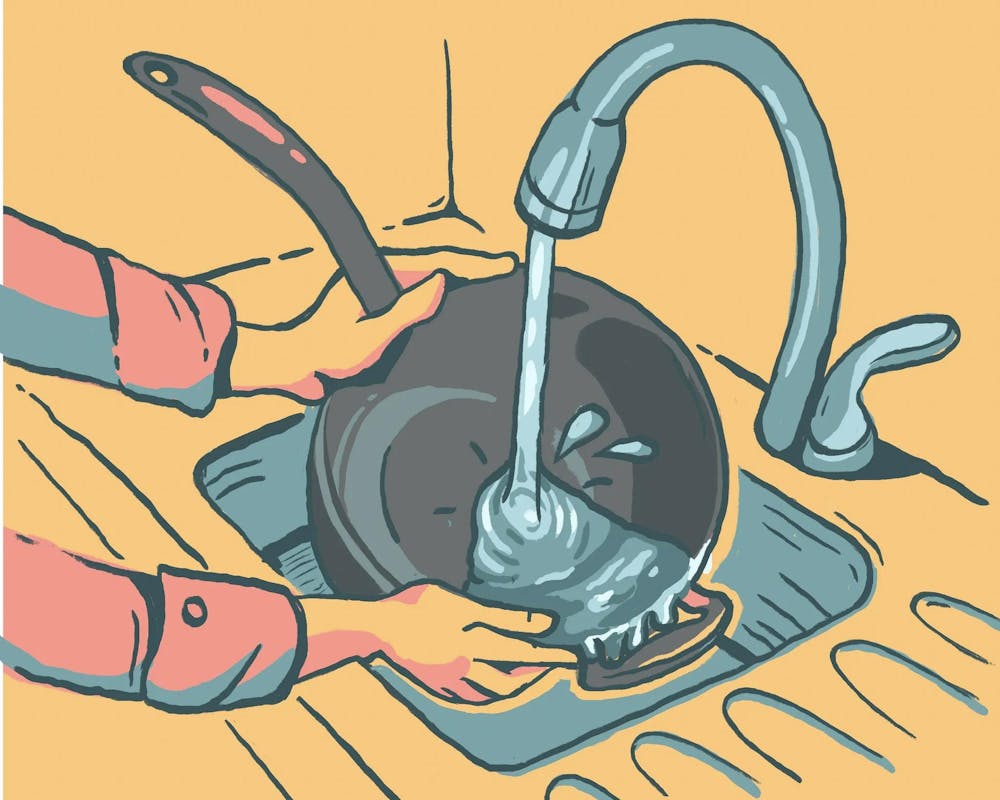
Most of the time, Professor of Physics and Engineering Jay Tang and Ph.D. candidate Thomas Dutta GS research the movement of bacteria in water. But their new study takes fluid mechanics beyond the lab and into the kitchen sink.
The study, titled “Thin film flow in the kitchen,” started as a side project just over a year ago after the researchers saw a collection of scientific articles covering fluid science in the kitchen, Tang said. This prompted Tang to propose a study examining how long it takes water to fully drain from woks to prevent rusting.
“I was just thinking from my own experience of … doing some cooking in the kitchen,” he said. Tang realized that the physics of drying woks overlaps with his research and could be a “good exercise to help us understand fluid dynamics.” The study was conducted in part in Tang’s lab in Barus and Holley also in part by Dutta in his kitchen at home.
Arnold Mathijssen, an assistant professor of physics and astronomy at Penn who previously wrote a paper on kitchen science, said that Tang and Dutta’s study, which covers various kitchenware, is particularly pertinent for woks. The spherical pans are seasoned — coated with a thin layer of oil that prevents rust and sticking and builds up over time to flavor food cooked in the pan — so they must be airdried, he said.
Dutta had also previously witnessed fluid mechanics at work in the kitchen growing up and watching his grandmother tilt oil bottles when making parathas — a South Asian crispy, fried flatbread. This technique allowed her to optimize the amount of oil she could get out of the bottles.
The research relies on the thin film equation — derived from the famous Navier-Stokes Equation — to describe how thin layers of liquid move. In thin layers of liquid, the lowermost layer experiences much greater “viscous drag” from friction between the liquid and the surface it is on, Dutta said. The friction creates a gradient where top layers of liquid move but the layer closest to the surface stays.
When water is poured out of a wok, for example, this friction creates a gradient between the thin layer against the pan and the uppermost layer. Given the thinness of the liquid, this gradient is more important than it would be for large volumes. Gravity also factors into the dynamics.
“Gravity is pulling (the liquid) down, and the bottom layer wants it to stay still,” Dutta said. “It’s the interplay of these two” forces. The thin layer equation takes the interplay of the forces into account, allowing the researchers to model the draining of water from woks.
Tang was surprised by the time it took to drain 90% of the liquid from the wok when poured out. According to Dutta’s calculations, it takes 10 to 15 minutes, Tang said. Since this layer is so thin and almost imperceivable, Tang had previously only waited “a couple of minutes” for the water to drain in his kitchen.
When testing these results in the kitchen, they found that it was most efficient to allow liquid to collect at the bottom of the container after an initial pour and then pour out the pooled liquid. This technique also could help minimize rusting in the cookware.
Mathijssen added that the study has applications in the world of medicine. For example, biomedical devices also need to drain liquids efficiently, since wiping them with a cloth risks contamination.
“This study nicely illustrates the fundamental physics of thin-film drainage,” Vivek Prakash — an assistant professor of physics at the University of Miami who was not involved with Tang and Dutta’s study and also worked on the paper with Mathijssen — wrote in an email to The Herald.
He added that he would be interested to see “a wider range of kitchen fluids, especially complex liquids like sauces or condiments that behave differently from simple Newtonian fluids” in further studies.
“It’s fun for (college students) to see their physics professors not only just teaching them college physics,” Tang said. “Kitchen physics is interesting for everyone.”