This is the fourth installment in a series of Science & Research articles addressing widely held beliefs and myths on college campuses.
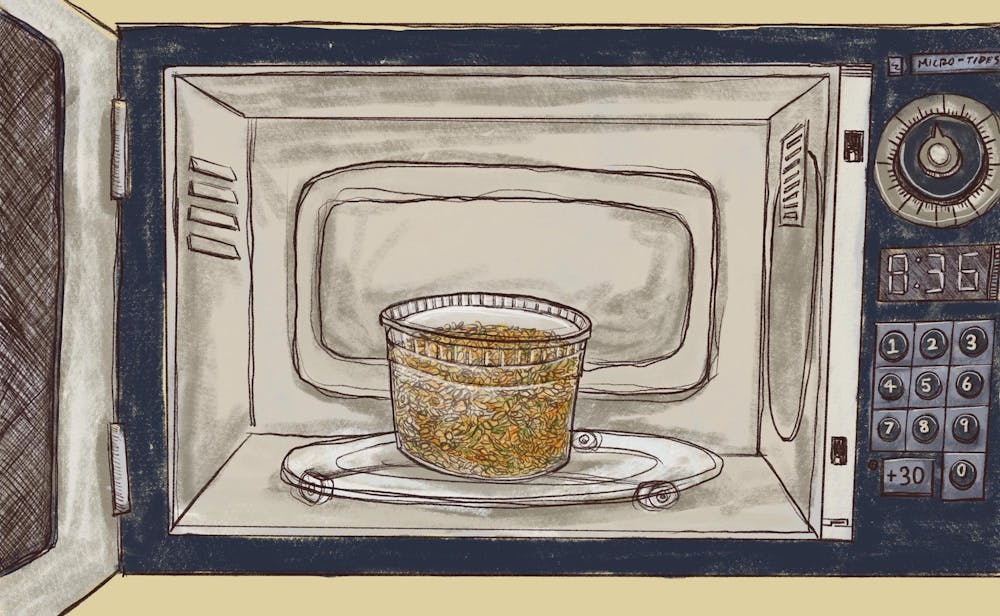
When students crave a break from the Sharpe Refectory, they might order some takeout or reheat leftovers living in the back of their mini fridge. But if they choose to warm up food in the microwave, they should think carefully about the material of the dish holding it if they want to avoid ingesting tiny pieces of plastic.
Microplastics are plastic particles that range in size from one nanometer to five millimeters, according to the United States Environmental Protection Agency. Some microplastics can be formed from the breakdown of larger plastic materials.
But being in college and without a fully stocked kitchen, it can be more difficult to avoid microwaving food in plastic containers. The Herald spoke with students about their perceptions of microplastics.
While Annabel Tu ’29 knows what microplastics are, she said that it’s not “a very pressing issue” in her mind. Similarly, Kaya Gehlbach ’29 said she is aware of microplastics and tries to avoid them where she can, but it’s not a “top priority” for her. Both Tu and Gehlbach said that being in college makes it harder to avoid microwaving plastic than being at home.
Sophia Dean ’27 told The Herald that though she tries “not to worry too much,” she also avoids microwaving food in plastic containers.
“I feel like I should be more worried, but it feels very normalized,” Dean said.
Andrea Yiu ’28, who learned about microplastics from her mom, does not microwave plastic. “She would always tell me not to microwave (plastics),” Yiu said, adding that she feels that “not everyone knows about this.”
Just three minutes of heating large plastic items — such as food storage containers — can release millions of microplastic particles, Kazi Albab Hussain, a researcher at the University of Nebraska-Lincoln, found in a 2023 study.
“Anything unexpected inside our body is bad,” Hussain said in an interview with The Herald. He explained that studies have shown microplastic build up in organs across the body, including the brain, lungs and kidneys.
The long-term effects of microplastics on human health are still not completely understood.
Hussain tested the abundance of microplastics released by food storage containers under a variety of conditions, including storage at different temperatures and microwave heating, Hussain said. Microwave heating by far causes the largest release of microplastics, he found.
According to Hussain, microwaves result in plastics receiving localized heat, which is when heat energy is applied to a specific region rather than a general area. This localized heat causes stress within the material, leading to cracks in the plastic polymers and subsequent release of microplastics.
This stress “can cause the release of or fragmentation of particles,” Hussain said.
Hussain added that the abundance of microplastics released by heating depends on a range of factors.
“If oily food or acidic food is present, that can actually change the chemistry … and that can actually accelerate the release” of microplastics, he said. In addition, the longer the heating period, the smaller particles can get, he said — which allows them to more easily travel and accumulate in the body.
Changmin Yan, an associate professor at the UNL whose research includes health communication, has worked on microplastics research. Yan told The Herald that the longer plastic is exposed to heat, the more microplastics are released that can leak into food or drinks.
Although plastic containers can be cheap and convenient, Yan recommends the use of glass and ceramic containers when heating up food in the microwave.
For now, Hussain’s message is clear: “Don’t use plastics in the microwave.”
Angel Lopez is a senior staff writer covering Science and Research. He’s a first-year student from Tyler, Texas and planning to study neuroscience and literary arts. In his free time, you can find him playing ping pong, listening to music, or reading.