Spinal cord injuries are among the most severe injuries an individual can experience, with the debilitating effect of paralysis. A study by Brown researchers could help provide insight on returning a feeling of sensation to patients who are paralyzed from the waist down.
Scientists have long believed that patients with severe spinal cord injuries have almost negligible chances of recovery without medical intervention, according to Jonathan Calvert, lead author of the study and assistant professor of neurological surgery at the University of California, Davis. Calvert conducted the study, which is published in Nature Biomedical Engineering, when he was a postdoctoral researcher at Brown.
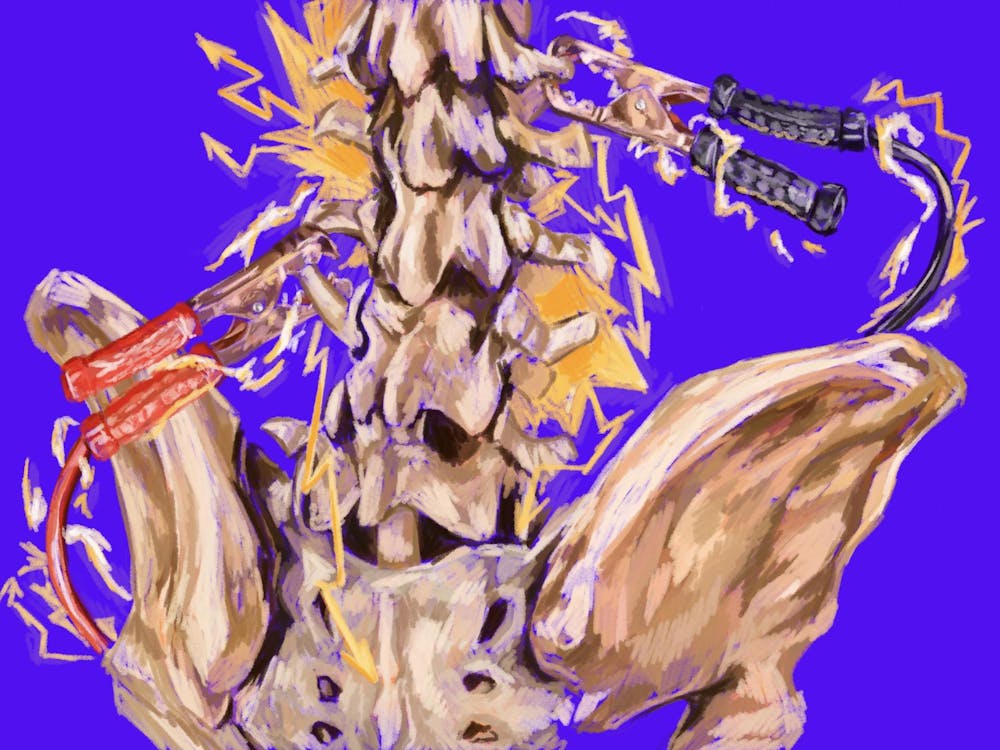
The study of this technology, which is still in its early stages, could help paralyzed individuals recover sensory feeling through an implant that provides electrical stimulation. While electrical stimulation below the injury site restores movement, stimulation above the injury site can restore sensory feedback, Calvert said.
In past research, Calvert and others in the field have been able to restore control over muscle movement for these patients by using electrical stimulation below the injury site on the spine.
“When paired with rehabilitation, participants could regain the ability to independently walk on a treadmill or the ground,” Calvert added.
But restoring motor movement without sensory feedback has drawbacks.
“If (the patients) are walking on a treadmill, they have to look down at their feet and see where they’re placing each one of their steps, which is a big limitation to actually using this in the community or at home settings,” Calvert explained.
In other research in the field, sensory feedback restoration has been attempted with non-invasive approaches, such as surface stimulation, a treatment which delivers electrical pulses through the skin. But these procedures come with physical limitations, Calvert noted.
The approach is temporary, which would be impractical for paralyzed patients, Calvert said. “Someone with a spinal cord injury might not have the level of independence where they can easily don and doff something,” he added.
The study’s approach offers a more permanent solution — it is the first of its kind to explore restoration of sensory feedback in patients using an implant, which is an “invasive modality,” Calvert said. The electrode arrays were implanted in the epidural space, which is next to the spinal cord.
The implant of electrode arrays can then allow doctors to “stimulate both above and below the injury,” therefore pairing motor restoration with synchronized sensory restoration.
Barring inherent surgical complications, the implantation of these electrodes was not found to have any additional adverse effects.
“We anticipate that this is a relatively safe and straightforward procedure that most participants should tolerate pretty well,” Calvert said.
Although restoring the direct feeling from the legs or feet is infeasible after the severance of nerves to the brain, patients could learn to interpret sensory feedback in “unnatural locations” — such as stimulus to their chest — to be associated with leg movement, Calvert said.
The study involved three participants. According to Lakshmi Narasimhan Govindarajan PhD’23, a postdoctoral associate at the Massachusetts Institute of Technology and an author of the study, this paper serves as a compelling “proof of concept” and opens up the path to further research.
“Rather than changing the hardware, we’re effectively changing the mapping between sensation and meaning,” Govindarajan wrote in an email to The Herald.
It’s important for the technology to allow for a personalized approach to tackle different types of spinal cord injuries, according to Govindarajan.
“Even within the patient population we studied, there’s significant variability — each person’s injury is different, the time since injury varies and the amount of remaining neural circuitry can differ quite a lot,” Govindarajan added.
Personalization is also important since sensation is such a subjective experience, Calvert explained.
Machine learning can achieve this personalization efficiently. Participants used a “DJ board” to control a series of knobs and sliders to adjust stimulation patterns in their spinal cord. This data was then used to train neural networks that optimize the delivery of electrical stimulation to achieve a desired muscle activity.
“Machine learning is particularly valuable here because it can leverage those broader similarities while still adapting to the unique characteristics of each individual, enabling precise, patient-specific tuning,” Govindarajan explained.
The implanted devices are not likely to “precisely duplicate the complex electrical signaling which a perfectly healthy spinal cord is capable of,” Professor of Engineering and Physics Arto Nurmikko, who was not involved with the study, wrote in an email to the Herald.
But “these types of sophisticated neuroengineering solutions can be truly empowering in improving the quality of life for patients with such a severe neurological condition as spinal cord injury,” Nurmikko added.
Nishita Malhan is a senior staff writer covering science and research.