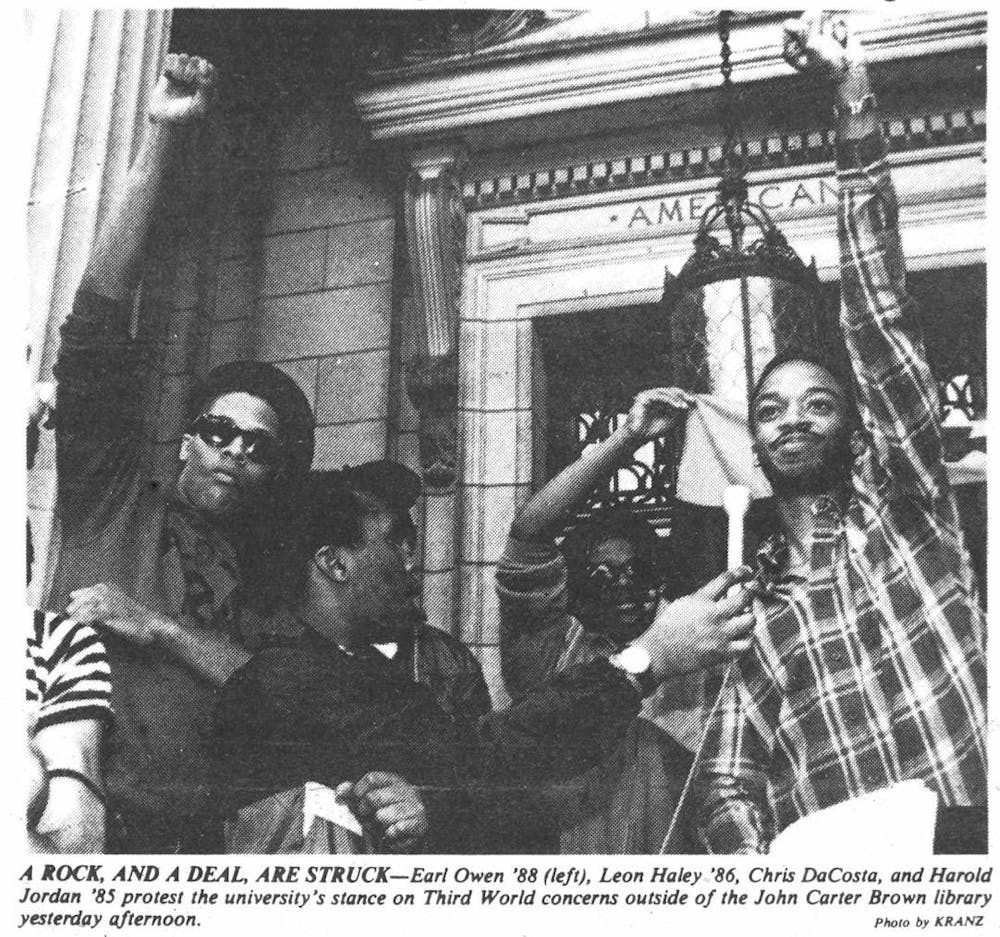
In recent years, activism at Brown has drawn national media attention, but the University’s history of protest dates back decades. Offered once every few years, the first-year seminar AFRI 0610: “Black Student Protest from Jim Crow to the Present,” examines this history, looking specifically at Black student activism on college campuses across the nation.
Taught by Vice President of Diversity and Inclusion and Professor of Africana Studies and American Studies Matthew Guterl, the course examines the intersection of protest and politics at the local, national and global levels.
Noliwe Rooks, a professor and chair of the Department of Africana Studies, said the course is designed to expose students to “different kinds of protests, different figures, different cultural issues," asking them to “situate what they’ve learned in the present.”
Guterl declined to comment on the course.
Students in the seminar engage with a variety of materials, including scholarly articles, memoirs and documentaries, with a particular emphasis on movements in the 1960s and 1970s, according to Avie Marsh ’29, who is currently enrolled in the class.
Classes are “very discussion-based,” Marsh said. The discussions are based on course readings, which are “about different schools, different movements (and) different protest tactics.”
The course introduced Marsh to material she had not previously encountered, she said. “In high school, there wasn’t really any Black history at all.”
The small size of the seminar — which is capped at 15 students — allows for a “very intimate class,” said Cassandra Coleman ’26, who took the class in 2023. “It’s the smallest class I’ve ever taken at Brown,” she added.
Eden Philippe ’29, a prospective biochemistry and molecular biology concentrator whose classes are usually “huge lectures,” said that it’s “nice to be in a class that’s so small and you can actually have your voice be heard.”
Students can “really claim intellectual space in the class,” Rooks said.
The class culminates in a final project where students work together to conduct research and collaborate on a paper of roughly 8,000 to 10,000 words.
This semester, students are examining a free speech case at Brown from the 1990s, in which a student was expelled under the University’s hate speech code, Marsh said.
For the project, students are conducting “first-person research and interviewing Brown alumni,” as well as digging through The Herald, Providence Journal and other media archives, according to Mira Flood ’29.
When Coleman took the course in 2023, the final project consisted of interviewing student organizers involved in campus protests in the 2010s.
Flood described the course as a safe space to think about campus activism, calling it “a thought incubator.”
“The class is less about teaching students to be an activist, but more about teaching about the history of activism and student activism,” Flood said. “We’re really just trying to understand a fuller picture of what activism looks like.”
For Coleman, the class’s approach changed her engagement with protests.
“Taking this class made the sacrifice of protests more visible to me, and especially for those on the front lines, like those who are occupying University Hall or sitting there on the encampment,” Coleman added.
Likewise, Philippe said that studying past movements has influenced how she interprets current events. “You can look at protests worldwide in a somewhat different lens.”
Coleman said the course shaped how she thinks about how protests function. “When I was a younger student, I definitely perceived protest as kind of like this spirited movement towards something you’re passionate about,” she said. But after taking the class, she saw protests as more “strategic and focused and planned.”
Studying earlier movements can help provide a framework for understanding activism today, Flood added. “If you can’t understand what has come before,” she said, “how are you expected to move the world in the future?”
Correction: A previous version of this article misstated information about the course's syllabus in 2023. It has since been updated. The Herald regrets the error.
Miriam Davison is a Senior Staff Writer for University News covering Academics & Advising. She is a first-year from Los Angeles, CA and plans to study tentatively the realm of International & Public Affairs and English, though her interests span from linguistics to history to music. In her free time, she plays on one of Brown's ultimate frisbee teams and likes writing silly poems.