
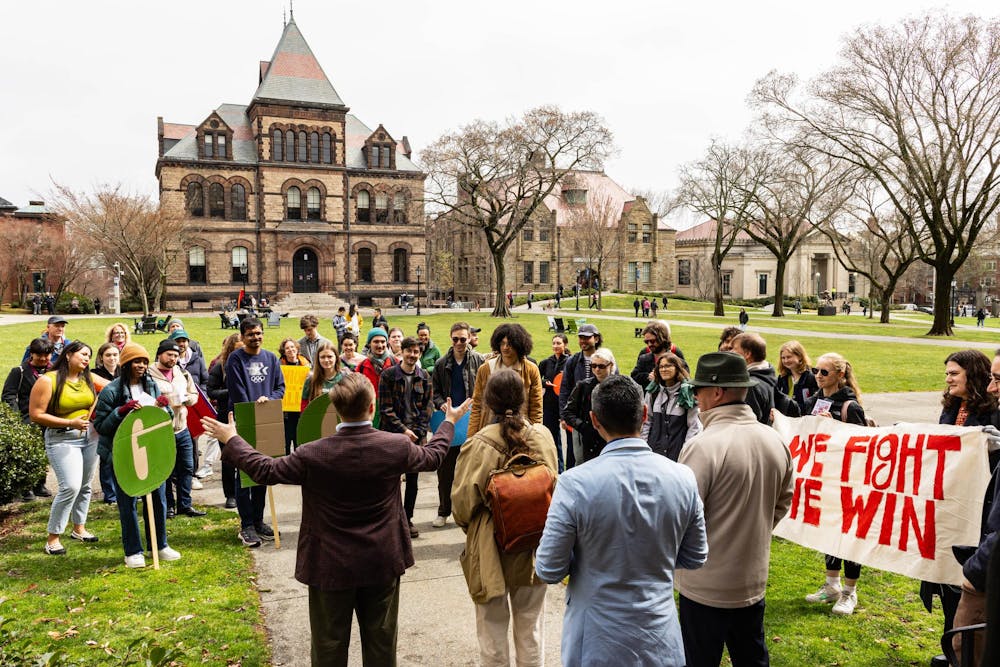
Graduate fellows rallied on Ruth J. Simmons Quadrangle Friday after announcing last Monday that they were prepared to unionize in a move that could alter the landscape of graduate student organizing nationwide.
Roughly 45 people attended Friday’s demonstration, including City Councilor Sue AnderBois (Ward 3) and Rep. David Morales MPA’19 (D-Mount Pleasant, Valley, Elmhurst). President of the Rhode Island AFL-CIO Patrick Crowley was also in attendance, along with other R.I. union leaders.
After a series of speeches and chants, the group walked to the Main Green, where they presented a letter to an administrative assistant inside University Hall arguing that Brown should voluntarily recognize the fellows as part of the Graduate Labor Organization.
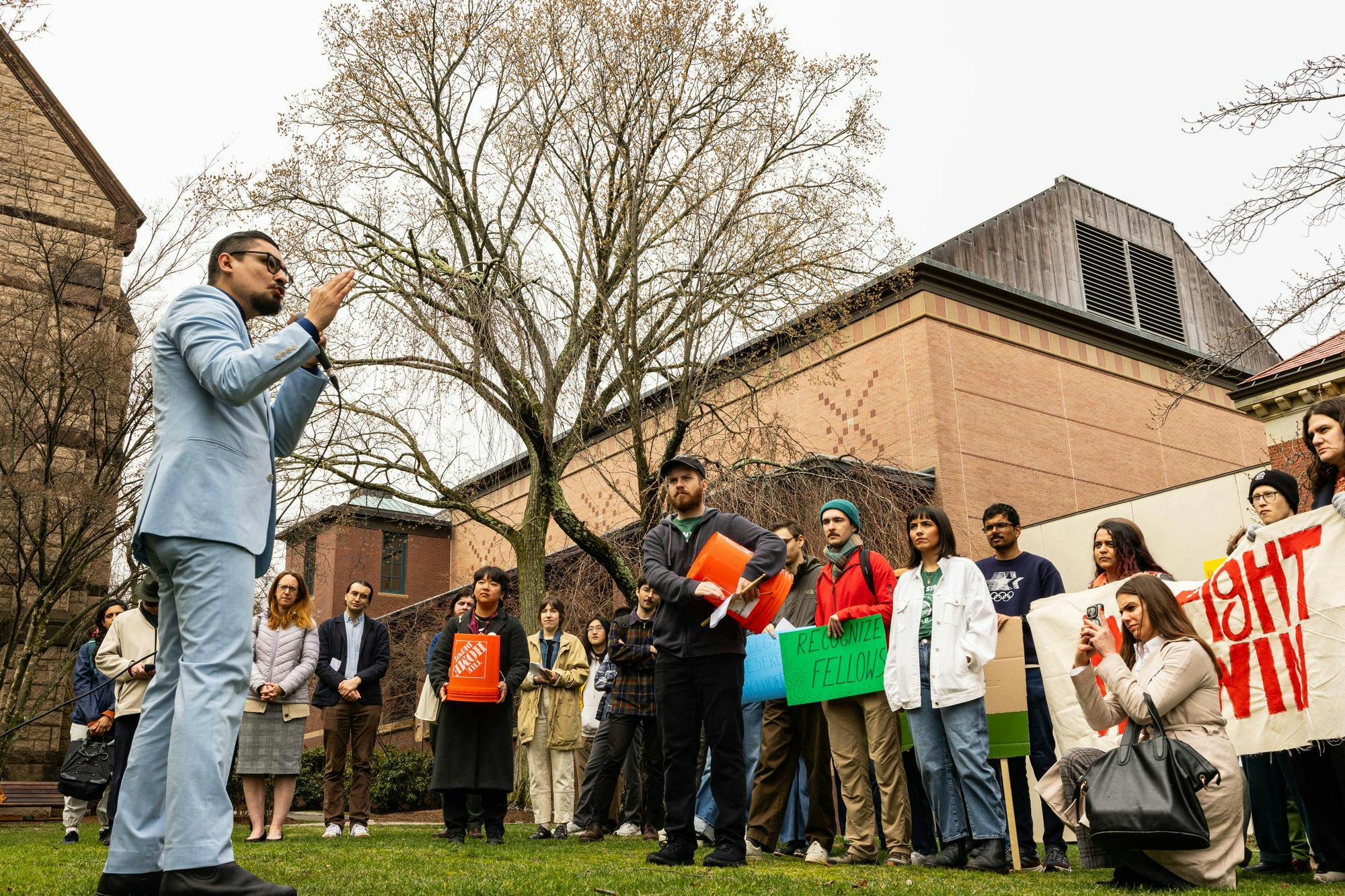
Last Monday, leaders from RIFT-AFT Local 6516 — GLO’s parent group — sent an email to University administrators stating that more than 70% of fellows had indicated they wished to be represented by GLO. Friday’s letter reiterated the union’s request for voluntary recognition.
University spokesperson Brian Clark did not immediately respond to The Herald’s request for comment. He wrote last week, after Brown received the union’s email, that the University “will review the request, determine next steps and respond directly to the organizers,” The Herald previously reported.
Although the National Labor Relations Board does not allow graduate fellows to unionize at the federal level, a novel Rhode Island law passed in August codifies their right to do so under the Rhode Island State Labor Relations Board. There appears to be no U.S. university where graduate fellows have successfully unionized.
“Our campaign operated in secret for over seven months,” said Maria Arievitch GS, GLO’s organizing director, in a speech at the rally. “Slowly but surely, we built up a majority” of fellows who wished to unionize, she said.
Lex Schultz GS, a first-year Ph.D. student and a fellow in the Department of Earth, Environmental and Planetary Sciences, said in a speech that one of the reasons they chose to attend Brown was its robust graduate union.
“I came here because I wanted to be a part of a community where graduate workers have a voice, have a seat at the table and where our labor is respected,” Schultz said.
On the University website, Schultz pointed to the use of “words like ‘devote’ instead of ‘work’ to make it sound like we don’t have a real job, like TAs or RAs,” they said, referring to teaching and research assistants.
Schultz said that they worked around 70 hours per week last semester, including attending classes and completing lab work.
“That’s two full-time jobs in any other industry,” they said. “If your boss expects you and requires you to take a specialized class to do your job better, that’s called mandatory professional development, and you get paid for it.”
Graduate fellows currently receive the same compensation and benefits as their unionized peers, but they are not able to file grievances against the University, which would give them a formal process to allege “inappropriate treatment.”
“The most dangerous part is that fellows do not have access to our union grievance procedure,” Schultz said. “The procedure is basically the heart of the Union. It’s what protects you from harassment and exploitation.”
Victoria Antonetti GS, the vice president of Local 6516 and a fifth-year fellow in applied math, said in an interview with The Herald that the union is prepared to fight for fellows’ unionization whether or not the University recognizes them voluntarily.
The process of fellow unionization will happen alongside GLO’s ongoing contract negotiations, according to Michael Ziegler GS, the president of Local 6516.
“For the University to be able to have as much success as they have” in terms of research and revenue, Morales said in an interview with The Herald, “there’s something to be said about basic fairness in place, and the basic fairness here is recognizing our fellows as being part of a union.”
“Brown works because we do,” Schultz said at the end of their speech. “The research happens because we do. The teaching happens because we do the teaching.”
“And it’s time for a contract that recognizes that fact,” they said.

James Libresco is a senior staff writer covering staff & student labor. He is a first-year student from Alexandria, Va. studying political science and contemplative studies. In his free time, he can be found playing basketball, meditating, or losing in Among Us.


