In the past, when communities in Rhode Island experienced flooding, stories and pictures were some of the only records of the extent of the flooding in the area, making it difficult for community members to adapt to future hazardous weather conditions.
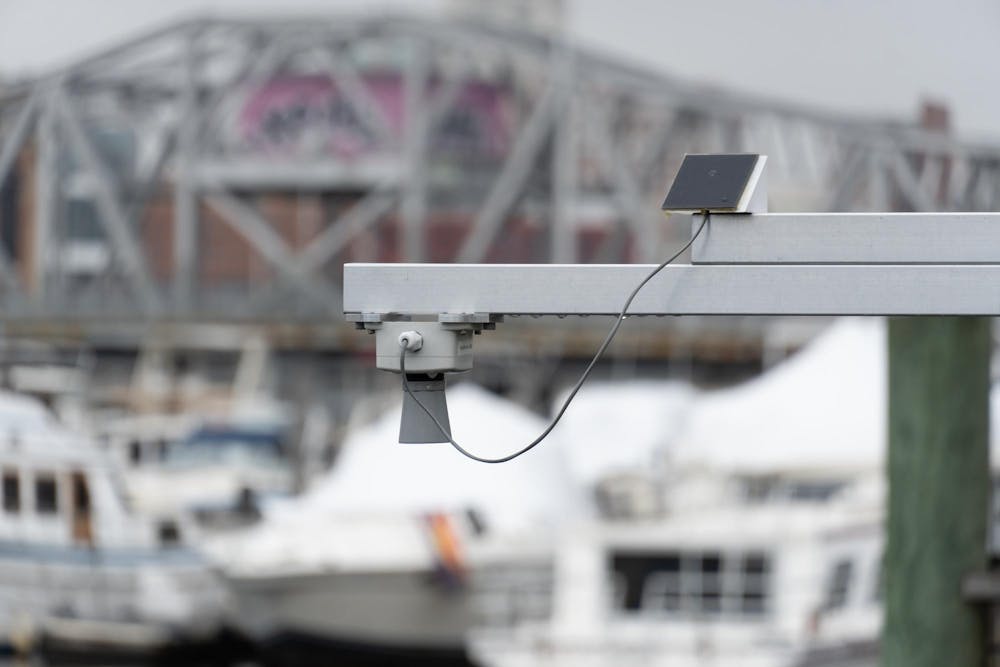
But a dashboard recently launched by Rhode Island Network for Environmental Sensing and Technology now provides real-time data that monitors water levels, air quality and temperature to better inform stakeholders.
The software is “proving people’s lived experience so that they can figure out ways to make changes,” said Sol Cooperdock, a NEST technical lead and a research associate in Earth, environmental and planetary sciences.
“There was a real need for localized, accessible data that wasn’t being met by existing networks,” Emanuele Di Lorenzo, project contributor and professor of Earth, environmental and planetary sciences, wrote in an email to The Herald. Having timely, accurate data can help residents and local officials make better decisions for their communities during hazardous weather conditions like floods and heat, Di Lorenzo added.
According to Cooperdock, the project, which is funded by the National Science Foundation, started out as part of a larger initiative on coastal climate resiliency in Rhode Island and Maine.
As Cooperdock spoke with stakeholders — often emergency or resilience managers — in coastal communities, it became “obvious” that the need for early warning systems for hazardous weather conditions was “one of the most pressing needs that a lot of these communities have,” Cooperdock said.
To identify locations to place the environmental sensors, researchers drive around with local community members who “point out locations that would be useful for monitoring,” Cooperdock added. The researchers then make decisions based on the feasibility of the sensor setup.
The real-time sensor data is uploaded to the NEST dashboard and made available to “everyday users,” according to Di Lorenzo.
According to Di Lorenzo, the data from each sensor is monitored by a prototype artificial intelligence agent developed by Brown undergraduate students. The software alerts the researchers to any unusual signals.
For data that appears to potentially be inaccurate, “we go through a more in-depth data processing, and if later it checks out, then (we) send it on,” Cooperdock said.
Before NEST, this real-time data wasn’t available or was too technical for non-experts. “Now, folks can see what’s happening around them and get alerts for things like flooding or extreme heat,” Di Lorenzo wrote.
Di Lorenzo hopes that NEST data will “become an environmental intelligence infrastructure for the state to provide situational awareness.”
“It’s always important for people just to have more awareness of the environment around them and what they’re living within and a part of,” Ralph Milliken, a professor of Earth, environmental and planetary sciences who was not involved with the project, explained. “We all are part of a very complicated and complex ecosystem.”
In the future, the NEST team hopes to combine the data with an AI agent system to provide a range of services, including education and coastal resilience planning, Di Lorenzo wrote. These steps will “enable different users with diverse backgrounds to interact with the data and knowledge in ways that enhance accessibility.”
“I’m really interested in the connection that is available through sensing,” Cooperdock said. “We’ve just started to scratch the surface.”

Alice Xie is a section editor for Science and Research from Los Angeles, California. She studies Applied Mathematics and Biology, and enjoys reading gut wrenching literature in her free time.