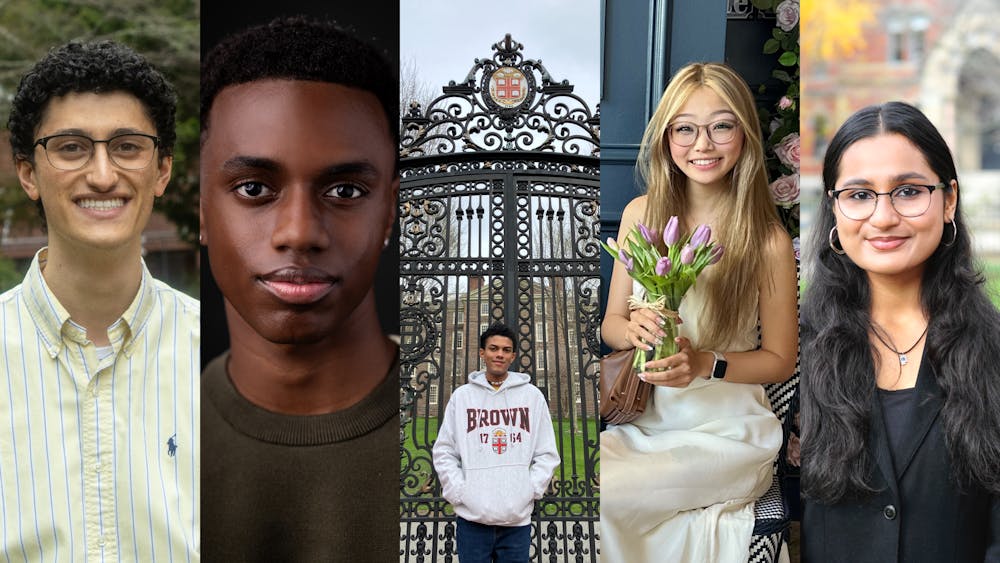
Voting for the Student Government Association’s Spring 2026 elections began on Tuesday. Ariel Shifrin ’27 is the sole candidate running for president of the Undergraduate Council of Students, while Kyle Kavully ’27, Dakota Pippins ’29, Cindy Sun ’29 and Meruka Vyas ’28 are all competing for the role of vice president.
Prior to ballots opening, the Student Government Association hosted a candidate debate on April 4. Voting will close at 11:59 pm on Thursday.
The Herald spoke to the candidates for president and vice president to learn more about their goals and priorities.
Ariel Shifrin ’27
According to Shifrin, the UCS has various mechanisms available to influence the state of affairs at Brown, but “too many of those mechanisms slip through the cracks,” limiting students’ opportunities for involvement. Shifrin told The Herald that his “highest priority is strengthening the efficacy of (the) UCS.”
About two years ago, Shifrin was appointed to co-direct the UCS’s polling committee. He was responsible for introducing the most recent UCS referendum, which redefined several UCS positions, removed outdated language from the UCS constitution and allowed the UCS to manage appointed roles internally.
While the UCS has in recent years “struggled” to spend its budget, Shifrin added, he hopes to use the funding granted to the UCS in its entirety in “places where (students) can see it,” such as improving the quality of Brown’s dormitory lounges.
He also plans to increase transparency by providing a stronger structure within the organization to ensure administrators clearly understand the UCS’s priorities. Shifrin also intends to host events to increase contact between students and the administration. Through opening a “robust” communications department in the UCS, he hopes to increase outreach and “meet students where they’re at.”
Kyle Kavully ’27
Kavully got his start in student government as UCS first-year representative two years ago. Last year, he served as the UCS chair of campus life.
One of his core goals is to create more accessible financial aid. He looks to decrease parental contributions for students and increase the number of students who do not pay tuition. Kavully also hopes to “establish swipes on Thayer” through expanded financial aid funding, he told the Herald.
According to Kavully, many of his campaign programs are rooted in ensuring that “minority groups feel advocated for.” As a Harambee House resident, he believes in having spaces where students are able to find community.
He hopes to increase student engagement with the UCS through town halls, direct contact with students and meetings with clubs and affinity groups. To make the impact of the council more visible, Kavully also plans to use social media to publicize the UCS’s initiatives.
Dakota Pippins ’29
As the partnerships team co-coordinator for Brown Rise Up and a member of the Deportation Defense Network, Pippins has spent the majority of his first year focused on advancing social justice causes.
According to Pippins, his top priority is to create “sanctuary campus policies,” which would include protections for students against federal immigration enforcement. He believes that “every institution has the responsibility to stand up.”
Pippins also believes the UCS must prioritize “making political stances that represent the student body,” he said, adding that the UCS should bring up student demands that “aren’t comfortable” to administrators.
Another one of Pippins’s goals is to hold University administration accountable, including for issues related to the quality of life at Brown. Additionally, he emphasized that he believes the UCS should work to preserve program-housing autonomy.
Cindy Sun ’29
Sun currently serves as the first-year representative for the UCS and has focused her efforts primarily on switching Brown from swipe IDs to tap IDs. She acknowledges that it is a “small issue,” but noted that the inconvenience “adds up.” Sun also supports the return of 24-hour access to certain libraries.
For Sun, it is the UCS’s job to “provide benefits for students.” Sun believes that with the recent referendum, many students “didn’t even know what they were voting for.” It should be the job of the UCS, she argues, to focus on what students are saying.
Sun also believes that the UCS’s structure should be “simplified” for students to increase accessibility and bridge the gap between the council and the student body. She added that she does not believe it is the UCS’s job to provide political stances on issues.
Meruka Vyas ’28
Vyas previously served as the UCS first-year representative and is now the UCS chair of campus life. One of her main priorities is building a “sanctuary campus.” As an international student herself, Vyas believes it is important to ensure that Brown’s international community is represented and has support for navigating resources.
For Vyas, it is not the UCS’s job to function as an activist body. She believes that the UCS is an organization concerned with “all matters related to student life” and should work to represent all students.
Vyas also advocates for giving students swipe access across all dorms. Currently, students often need to ask to be let into other dorms as they only have access to their dorm most of the time. Since students do not necessarily know who is a Brown student, she said, they have to “play the guessing game” when deciding to let someone in. She argues that complete swipe access would remove this security risk.
Expanding the role of UCS committees is another one of Vyas’s goals. She believes that the UCS should build a larger network with student organization leaders to better assess campus needs and interests and also have greater engagement with the Providence community.