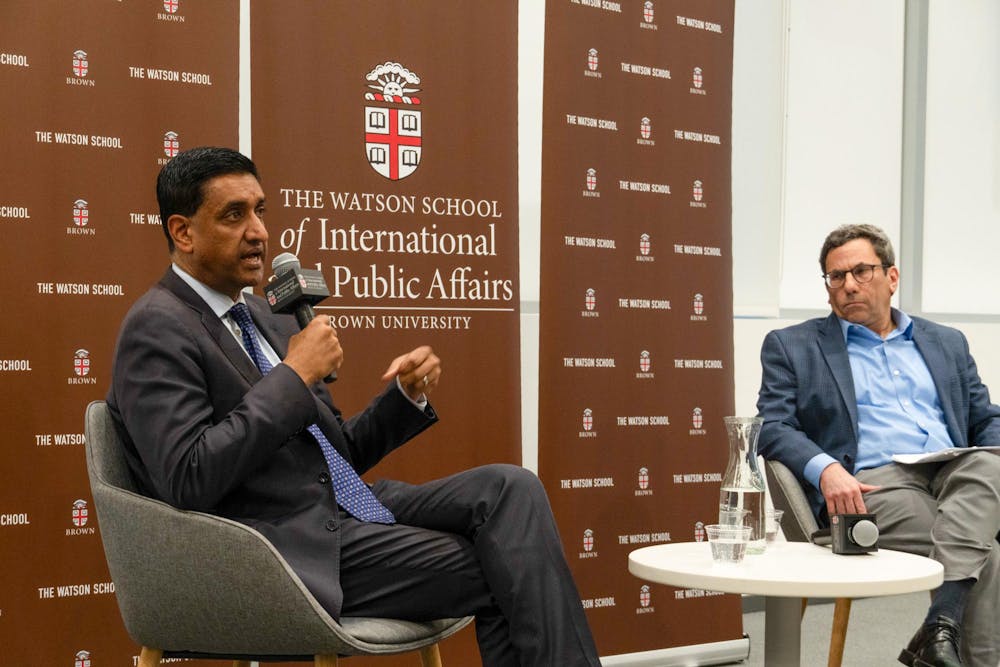
U.S. Rep. Ro Khanna (D-CA 17) discussed taxing the wealthy, the government’s role in addressing economic divides and his stance on funding for Israel’s Iron Dome at a Wednesday talk hosted by the Taubman Center for American Politics and Policy.
“We’re living in a new Gilded Age,” Khanna said in his opening remarks. Khanna noted that the richest billionaires in the United States have wealth equivalent to over 10% of the GDP, a concentration far higher than that possessed by the original Gilded Age robber barons.
During the event’s question and answer portion, Khana also discussed the United States’s foreign policy in the Middle East. An attendee asked Khanna about his stance on funding for the Iron Dome — Israel’s air defense system that intercepts incoming missiles and projectiles — citing his previous support for the funding of defense systems for Israel.
Just over ten minutes before the talk on Wednesday, Khanna released a statement saying that he supports Israel’s need for the Iron Dome but believes that the country should fund it themselves. “They have a $45 billion defense budget, and they should be able to buy it and pay for it,” he said at the event. “I don’t think that the United States should be subsidizing it.”
Khanna’s recent change in stance regarding the issue falls in line with other House Democrats, including Rep. Alexandria Ocasio-Cortez (D-N.Y. 14) and Rep. Al Green (D-TX 9).
The representative also helped introduce the “Make Billionaires Pay Their Fair Share Act” in March, which proposed the establishment of an annual 5% wealth tax on the country’s billionaires. The bill plans to use the over $4 trillion raised in the next decade by the tax to support working families.
Khanna’s district encompasses Silicon Valley — including cities such as Cupertino, San Jose and Santa Clara — and “has about 25% of the wealth of the nation … at a time where 70% of Americans don’t believe in the American dream,” he said.
He called for what he termed “a Marshall Plan for America” drawing on the United States’s economic foreign policy following World War II.
Khanna suggested policies such as the formation of an industrial bank “that funds critical industry and critical manufacturing,” investments in trade schools and a program to employ job-seeking young people modeled after the New Deal-era Works Progress Administration. Khanna added that the United States should lower costs through national health insurance and other initiatives.
“We can pay for this by taxing the extraordinary wealth in this country,” he said. “If America has done good by you, you can do good for America by paying some taxes.”
Khanna said he has received “mixed” opinions from some billionaires on his proposed wealth tax. Among those who disagree with the policy, Khanna said, “there have been alternative proposals, recognizing that the ultra wealthy are simply not paying their fair share of tax, given the way they’re accumulating wealth.”
To garner support for his policies in a divided political climate, Khanna called for “a vision of economic populism” that provides basic necessities such as health care and education by challenging the “massive economic wealth gap.”
“The hope is that we could build large majorities around that,” he added.
When asked about his stance on the war in Iran, Khanna said that he has “been most active in trying to stop the war.”
“We have had service members killed, we have increased China's influence over Iran,” Khanna said, adding that the outcome is the opposite of what President Trump intended. “At this point, we should just end the bombing,” he argued, urging for a peace settlement.
The White House did not immediately respond to The Herald’s request for comment.
Khanna also addressed concerns about the housing market and the rising cost of housing in the country. He said that he believes the solution could be a policy that provides yearly credits to young people working to buy their first house, coupled with reform in zoning laws that would allow the development of more housing.
Khanna’s “Marshall Plan for America” would differ from Trump’s tariff approach, because his proposal would be rooted in “what has worked in the country from Hamilton to Lincoln to FDR,” he explained.
“Trump has a belief that you can build manufacturing capacity simply through tariffs” by using “one tool of industrial policy without all the other tools,” Khanna said.
While Khanna believes in the strategic use of tariffs, he added that the Trump administration is using them “in a way that's blanket against allies and competitors and across the board, even for things we don’t make,” Khanna added.
Khanna also highlighted the problem of what he called the United States’ “gerontocracy” and “glamorized view of (the United States’) prior industrial economy,” adding that he believes critical manufacturing is not the solution for the future of the economy.
When asked whether he believes that his ideas will resonate with “the right,” Khanna said that they are “rhetorically for it, but then they don’t want to spend the money.”
“This requires federal investment, and when push comes to shove, their policies have been tax breaks for the wealthy,” he said.
Attendee Garrett Brand ’26 asked a question to turn the conversation to “disillusionment with the Democratic party” among young people over the past couple of years.
“My advice is: Go run,” Khanna said. “Your generation should lead.”
Brand attended the event because he believes that Khanna is “one of the more exciting people in Congress right now.” While Brand appreciated listening to Khanna’s perspective on issues that were raised, he said that he wasn’t “the most satisfied” with Khanna’s response to his specific question.
“His answer was, effectively, run for office and get involved with politics, which I feel like is kind of preaching to the choir of the crowd here,” Brand said. “I think that was a little unsatisfying.”
Khanna said that he remains optimistic about the future because “this country is making progress in spite of ourselves.”
“The challenges we face pale in comparison to the challenges that previous generations have faced,” he said. “We need to do our part to defeat Trumpism and build a multiracial democracy for the future.”
Thanmay Kumar ’27 went to the event to learn more about Khanna and his policies. Kumar said that he “may be a little bit interested in public service in the future,” and wanted to explore the field more.
Kumar liked Khanna’s encouragement of young people to go into public service, as well as his highlighting of the role that the youth can “play in shaping the future,” Kumar said.
“I think it’s something at Brown that a lot of people forget about, and it’s something that we should keep in the forefront,” he said.
Correction: A previous version of this article misstated the timeline for the revenue used by the “Make Billionaires Pay Their Fair Share Act.” The Herald regrets the error.

Roma Shah is a section editor covering University Hall & Higher Education and Admissions & Financial Aid. She's a sophomore from Morgan Hill, CA studying neuroscience. In her free time, she can be found doing puzzles, hiking or curled up with a book.