
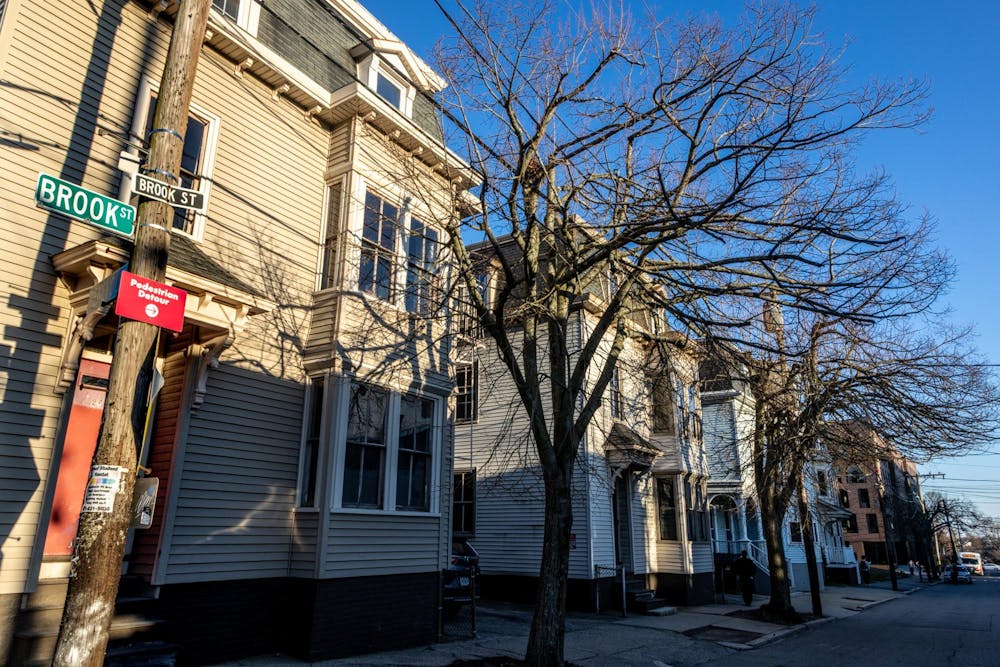
Brown is planning to construct a new economics building on Brook Street between Benevolent and Charlesfield streets. The University is looking to develop on a Brown-owned lot that currently holds four residential structures and a parking lot, according to University spokesperson Brian Clark.
In March and April, meetings were held with neighboring residents and the Providence Preservation Society, during which University administrators discussed plans for the development.
But community members and PPS leaders have said there has been a lack of transparency in the process and criticized the development plans. They have expressed concerns with the new building’s height, the future of the buildings currently on the lot and the loss of residential buildings amid a housing crisis in Providence.
The development — which is expected to be “a fully donor-funded project,” Clark wrote in an email to The Herald — is currently “in its early planning stages,” and a feasibility study has been completed. The University has begun a search for an architect “to help develop the vision for the project,” Clark wrote in an email to The Herald. The lot contains properties that were included in the University’s request for proposals last summer.
Faculty, staff and students in the Department of Economics are currently located across five separate buildings. “A dedicated building in the heart of campus near similar academic units,” such as the Watson School of International and Public Affairs, “would unify (the department’s) people and activities,” Clark wrote.
According to slides shared at a March meeting between University administrators and community members obtained by The Herald, the building is expected to be taller than all other neighboring University buildings, including Stephen Robert ’62 Hall, the Danoff and Chen Family Halls and the Watson School of International and Public Affairs.
Brown will “initiate a formal community engagement process to collect and consider feedback from local residents and community leaders,” before submitting an amendment to Brown’s Institutional Master Plan for approval by the Providence City Plan Commission, Clark wrote.
Erika Lamb and Tom Lamb, nearby residents who hosted a neighborhood meeting about the proposed building on Tuesday, first learned about the possibility of a development in their neighborhood in August when University leaders invited them to a meeting about Brown’s plans to sell several properties in the area.
“We were all really surprised,” Erika Lamb said in an interview with The Herald.
The University later invited residents to a March 31 meeting to discuss “a new academic building we are planning in your neighborhood,” according to emails obtained by The Herald.
Attendees of the March meeting were “outraged, and people spoke very harshly and very vociferously,” according to Erika Lamb. Tom Lamb described the communication between the University and residents of the neighborhood as “very poor.”
Tom Lamb said that the meeting did not feel like a forum for resident input but rather entailed “Brown presenting to us what they are proposing.” He noted that the University was clear that the proposals were not yet the final plan.
“The public process should shape a project like this, not come after the fact,” Erika Lamb said.
Associate Vice President for Government Relations Al Dahlberg, a University administrator who helped run the meetings, did not respond to a request for comment.
Tom Lamb called the development “institutional creep,” saying that future University projects could happen nearly anywhere on College Hill as Brown buildings are located near residences.
Erika Lamb noted that she is also against the development because she is “specifically against demolishing houses,” highlighting Providence’s current housing crisis.
Clark noted that the buildings on the lot are located within an I-2 Educational Institutional District Zone. The EI zoning district regulates the size of new developments and “permits higher education institutions and their expansion in a planned manner, while protecting the surrounding neighborhoods,” according to the City of Providence’s zoning ordinance manual.
Marisa Angell Brown, executive director of the PPS, said the society has met with the University about the development. Angell Brown has been talking with neighboring residents about pathways to contest the construction, including an appeal to sustainability and history.
Angell Brown said that the PPS plans to publish an open letter next week calling for the University to publicly share “whether there has been a rigorous examination or feasibility study about the reuse of the existing buildings.”
If the buildings cannot be repurposed or moved — after studies on the development are conducted and published — Angell Brown hopes the University will handle the demolition of the buildings responsibly by manually deconstructing them and saving items that can be reused.
“We would really expect that an institution like Brown, with its sustainability goals, would have a serious deconstruction and salvage plan at the very least,” she added.
On behalf of University Architect Craig Barton, Clark wrote that the University does not yet have specifics on “any potential impacts to existing buildings on the site” due to “the very early nature of the planning process.” He added that for any new building or renovation project, the University considers “environmental impact and sustainability.”
Jeff Tingley — an attendee at Tuesday’s neighborhood meeting — currently lives on Benevolent Street, where he grew up. “A lot of Brown’s development is very good for Providence,” he said in an interview with the Herald. “Providence needs Brown. Brown needs Providence.”
“So we have to work together,” he said. Tingley also said he hopes Brown students will bring up the issue with University administration.
Tingley said that Brown’s presence in the neighborhood has been positive overall, but there have been issues. “From a resident’s perspective, many of us have felt that we’re not listened to, and that Brown really does what Brown wants,” he said.
In response to concerns about transparency with local residents, Clark wrote that the University began the “multi-year” process by meeting with “local stakeholders,” adding that “a robust community engagement process” will follow the selection of an architect.
Providence city councilmember John Goncalves ’13 MAT’15 (Ward-1) has attended community meetings about the potential new construction, and he wrote in an April 3 letter to President Christina Paxson P’19 P’MD’20, Executive Vice President Russell Carey and Dahlberg that he urges “reconsideration of the current proposal.”
“Accumulated holdings position the University to reshape the neighborhood in ways that do not seem to reflect the needs, character or voices of long-standing Providence residents,” the letter reads. The letter also raised concerns about the new building’s height blocking light from neighboring houses.
In an interview with the Herald, Goncalves said that in the coming weeks, he plans to publish the letter to a 20,000-person email list and ask people to sign onto it.
“If our neighborhood is very clear about its stance and what they see as a looming concern, my job is to make sure that those constituents’ concerns are being elevated, and we’re using our voice to hold the institution accountable,” Goncalves said.
In a Wednesday evening email obtained by The Herald, which was sent from Carey to neighboring residents, he wrote that the University is “deeply committed to community engagement.”
“The University has an extensive history of carrying out the design of new and renovated academic buildings in a manner that embraces and positively impacts both the campus and the College Hill neighborhood,” he wrote, “and we will do so again with this project.”
“We do not expect to propose anything other than what is allowed by right within an I-2 zone, and no variances or waivers will be necessary,” Carey wrote. “While we are sensitive to the questions and concerns raised in the meeting, we are seeking to develop a site that for forty years has been designated by the City for exactly this academic and mission purpose.”

Roma Shah is a section editor covering University Hall & Higher Education and Admissions & Financial Aid. She's a sophomore from Morgan Hill, CA studying neuroscience. In her free time, she can be found doing puzzles, hiking or curled up with a book.
Jeremiah Farr is a senior staff writer covering university hall and higher education.


