
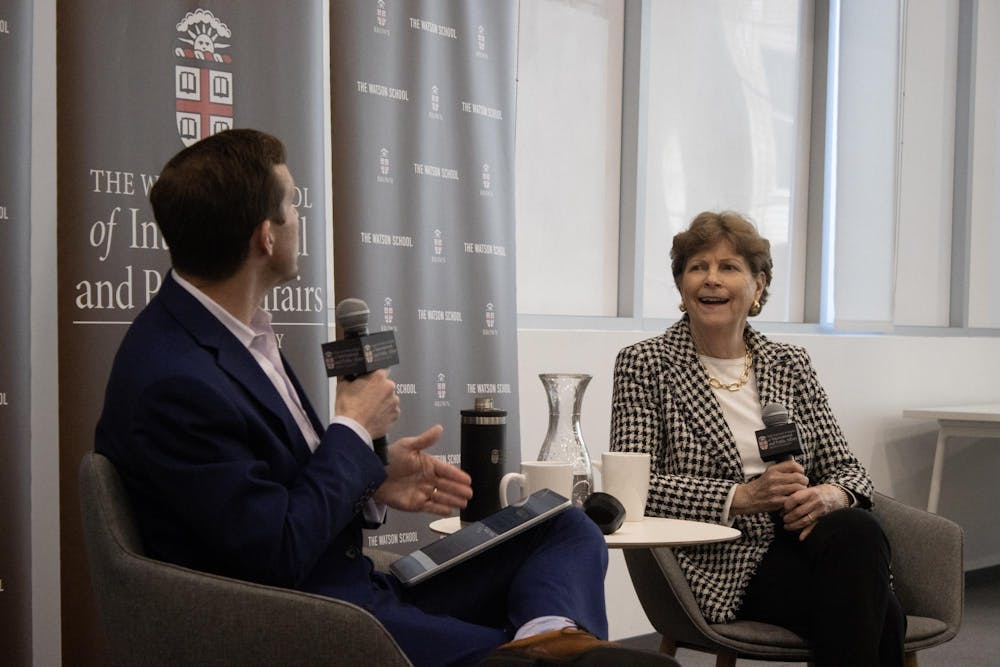
On Thursday, U.S. Sen. Jeanne Shaheen (D-N.H.) visited Brown for a fireside chat with John Friedman, dean of the Watson School of International and Public Affairs. At the event, Shaheen discussed the war in Iran, called for the militarization of Taiwan and argued that inefficiency in Congress stems from increased political polarization.
Shaheen, who has served as a politician for over 35 years, began her career as a member of the New Hampshire state senate in 1990. After her 1996 election as governor of New Hampshire, she defeated incumbent Republican Senator John Sununu in 2008 and began her first of three terms as a U.S. senator the year after. Her victory made her the first woman to serve as both a governor and a U.S. senator during their career.
Shaheen, the ranking member of the Senate Committee on Foreign Relations, discussed her disapproval of the recent U.S. attack on Iran.
Although Iran has historically been “one of the biggest supporters of terrorism across the Middle East,” Shaheen argued, “(Trump) went into this war without a clear strategy for what he wanted to accomplish.”
The White House did not respond to The Herald’s request for comment.
Shaheen argued that though Iran’s previous supreme leader, Ayatollah Ali Khamenei, was killed by U.S. and Israeli forces, his son’s appointment as the new supreme leader has left the United States “at a place where we’re not any better off.”
A two-week ceasefire between the United States and Iran took effect on Wednesday, but Shaheen said that the terms of the agreement remain unclear. She pointed to Israel’s continued bombing of Lebanon and Iran’s blockade of the Strait of Hormuz, a major transportation pathway for the world’s oil supply.
Nonetheless, Shaheen argued that the United States is “better off to be negotiating with Iran than bombing Iran.”
Shaheen then discussed her recent bipartisan trip to Taiwan, adding that during her time there, she encouraged the Taiwanese government to pass their $40 billion defense budget.
“It’s a very strong message to China to see that you are engaging and spending those dollars in your own defense,” Shaheen said. She also emphasized that she wants to increase support for funding Taiwan’s military in Congress.
Taiwan is a large producer of semiconductors, which are used in the United States for products ranging from smartphones to cars. Shaheen argued that if China begins blocking Taiwan’s semiconductor exports to the United States, the U.S. technology sector could suffer.
To further deter a potential conflict between China and Taiwan, Shaheen said the United States must display its status as a prominent world power to China, a standing that she claimed has been diminished by the United States’ withdrawal from various international organizations, including bodies within the United Nations and the World Health Organization. In doing so, the United States will “make it very clear that China could not take over Taiwan without a fight,” she said.
Shaheen then transitioned to her thoughts on domestic policy. She described one “school of thought” in the Senate Democratic Caucus that includes voting against “everything the Trump administration wants to do.”
But instead of embracing party-line politics, Shaheen said she prefers to vote on bills based on how they impact her constituents. She added that constant disagreement based on political affiliation prevents legislation from being passed.
“The best way to address the concerns of my constituents is to get things done,” she said.
Jordan Roosevelt ’29, who lives in New Hampshire and attended the fireside chat, thought Shaheen’s emphasis on compromising with other politicians was impactful.
“She is a Democrat,” Roosevelt said, “but she made a very clear point about compromise and how that’s important.”
In an interview with The Herald, Senator Jack Reed (D-R.I.), who attended Thursday’s fireside chat and has worked with Shaheen for decades, described her as “one of the most extraordinary members of the Senate,” noting that “she brings a rare virtue of common sense and common decency.”
Reed noted Shaheen’s emphasis on “the need to refocus our efforts on helping working Americans literally get by and, importantly, get ahead,” on issues such as health care, education and affordable housing.
“Those are the same themes that we have to address here in Rhode Island,” he added.
Marat Basaria is a senior staff writer covering activism.


