Jack DiPrimio in conversation with Duncan Nofsinger.
Duncan Nofsinger has worked in New York City’s independent music scene, including as an NYC Artists and Repertoire Representative with an indie record label and as a production intern in the live venue sector. He is currently pursuing his M.A. at NYU, focusing on the modern music industry and experiential musicology.
As an undergraduate at American University, he spent nearly four years on staff at WVAU Radio and interned at (Le) Poisson Rouge and FilmNation Entertainment. He earned his bachelor’s degree in Communication and Media Studies from American University in 2023. Jack DiPrimio and Duncan Nofsinger met at American University in 2021 as undergraduate students.
Hip-Hop and New York’s Enduring Pull as a Music Capital
Jack DiPrimio [JD]: Would you say that New York City is still a really important place to be in the music industry now? A lot of people move to Los Angeles to pursue that world, but New York has such a long history too.
Duncan Nofsinger [DN]: New York has long been a hub of forward-thinking music. You could go back to the CBGB era—with bands like Talking Heads, Television, and Blondie—and, of course, to the birth of hip-hop. That spirit of innovation has not disappeared. There are still strong bands emerging from the city. Los Angeles has an incredible scene as well, but groups like Geese feel distinctly New York—there is an energy to their sound that makes their origins unmistakable. Geese has sort of a frenetic energy, and they break a lot of the rules and conventions of other indie bands. They’re having a big moment right now.
JD: As hip-hop became the dominant genre in the 21st century, do you think it changed in terms of how political it was? Some critics argue that SoundCloud rappers pushed the genre away from political critique and more toward angsty aesthetics and vibes.
DN: I think rap is mainstream now in the same way that rock was in the 20th century. And with that comes more surface-level material. SoundCloud rap was definitely more aesthetically driven than politically driven, but that doesn’t make it invalid. Hip-hop doesn’t always have to be “fight the power.” I still think hip-hop can play a role in many emotional, political, and protest forms. It can break out of that box—it doesn’t always have to stay in it.
JD: Do you think Drake played a major role in pushing rap further into pop territory?
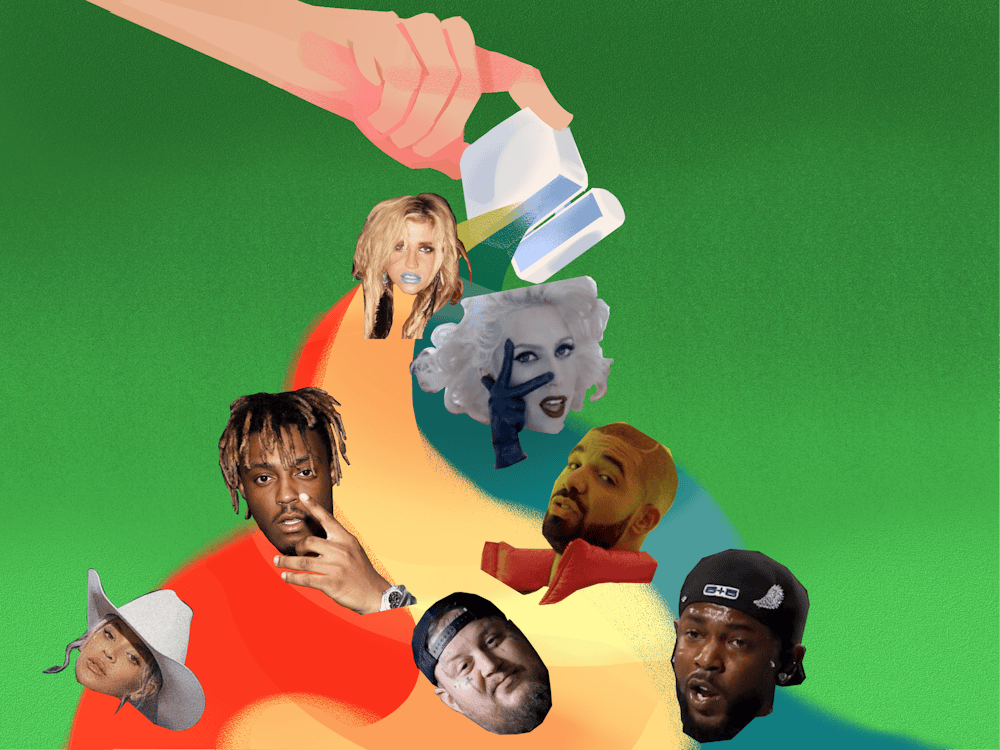
DN: Historically, Run-D.M.C. did that with “Walk This Way,” but in the modern sense, yeah, Drake has been the most influential. He’s constantly chasing trends, whether that’s dance music or electronic sounds. As producer Rick Rubin (who produced for Run-D.M.C. and Public Enemy) often explains, an artist’s deepest work comes from self-understanding rather than trend-chasing. Kendrick’s catalog feels aligned with that philosophy. That difference explains a lot of their tension.
Commercialism vs Anti-Establishment Ethics
JD: Kendrick Lamar is often seen as a counterweight to that more commercial instinct. How do you see his role in political music?
DN: Yeah, I mean, country music definitely leaned patriotic. Pop, I think, less so. But protest music has always existed. Kendrick Lamar is a really good example of that. You know—To Pimp a Butterfly; good kid, m.A.A.d city; DAMN.—there’s a layer of political messaging there. Some of it is subtle; some of it is very overt. He even directly incorporated Fox News criticism into his work. That kind of back-and-forth opened the door for younger artists to speak out politically.
JD: Would you say that Beyoncé followed a similar path to Kendrick in prioritizing authenticity over metrics?
DN: Yeah. I think she realized she could pursue capitalism elsewhere and let the music itself be fully authentic. Since her self-titled album, she’s really been doing exactly what she wants. She has an audience that trusts her enough to follow her, which is rare.
9/11 and the Turn of the Country “Era”
JD: If we move to the moments right after 9/11, there was a dramatic surge in overt patriotism and nationalism across American culture. In country music specifically, songs like Toby Keith’s “Courtesy of the Red, White and Blue (The Angry American)” and Alan Jackson’s “Where Were You (When the World Stopped Turning)” became massive hits. Do you think 9/11 marked a turning point in mainstream music, particularly in country?
DN: Yeah, I mean, country music is Black music. It started as such and it came out of blues, folk, and gospel/spirituals. And I think particularly since 9/11, you see kind of the turn from country as outlaw, working man’s, blue-collar-type music into kind of what the collective consciousness sees it as now: the yee-haw guns and trucks and beer and women. I also think 9/11 was a big shift. Other people have made that observation; that's not new. The country mainstream packaged the working man’s plights into nationalism and pride for a country that fell in line with conservatism rather than anti-establishment sentiment.
JD: In that context, now, how do you see artists like Lil Nas X and Beyoncé entering country spaces?
DN: Beyoncé is a great example of a response to that. There have always been people staying true to how country initially came to be. Not that Beyoncé is now working class, but there is a reclamation to her album. She's doing it in a way only she could, with Black songwriters helping her out and being featured. Like Rhiannon Giddens playing banjo—she’s iconic and her flowers were long overdue.
I also think Lil Nas X is a good example because there’s a lot of the same discourse that was happening with him as with Beyoncé. It sounds different than what we were talking about with bro-country in the mainstream, but I think people might say, oh, this doesn’t sound like what I know country to be. But that doesn’t warrant the racially charged responses. People should be ready to accept that genres move forward. No genre ever stays static. It’s easier to point a finger when the artist performing it doesn’t look like the ones who have always been popularized.
Recession Pop, the Digital Era (2008–2012), and 2016 Nostalgia
JD: You’ve mentioned before the idea of “recession pop.” How would you describe that era, especially from around 2008 to 2012?
DN: I think that era was really the dawn of the digital age. Sonically, pop music leaned much more electronic and hedonistic. Artists like Lady Gaga and Kesha really embodied that “nothing to lose” energy.
JD: Why do you think there’s so much nostalgia right now for 2016 in particular?
DN: I think 2016 was just a fantastic year for music. We’re far enough away from it now that people can romanticize it. Trends resurface faster because culture moves faster. And I think people also miss an earlier digital world that felt less dark and less sinister than the one we’re in now.
JD: Do you think artists like Charli xcx are bringing back some of that earlier energy?
DN: Yeah, I think Charli xcx is bringing it back, but in a very Gen Z way. There’s a lot more self-awareness and irony. She’s building a character, but there’s still emotional truth underneath it.
JD: At this year’s Grammys, there seemed to be overt religious symbolism in several performances; artists like Jelly Roll and Alex Warren leaned heavily into that imagery. Do you think we’re seeing a new wave of conservatism or religious influence in mainstream music?
DN: I would agree. There is sort of a new wave of conservatism and religious pandering. Pandering might be a little strong, but I don't know. I think of Alex Warren’s set where he was basically lifted up like Jesus. I mean, that was pretty clear with the gospel choir and all that too. And of course, Jelly Roll's speech was, you know, he looked like a pastor on top of that stage preaching the good word.
TikTok, Gen Z Cynicism, and the Pressure of Visibility
JD: Do you think Gen Z’s music reflects a different outlook than the optimism of the early 2010s?
DN: Yeah, definitely. Early 2010s music had a kind of earnest optimism to it. After 2016, music became more introspective and painful, reflecting political instability and then COVID. The COVID-era pop was much more intimate and singer-songwriter focused. That lack of hedonism and expression of emotional pain really shaped Gen Z’s sound and how they engage with music.
JD: What do you think about TikTok and its role in shaping music today?
DN: I think TikTok has the [making air quotes] potential to be democratizing, but it’s also made things a lot harder. Everyone is competing with everyone else globally now. A few artists break through, but for most people, it’s more difficult than it used to be.
JD: Do you think that pressure changes how artists make music now?
DN: Yeah, definitely. There’s this added pressure to constantly perform and be visible. And especially with Gen Z, there’s such a fear of being “cringe,” which shapes how people present themselves and their work.
One Last Word
JD: Last question. What worries you most about the future of music?
DN: AI really worries me. Companies are debating things like fair use and licensing, but platforms like Spotify see massive monetary potential in AI-generated music. It fits really well into passive listening models. And if companies don’t have to pay artists for training data, that’s a serious problem.


