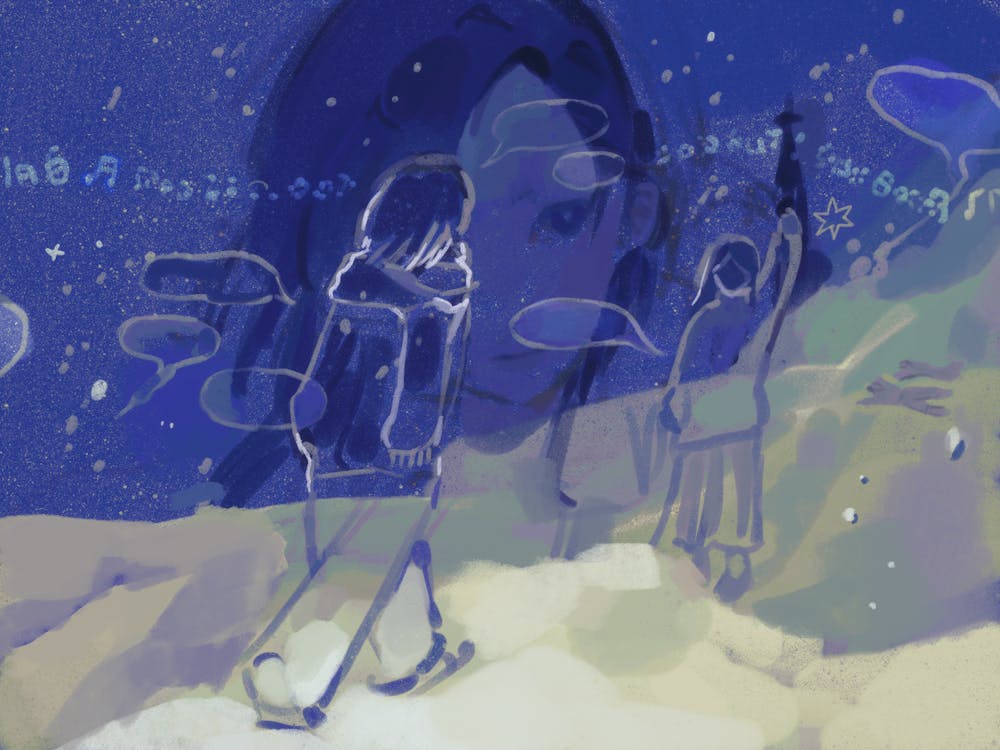
My memories of the years my family spent in the Midwest are blurry. What I do remember is a sense of sameness: the childish assurance that the wet, slippery snow that fell in December to block our front door in dense heaps was the same snow everyone else on Earth was wading through. That the tongue I knew was what everyone else spoke in the big wide world.
And I used to know Mandarin like music. As a child, it was the first language I learned: I toyed with its tones and rolled them over my tongue, lowered my words to whispers, stretched them to shouts. Although I was born in Illinois, it was the sole language my immigrant parents spoke fluently at the time—and so until I entered school, it was the sole language I spoke too.
Then I walked into a square brick building, and my world shifted under my feet. All the other kindergarteners chatted and played together in a whole other timbre—English—a timbre I found myself unable to imitate. I was placed in ESL classes and sat alone during lunches. I struggled to mold my mouth around the staccatos and swoops of this new language. But with time and effort, and dozens of afternoons spent alone with the English instructor sounding out phonetics, it became easier and easier.
As I grew older, Mandarin and I drifted apart, and my family moved away from Illinois. English is now the only language I’d consider myself fluent in; in fact, it’s what I’m here to study. And my life itself has been a long study in fashioning words into phrases, phrases into music. Now I flip from key to key, conversational to journalistic to prosaic and back again. The older I get, the more colors my voice takes on. And yet the loss of its first one hangs like steam over my head, warm and ungraspable, breezing away into the new spring air.
—
I spent this past winter break in California traipsing through my neighborhood in T-shirts and shorts. I’d throw open the curtains on my window before I went to sleep and wake to golden morning light waterfalling into my room. I’d take my friends down to the coastline before sunrise and we’d hike along the shore wearing tank tops, marveling at the crashing waves below, marveling at the warm salt air.
All this to say that arriving back in Providence in January was a shock to my system. Every time I stepped outside into the below-freezing weather, shivers racked my body and my teeth began to chatter cartoonishly. The clotheshangers in my closet sagged with bulky sweaters and puffer jackets; I wore three to four layers everywhere I went.
Most of all, thinking of the semester ahead filled me with an unfamiliar—but unshakeable—sense of gloom. Four reading-heavy classes stretched before me, I had just committed fifteen hours per week to the Herald, and my other extracurriculars bloomed in a thousand colorful boxes across my Google Calendar. Campus felt like it’d lost its novelty, as if I’d already explored every corner there was to explore. The dreaded sophomore slump had finally begun.
—
It felt as if we’d only been back for a heartbeat when we were warned of the first winter storm. Classes were cancelled, meetings were postponed, and my mom called me frantically a few days before the storm hit upon seeing the forecast from 3,000 miles away.
“Do you have food in your room?” she asked in Mandarin, her voice quick and small over the line. “Do you have good shoes to walk in? A thick jacket?”
“I have the same clothes I’ve always had,” I said back, but in English. Truthfully, there was a part of me that vibrated with apprehension, almost definitely overblown, but irrefutably there. My brain conjured up images of pipes freezing and trees toppling over; my Instagram algorithm filled my feed with videos of trees “exploding” in the Midwest.
Later, when I voiced those concerns to my friends, they poked fun at me—gently, of course. “You’re not going to starve,” one of them said. “The Ratty is literally two steps away from your dorm.”
Another friend—a Rhode Island native—laughed as she recounted how, as kids, so much snow would fall in the winter that the snowdrifts would be several feet high. She and her sister would dig tunnel systems on their driveway beneath the surface. I tried to picture that then—imagined being enclosed in soft, freezing white, little mittened hands pawing in front of me, huffing crystals into the air.
—
Brown offers classes in over twenty-five different languages. It’s a little embarrassing for me to admit that I haven’t taken any of them, despite being a sophomore, despite having declared my love for the humanities a thousand times over. I’ve always taken one look at the frequent meeting times and balked at the idea of slotting that extra time commitment into my life. Even now, the familiar excuses rise to the tip of my tongue: I’m too busy. It’s so much work. I should fulfill my concentration requirements first.
Further down though, I wonder if I say those things in defense of a sorer spot. A sense that I’m not proficient in my native language, or the languages I studied in high school, or any of the rest of them. An aching fear that—with my monolids, my nose bridge, a face that screams other—English will never truly belong to me, and yet as a born-and-raised American, Mandarin will never belong to me either. What’s a mouth without a tongue? What’s a home without a voice?
—
I spent that first storm skirting gingerly around patches of black ice and attempting to fold my scarf all the way up over my nose. The sensation of sinking calf-deep into snow with every step was completely unfamiliar to me. Even venturing to the dining hall was a trek; I shuddered at the prospect of having to hike to my classes through the frigid cold once the storm warning was lifted. Over and over, I found myself homesick, yearning for the loose sand and dry soil that I grew up in.
After dinner on the first day of the storm, my friends declared that they wanted to make snow angels, and bounded up George Street to the Main Green. They dropped onto their backs joyfully and vanished into the white in an instant; I could barely make out the words they shouted to each other through their giggles and the fast, thick flurries still falling.
I hung back. Even just looking at the snow sent shivers of apprehension through my body. I could already imagine how the cold would chill me to my bones, how the moisture would seep through my pants, and how I’d have to walk back to my dorm trembling afterwards.
“It’s freezing,” I protested.
“It’s just a little chilly!” my friend said.
I shoved my hands deep into my pockets and blew a long breath into the air, saw it become cloud, vapor, and then nothing at all. The sounds of laughter swirled through the evening.
—
I was told once during freshman year that I talked like a valley girl—that I gestured with my hands like one, too. My speech was peppered with “totally” and “oh my God.” At times, the ends of my sentences curled upward, bookending them like noncommittal questions.
After almost two years here, though, that accent has softened. My usage of “like” has diminished drastically, and my sentences now curve downward instead. When I go home, I find myself calling subs “grinders,” and in the city I almost expect to hear the slight touch of a New England accent in every adult I meet. The East Coast has followed me home, or perhaps it just came as a part of me.
—
And all too soon after the first storm, my phone began lighting up with warnings for a second, except this one was going to be huge. Over three feet of snow. An official state of emergency across Rhode Island. A day-and-a-half-long blizzard warning. If the last storm had been anxiety-inducing, waiting for this one felt downright terrifying.
But in comparison to the hype, the blizzard’s actual arrival felt almost quiet. I went to sleep on a clear night and woke up with snow blanketing my window. I was the first person to leave my dorm building that morning, which I know because I dredged a path through the still-falling snow, which was already up to my knees.
I passed the day in the Ratty, jostling for table space during meal times, writing my paper during the off hours. As I toiled, I tried my best to ignore my visions of snowdrifts freezing on the ground for weeks, another seemingly-endless stretch of winter before us, that biting cold that I’d already grown all too familiar with.
—
Since getting here, I’ve been fascinated by voices. And not just their sounds: the ways I can see people’s homes peeking out from behind the ends of their sentences, the ways that a childhood memory can shine through a specific description, the pause before a phrase. How my Midwest friends say “wuhder” instead of “water,” how my Maryland friends call it an “airsip” and not a “waterfall.” How she talks about the Rockies. How he talks about the South. I ask each of them why. I listen to the stories they tell me in return.
In some senses, I am a traveler, from southern China to suburban Illinois, from the Conejo Valley to Providence. And if I am a traveler, my voice is too: a splotchy jigsaw of West Coast drawl, college academic speak, East Coast slang, “like” and “um” and the occasional swear (or two), that slight but persistent rasp when I wake up in the morning, a laugh that comes bursting out of me no matter how quiet the room is.
I speak in slow Mandarin on the phone to my mom. When I can’t think of the right phrase, I slot in an English word instead. It’s my very own dialect of Chinglish. She has one too.
—
After the brunt of the snowfall, my friends and I retreated to my dorm. We sat in there for hours until one of us had the bright idea to check the dining hall hours, noticed that the Ratty was still open at 10 p.m., and decided to rally the group to venture out again in search of pizza.
But once we reached the dining hall, we were only met with heartbreak. An employee poked her head through the doors and told us that they were out of food.
We trudged up Wriston Quad aimlessly, disappointed, trying to kill time before we all inevitably had to return to our p-sets and papers. I shivered and rubbed my arms; even bundled up in a thick jacket, I felt frozen.
Conversation stalled momentarily, and I turned around to confess to the group for the thousandth time that I’d never seen this much snow before. But when I did, I was met with the sight of one of my friends tackling another into the three feet of snow on the grass. They went down in a spray of white and silver, shouting.
“Wait, guys—” I tried to protest. Then hands were on my shoulders, and I went down too. I landed flat on my back in the snow and the world went soft, powdery white. Surprised laughter burst from my throat, clouded in the air. I yanked her down with me too and we wrestled, giggling.
Between my jacket and my friends, the snow wasn’t nearly as cold as I’d expected it to be.
—
I type this now on one of the first sunny days of the year, curled up in a big black chair on the Main Green. The few staunch piles of snow that remain on the grass look like lonely islands, sloughing apart in a sea of warm green.
The slightest of chills still lingers in the air; I’m not quite at ease without my thick puffer jacket yet. But it’s springtime enough that the blizzards feel like they happened ten years ago, that the pale yellow light beaming through my window could keep me warm for the rest of my life.
And I swear, as Providence defrosts, I’m defrosting too. Every person I speak to at Brown is a lesson in a foreign language; every new environment I wander into an immersive experience. I sprawl out on the grass and feel blades of grass tickle my ankles. I wrap my tongue around unfamiliar slang words and jokes. Campus feels new, again and again, and I do too.
All this to say—I’m professing that I am in love with everything that language can be. And that I think love is clutching new words to your chest, committing them to memory, asking why over and over again. All of the people I hold dear speak in their own unique languages; their voices flutter around me like snowflakes, gather and build and seep into my skin, each just a little different from the rest, each just as exquisite.
Michelle Bi is a metro editor covering City Hall & Crime and State Politics & Justice. She is a sophomore from Oak Park, CA and studies English and IAPA. In her free time, you can find her playing guitar, the LA Times crossword or one of her 115 Spotify playlists.


