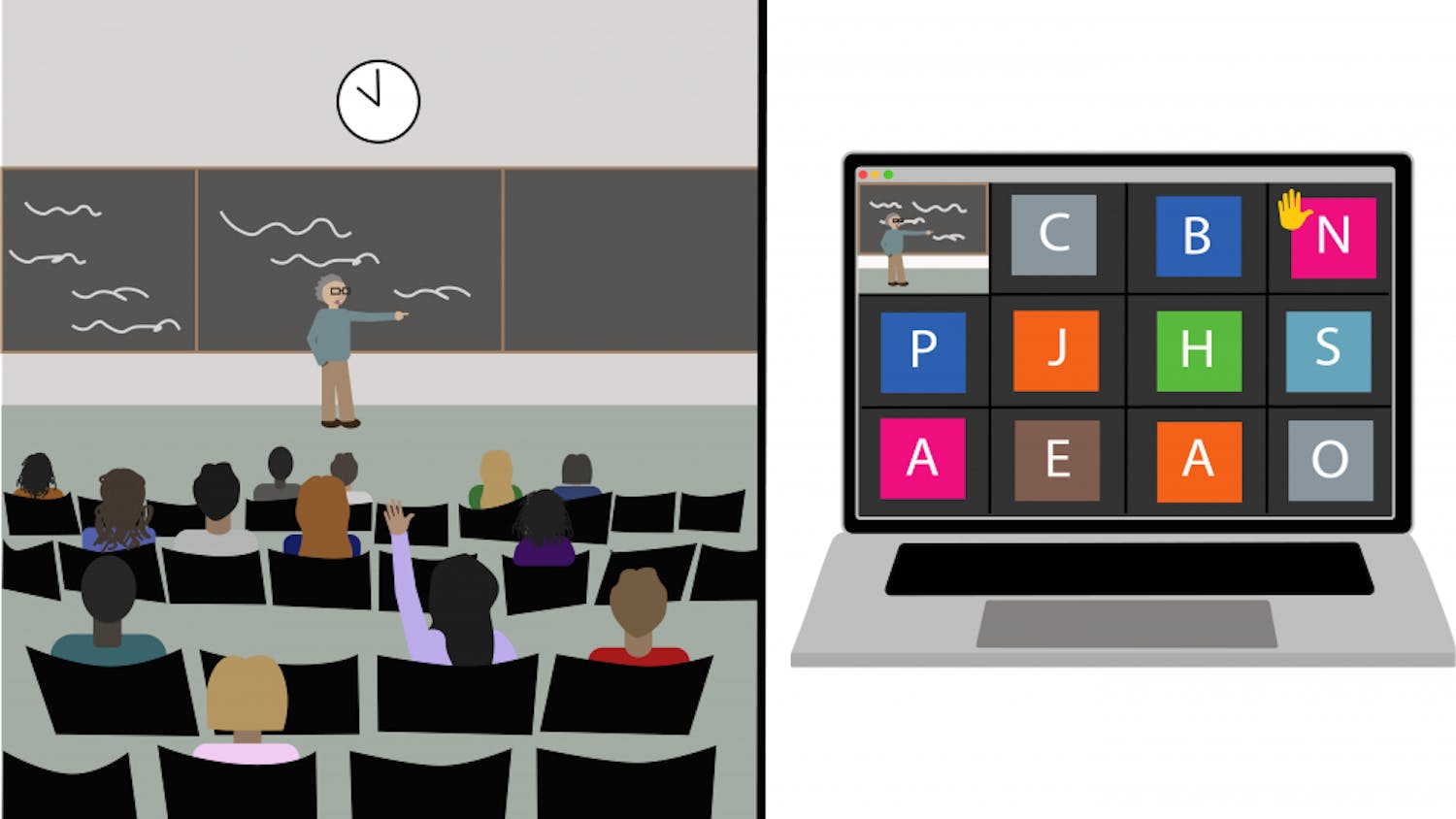
Students looking to attend medical school now face a shorter, more frequently administered and computerized Medical College Admission Test.
The new MCAT was administered for the first time at sites around the country Jan. 27 and 29, two of the 22 testing times scheduled for the year. Prior to the change, only two paper-based administrations offered annually. The only site in Rhode Island where the test can be taken is the Thomson Prometric testing center in Warwick, though in previous years the test was administered on campus.
Test-takers are now greeted by a test that takes between five and five-and-a-half hours to complete, compared to the paper version's eight- to ten-hour duration. The number of multiple-choice questions for the physical sciences, verbal reasoning and biological sciences sections has been reduced by one-third.
Switching from the all-paper format also saved a considerable time by eliminating the lengthy process of distributing and collecting test materials, said Jeff Meanza, director of graduate programs for the Princeton Review. It "should be a more positive experience," Meanza said, who described the old exam as "sort of unyielding."
But not everything went smoothly at the exam administered on Saturday. Test-taking nightmares came true for Daniel Sonshine '07 when, six minutes into reading a passage on robotic fish in the verbal reasoning part of the exam, he looked at the first question, and realized it was asking about songbirds.
The questions were clearly for a different passage. "I started to panic," he said. The mistake threw off his concentration, he said. "I tried to focus, but I couldn't."
No more than 800 of 2,500 test takers encountered the mistake Saturday, according to Robert Jones, a senior vice president at the Association of American Medical Colleges, as quoted in the New York Times.
Harry Samaroo '07, who had previously taken the paper version of the MCAT, also took the new computerized exam Saturday, though he took the test in New York City and did not encounter any problems. "The computer-based exam felt much shorter," he said. "People will probably really like the computer-based exam. It's much more of an independent testing experience."
But Samaroo said he still prefers the paper-based exam because he is accustomed to taking tests in that format.
"It was my first computer-based testing experience. You feel like if you had more practice, you'd be better at it. You've been taking paper standardized exams your whole life," he said. Samaroo added that students who are more comfortable with reading and typing quickly on a computer had an advantage over those who read and write more quickly on paper.
"I have mixed feelings about it being computerized," said David Guttmann '07, a pre-med student. He cited "a psychological element" in his hesitancy to embrace the revamped exam and said, "I'm accustomed to paper-and-pencil exams." But he said he favored shortening the test, which he took in August 2005.
"What's unfortunate about the way the test was structured earlier was it became a test of endurance," Guttmann said. The new format is "more focused on what you know than how many questions you can answer, which will benefit a lot of people," he said.
"Whenever you change a test format, there are pros and cons," said pre-med Daniel Morris '07. "But in this case, there are a lot of benefits." Morris, who took the paper-based exam in August 2005 in Sayles Hall, cited the more frequent administrations of the test as an important new convenience for test-takers, though he was worried that off-campus testing could pose an inconvenience for students without a car.
The exam now consists of 52 physical sciences questions to be completed in 70 minutes, 40 verbal reasoning questions to be completed in 60 minutes and 52 biological sciences questions to be completed in 70 minutes.
Computerized MCAT test-takers must still complete two writing samples, which are typed into a basic word processor without spell check, in one hour. During the test, students may take up to three ten-minute breaks, according to the Web site for the AAMC.
The exam still costs test-takers $210 per administration. Students may now take the exam up to three times a year. The waiting period for results, previously 60 days, has been cut to 30 days. The association has promised to cut the waiting time for results down to 14 days, according to its Web site.
The Thomson Prometric testing centers - the only locations where the MCAT can now be administered - provide noise reduction headphones and storage lockers for test-takers.