As planning for renovations to transform Faunce House and J. Walter Wilson Laboratory into a central hub for student activities and services moves forward, University officials intend to look to an important resource - the student centers already in existence at other Northeastern campuses.
"Before the Plan for Academic Enrichment, an (Undergraduate Council of Students) task force had issued a report on the needs for Brown's campus. There were a lot of road trips during that process, and a consultant was brought in to help analyze patterns here and at other schools," said Ricky Gresh, director of student activities.
The process of planning Brown's campus center "does not have that sort of external focus yet," he said. "However, we are creating a planning community that will go on road trips and reach out to other schools. Just in this area alone there are quite a lot of great models to look at and learn what worked well and what did not," Gresh added.
Princeton UniversityOne such model is the Frist Center at Princeton University. Opened in 2000, the 200,000-square-foot Frist Center was fashioned out of an old physics laboratory at Princeton with $48 million and six years of planning and construction.
By all accounts, the investment was a success. "The Frist Campus Center undoubtedly bettered Princeton by creating a campus heart: It provides study, dining and entertainment spaces for faculty, students and community members, and it has even changed walking patterns and pedestrian destinations, as we flock there for mail or on our return from a Saturday night out," declared a Nov. 26, 2001 Daily Princetonian op-ed.
According to a Sept. 11, 2005, article in the Princeton Weekly Bulletin, a university-run news brief, the Frist Center is frequented by 12,000 students, faculty and staff each day, a number that has increased approximately 20 percent during its first year of operation. In 2004, the center hosted 13,519 events and meetings.
In addition to a food court and an entertainment center, Frist contains a number of classrooms and lecture halls, equipped with projectors and sound systems so that they may be used for any number of purposes.
But the Frist Center's design reflects a very specific element of Princeton's campus culture that does not exist at Brown.
"Princeton's social life for many years was dominated by eating clubs," said Princeton Professor of Sociology Paul DiMaggio, referring to the fraternity-like organizations that meet separately from the rest of the campus and which he said had come to define Princeton's campus culture. "The Frist Center was very important because it provides alternate meeting places for students who are in eating clubs. Students see more people."
Just as the Frist model reflects Princeton's culture, Interim Vice President for Campus Life and Student Services Russell Carey '91 MA'06 said he believes such a building cannot simply be copied. "Our priority is to come up with facilities that are right for Brown, that fit Brown and match the educational opportunities that are right for Brown students. We are informed by what others are doing, but not driven by that," he said.
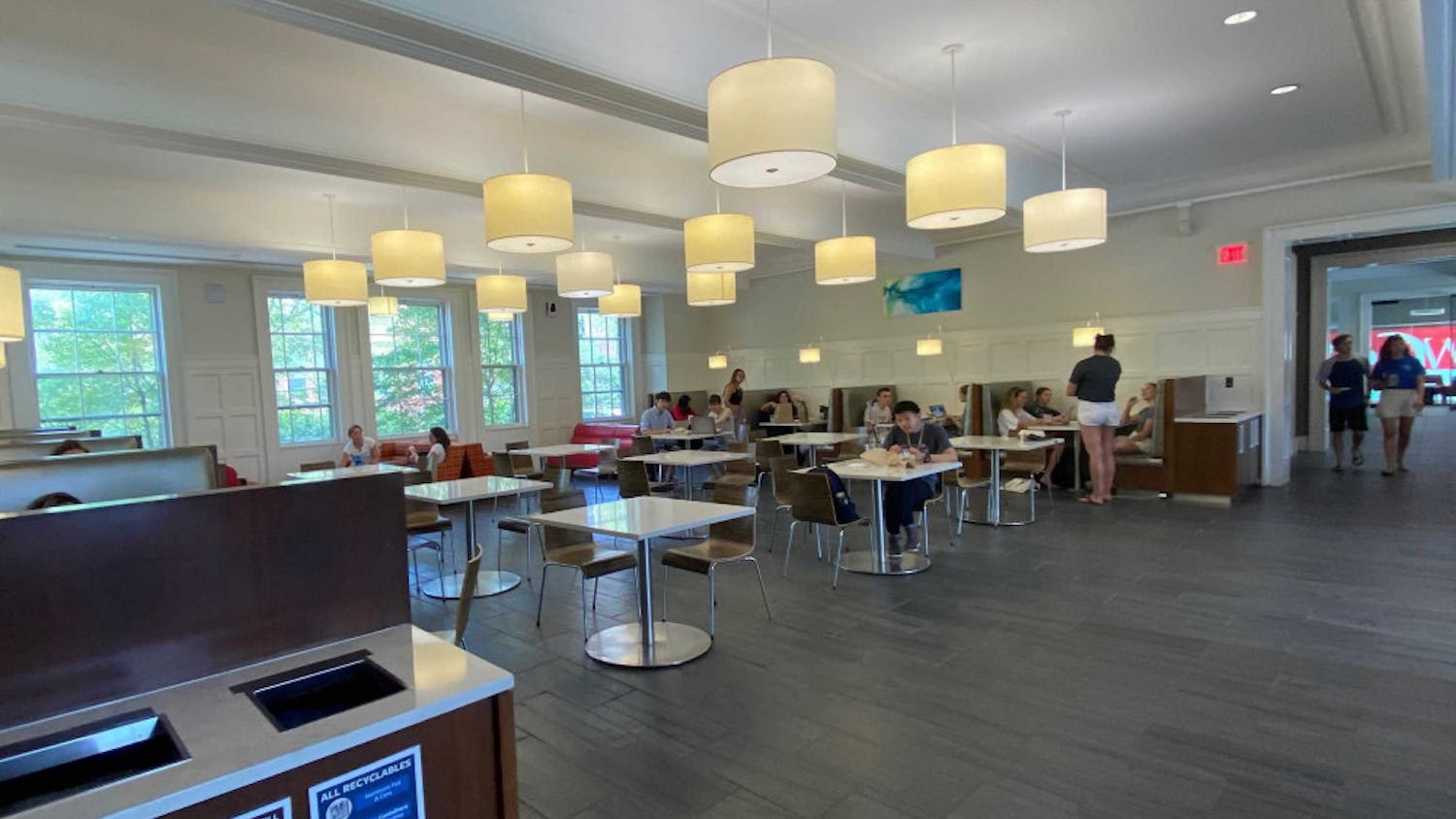
Williams CollegeA second potential model for Brown is Williams College's Paresky Center. Opening in February 2007 after two and a half years of construction, this 72,000 square-foot structure contains an auditorium, dining room, marketplace, balconies and a number of lounges that students and student groups may reserve for events. Paresky was constructed to replace an existing student center that had occupied the same location.
Williams senior Maggie Lowenstein was enrolled while the old center, Baxter Hall, was in operation. "Baxter was kind of a bare-bones student center - dining hall upstairs, mailboxes, some offices for student organizations," she said. "There was not a whole lot of general common space. It was functional but not necessarily like a campus hub. ... It was just kind of there."
Before constructing Paresky, Lowenstein said, the Williams administration had made an effort to improve some of the other campus spaces, such as improving coffee bars and other common areas. However, student organizations were forced to meet in rooms dispersed around the campus, and even the mailboxes were not centrally located.
Like Princeton's Frist Center, Lowenstein said Paresky was extremely well-received once completed.
"The way it is now, there is a good mix of student offices and other space. There is space to hang out, and the dining hall area is integrated with the social spaces. It is very nice that you can use the space in so many different ways. I think that is what a student center is supposed to do," Lowenstein said, adding that, unlike at Frist, Paresky was constructed deliberately to have no academic classrooms. "Everybody studies all the time, tons. It's nice to have a place without academic pressure."
And at Brown...So what would a similar hub for activity look like at Brown, and how would it reflect the University's culture? The answer, according to Gresh, is that the University would like to construct not a student center, but rather a campus center.
"Brown is intent upon Faunce being a campus center. A student center is typically a place for students, student offices and space for a majority of student activities. The philosophy and approach is student-centered," Gresh said. "A campus center is a more recent idea, also taking into consideration how to get graduates and undergraduates to interact with each other and with faculty. We ask, 'How does this resource serve to bring the campus together - not just students?' "
Gresh said students perceive Faunce House as a natural continuation of the Main Green. Activities from the Main Green continue on to the steps of Faunce and often into the building. And, despite its small size, students already treat the Blue Room as a sort of hub for social interaction and meetings.
While the exact nature of how the campus center will be constructed has not yet been determined, Gresh said it will expand upon these strengths while addressing concerns that the rest of the building is underutilized and relatively inaccessible to students.
Noting that the campus center is in the early planning phase, Carey said many University services would be consolidated into Faunce and J. Walter Wilson, with the intent that all of them become better utilized. "Particularly once an architect is selected, there will be a specific planning process to make that vision a reality," Carey said.
Carey specifically referenced the University's peer tutoring in writing programs, which are currently divided between the Writing Center in the Rockefeller Library and the Writing Fellows program in Rhode Island Hall. "This program will be much more effective if it is located in the same place," he said.
"People need opportunities and space in order to work collaboratively and collectively, face to face," Carey said. "We see this space as one where a faculty member might meet with his or her advisee, a place where all types of formal and informal interactions take place on a daily basis between faculty, students and staff."