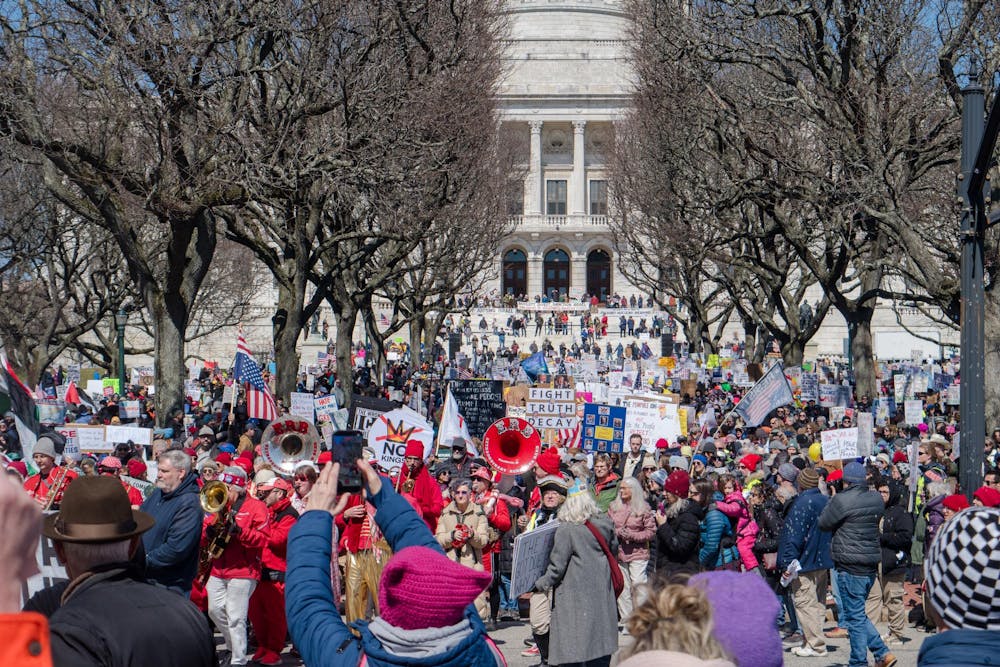
Thousands of protestors gathered at the Rhode Island State House on Saturday to protest against the Trump administration. The rally was part of a series of “No Kings” demonstrations across the country.
Over 35,000 demonstrators attended this iteration of the protest, according to MK Getler, co-chair of Indivisible Rhode Island, one of the groups that helped organize the Providence demonstration. Similar “No Kings” protests took place in Providence on Oct. 18, with an estimated turnout of 32,000, and on June 14, with an estimated 3,000 or more protestors in attendance.
Beginning at the State House, demonstrators carried banners and signs — and some wore inflatable outfits or historical costumes — as they marched through the city. The crowd walked past Providence City Hall, through Kennedy Plaza, across the Providence River and circled back to the State House for a series of speeches.
The protests aim to bring people together to “disrupt President Trump’s attempts to rule through repression,” according to the No Kings website, which calls the war in Iran “illegal (and) catastrophic,” and cites recent immigration enforcement actions across the country.
Ashe Shirazi ’28, a speaker at the protest, called the Trump administration’s recent attack on Iran “violent” and “unprovoked,” adding that the money spent “to commit war crimes” could instead be spent on “health care and social security to make American life affordable.”
Another speaker, Autumn Guillotte, political director for the Rhode Island AFL-CIO, called for economic reform, encouraging attendees to call their representatives and ask to “tax the rich.”
“The choice comes down to millionaires or Rhode Islanders and their ability to feed their families and go to the doctors. I choose us every time,” she said.
Rhode Island Secretary of State Gregg Amore, who also spoke at the rally, argued for the importance of free elections.
“The federal courts have diminished the Voting Rights Act time and time again, and Congress has refused to reauthorize or pass the John Lewis Voting Rights Act,” he said. The John Lewis Voting Rights Act would update the original 1965 Voting Rights Act, aiming to strengthen protections against discriminatory voting practices.
Because that act has not passed at the federal level, he said his office promoted its own bill: the “Rhode Island Voting Rights Act,” which aims to create procedures to prevent discrimination in voting processes.
Alexis Adamonis, another protest speaker and a local high school student, said that her generation is “petrified of what the future holds,” citing high living costs, climate change and increased abortion restrictions as issues making her “incensed with anger.”
But Adamonis also noted the need for hope. “This country was built on hope,” she said. “A hope strong enough to stand here today — and no broken law, no act of violence, no destructive tyrant has ever destroyed it.”
Protestors advocated for a range of issues at the march, with members of the Rhode Island Democratic Socialists of America staging a demonstration at the Exchange Street Bridge, hanging a large banner reading “From the river to the sea, Palestine will be free” and chanting “Free Palestine” at marchers.
Brittany Kubicek, an independent socialist running for House representative for District 5, said she did not consider the demonstration to be a counter protest, but instead “an enhancement of the voices and things they may or may not have been able to say up on the main stage.”
Anna Lysyanskaya, a professor of computer science, brought her sons to the protest so they could “see what democracy looks like,” she said in an interview with The Herald.
“This administration is so cavalier with the law, with the due process of the law,” Lysyanskaya said. “I myself am an immigrant, and I know my constitution because I had to pass a citizenship test, so it’s blatantly obvious that they have absolutely zero respect for the Constitution.”
Her son, Arthur, a third grader at the French American School, carried an American flag previously flown over the U.S. Capitol.
Lysyanskaya said she had once mentioned to a former student — who worked for U.S. Rep. Jim Langevin — that there were not enough American flags at demonstrations. She soon received a flag from Langevin with a note requesting that the family fly it at protests.
“We have to come and carry our special flag,” Lysyanskaya said.
Narragansett residents Thomas Lynch and Barbara Mariconda attended the protest together. Mariconda said the two have attended every protest they can.
“We’re so absolutely concerned about the state of our democracy,” Mariconda added.
Many middle and high school students also marched on Saturday.
Carys Marderosian, a 14-year-old student at the Gordon School, said the protest was especially “important” because she was not yet of voting age. “I don’t like feeling helpless.”
“I think that it’s really important that as many people as possible come and show out,” said Indira Peckham, a 16-year-old Wheeler student.
“The most important thing is that you continue,” she added. “One protest isn’t gonna be enough to actually change anything.”
According to Getler, future protest organizing is in the works, including a national day of strike in April.
Getler also hopes to increase voter turnout in the upcoming primary elections in September, as well as the upcoming midterm and presidential elections. “We had a very low voter turnout for the 2024 election,” they said. “In 2028, we’re trying to fix that.”
Michaela Hanson is a senior staff writer covering community and culture.

Ian Ritter is a university news and science & research editor, covering graduate schools and students. He is a junior concentrating in chemistry. When he isn’t at The Herald or exploding lab experiments, you can find him playing the clarinet or watching the Mets.