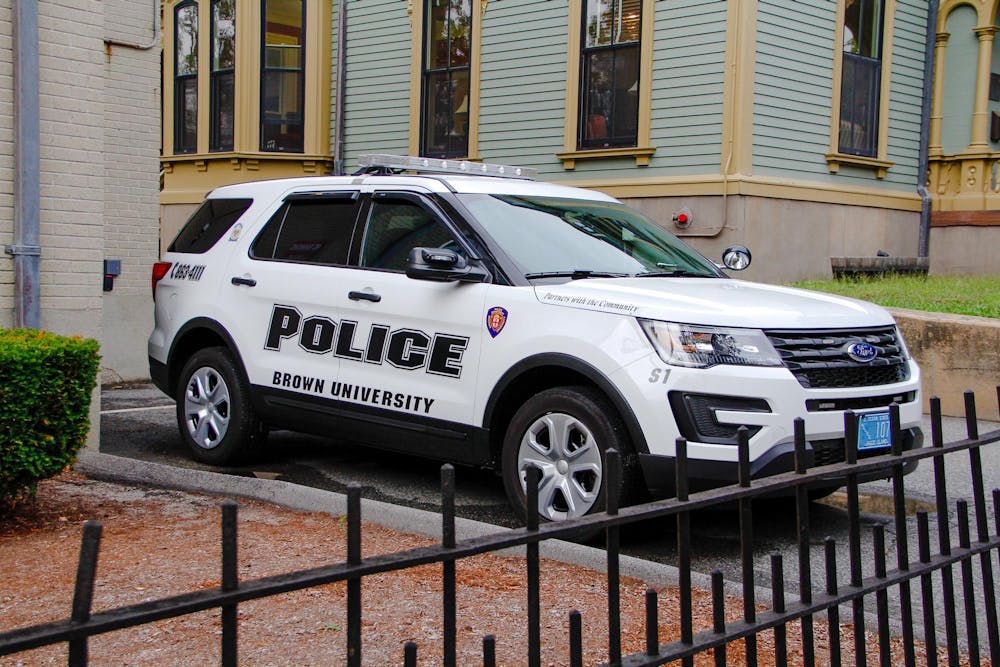
On Monday, the American Civil Liberties Union of Rhode Island filed a lawsuit against Brown’s Department of Public Safety over the department’s alleged claims that it was not subject to public record disclosures under the state’s Access to Public Records Act, or APRA.
University Spokesperson Brian Clark said the University has yet to formally receive the lawsuit, but is prepared to “mount a strong effort” defending its exemption from APRA.
“If we are served with the complaint, we will conduct a full review and respond as appropriate through the legal process,” Clark added.
The suit was filed on behalf of two journalists, one of whom was a past reporter for The Herald. The Herald is not currently a party in the lawsuit.
According to the lawsuit, the two reporters — Noble Brigham ’24 and Michael Bilow — previously filed requests with the DPS in 2022 and 2023 for copies of arrest reports under APRA, which requires public bodies and agencies to make arrest reports and other internal documentation publicly available. But the suit alleged that in both instances the DPS did not provide the two journalists with the requested arrest reports, stating that it was not subject to APRA as a private agency.
Both journalists then filed complaints with the Rhode Island Attorney General over the department’s alleged violations of APRA, according to ACLU R.I. The attorney general decided in January 2025 that the DPS was not subject to APRA, which sparked the lawsuit filed in state court Monday.
Clark cited the DPS’s limited operations on University property and its close working relationship with the Providence Police Department, which is subject to APRA, as two reasons why it should not be subject to the law.
“Brown DPS also shares information regularly and in multiple ways,” Clark added. “For example, we offer public access to a daily police log that includes details on incidents and disposition, and report annual crime statistics each fall in accordance with the federal Clery Act.”
The ACLU R.I. argues in the suit that the DPS falls under the definition of an “agency” under APRA, which defines “agency” as any “public or private agency, person, partnership, corporation or business entity acting on behalf of and/or in place of any public agency.”
“By engaging in one of the most fundamental functions of government — the enforcement of criminal laws and exercising the power to search and seize individuals — (the DPS) is acting on behalf of and/or in place of a government agency or public body,” the complaint reads.
The suit is seeking a judicial judgment that defines the DPS to be a public body under APRA, making it subject to the public disclosure law.
This is a developing story. Check back for updates.

Sophia Wotman is a University news editor covering activism and affinity & identity. She is a senior from Long Island, New York concentrating in political science with a focus on women’s rights. She is a jazz trumpet player, and often performs on campus and around Providence.