After first stepping foot on campus, many Brunonians polish up their resumes and flood information sessions as they prepare to try their hand in club applications. But finding one’s place isn’t always easy.
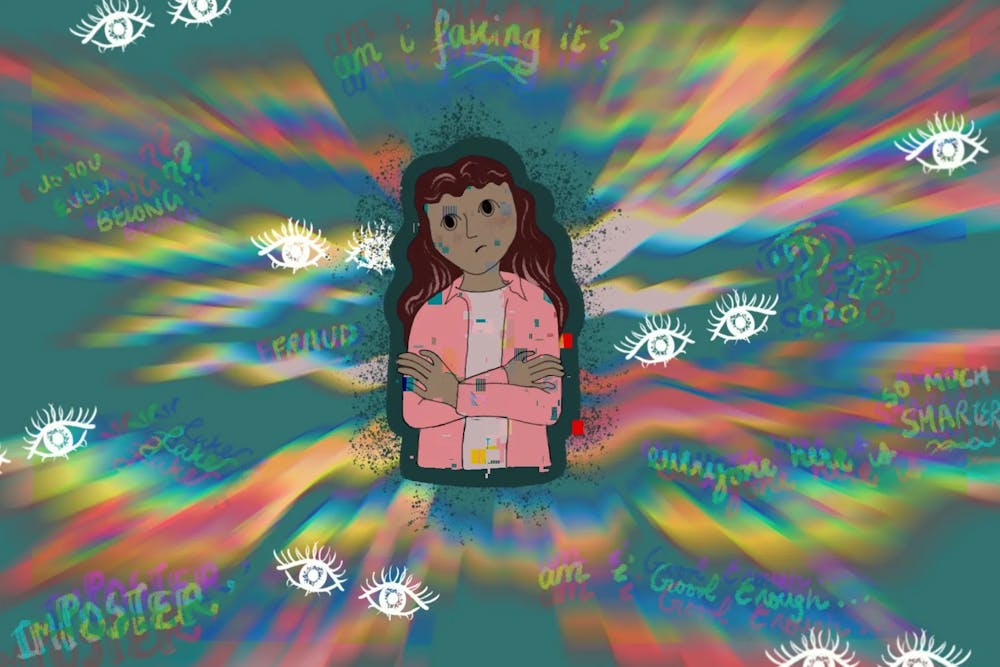
Imposter syndrome, also known as the imposter phenomenon, often leads to “feelings of inferiority or self-doubt existing despite evidence of accomplishments and successes,” said Edward Feller, clinical professor of medical science. Students experiencing the phenomenon often attribute their achievements to luck and face a fear that they will be “exposed as being a fraud,” he added.
When Bryanna Gonzalez ’29, a freshman planning to concentrate in business economics and philosophy, first started joining clubs, she said she felt “behind.” Gonzalez added that her doubts surfaced most strongly in selective, pre-professional spaces.
Members of finance-focused clubs “are very knowledgeable on things that I don’t know about,” she said. “It felt like they were more so taking (applicants) with a bit of experience.”
That perception discouraged Gonzalez from applying to some clubs. “I felt like there wasn’t even really a chance of me getting it,” she said. Instead, she “overcompensated” by joining many other clubs to gain experience.
Sofia Nystrom ’27, president of Brown Consulting Club, said that while clubs like BCC are competitive to get into, “once you’re in the club, it’s more of a collaborative spirit.” Nystrom added that the desire to collaborate is something that they look for in their applicants during recruitment.
Nystrom, who joined BCC as a first-year, said she felt intimidated prior to applying to the club. “Everyone is so talented and so intelligent that it’s kind of scary,” she added.
Faizaan Qureshi ’27, co-president of the Brown Investment Group, told The Herald that he came to Brown with no prior finance experience.
“I had no clue what investment banking was until a month before my freshman year, and I know that’s the case for a majority of students coming to Brown’s campus,” he said.
Qureshi said that imposter syndrome is “natural” when coming to competitive institutions, especially for first-years and sophomores.
According to Feller, Brown’s “highly competitive” atmosphere can heighten students’ feelings of self-doubt. “A lot of the students were clear stars from their high school environment. You come to Brown, and everybody’s a star,” he said.
But the experience is not limited to students. “Imposterism is alive in the faculty,” Feller said. Sometimes, people with imposter syndrome will avoid applying for competitive positions, which “can blunt their successes.”
The imposter phenomenon can disproportionately affect communities who are “underserved, marginalized and stigmatized,” Feller added.
“Students of color, first-gen students and women are more likely to experience imposter phenomenon,” said jesús hernández, director of community-engaged learning at the Swearer Center. “We live in a society that questions those groups’ capacities more frequently, and that lends itself to creating conditions where students would experience those feelings.”
According to hernández, imposterism is “the misrecognition of your achievements — it’s the inability to see the things that you’re achieving and focusing only on the things that you think that you’re not achieving.”
This can create feelings of “anxiety and alienation — that you don’t belong in a particular place or in a particular job or doing a particular thing,” he added.
A Women in Business Panel on imposter syndrome helped Gonzalez navigate her own feelings on the subject, she said. The conversation really resonated with her, especially since both she and one of the panelists were first-generation Latina women.
“That helped a bit, just to see someone who was similar to me,” she told The Herald.
Gonzalez said that she feels imposter syndrome is rarely discussed openly at Brown. She said that if professors addressed the topic in introductory classes, “it would help people feel more welcome in spaces they might have never been exposed to before.”
Some faculty already try to counter those pressures. Gonzalez recalled a philosophy professor who “graded people based on improvement and personal growth as opposed to comparing people to each other,” she said.
Feller, who teaches at the Warren Alpert Medical School, said institutional choices can matter. He said Warren Alpert uses a mandatory Satisfactory/No Credit grading for first-and second-year medical students to reduce external comparison. The grading system “allows people to progress, which facilitates internalization of success, rather than looking outward,” he said.
According to President of Brown Model United Nations Elijah Nelson ’27, MUN offers novice meetings, where interested students without prior experience can learn foundational skills to succeed in the club. “Simply going to meetings, seeing the environment, is enough to overcome that feeling of being out of place,” Nelson said.
“I’ve seen a lot of students find purpose through their community-engaged learning,” hernández wrote in an email to The Herald. “Knowing your purpose, or why you are here at Brown, can be a powerful lodestar as you navigate doubt.”
Angel Lopez is a senior staff writer covering Science and Research. He’s a first-year student from Tyler, Texas and planning to study neuroscience and literary arts. In his free time, you can find him playing ping pong, listening to music, or reading.