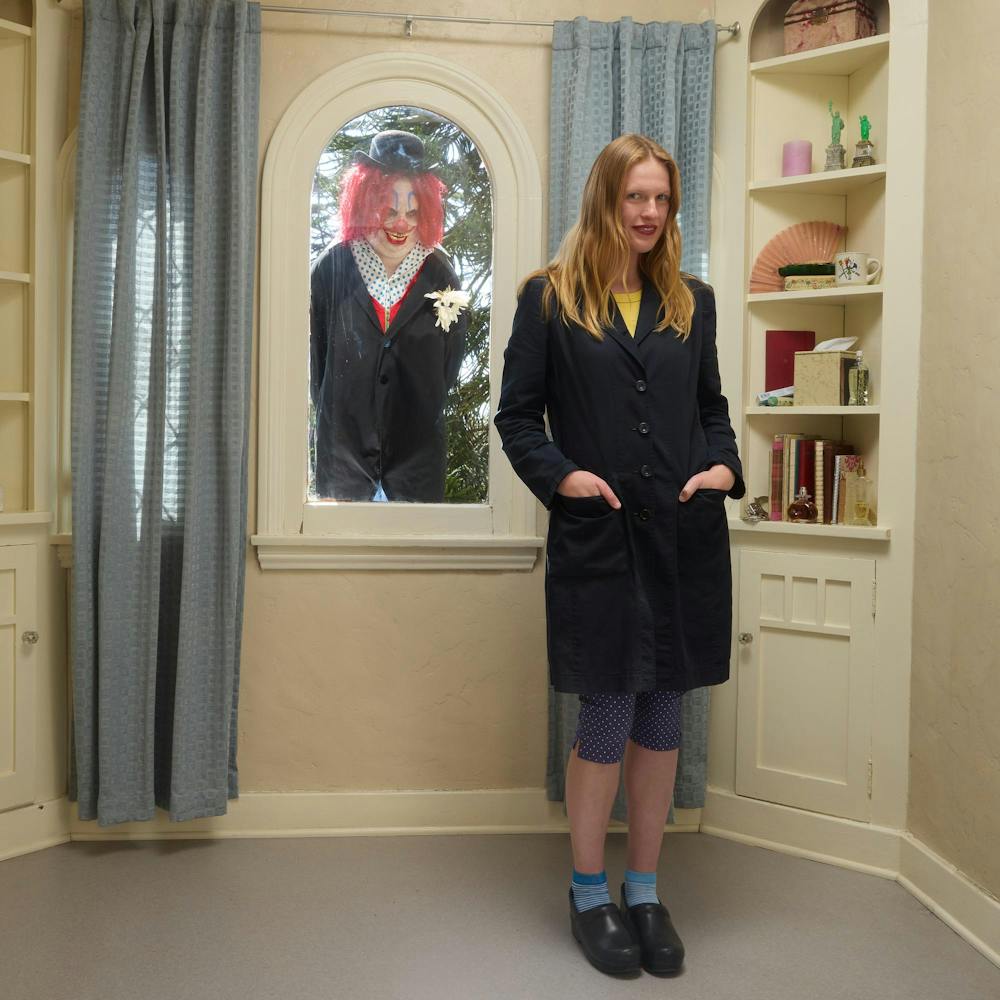
Released just last month, Audrey Hobert’s debut album “Who’s the Clown?” depicts the messiness of dating, body image insecurities and a fluctuating identity with blunt authenticity.
Having previously worked in screenwriting at Warner Bros. Discovery and Nickelodeon, Hobert’s first foray into the music industry began through a series of co-written songs with her childhood best friend — and now two-time Grammy-nominated singer-songwriter — Gracie Abrams. Two of their most viral songs, “That’s So True” and “Risk,” both appeared on Abrams’s 2024 album “The Secret of Us (Deluxe).”
Hobert’s credentials extend beyond collaborations with Abrams. She has also co-written with her brother Malcom Todd as well as singer-songwriter Alessi Rose. But from first listen, “Who’s the Clown?” reveals Hobert’s talent as a solo artist.
She opens the 2000s pop-esque record with “I like to touch people,” a track that sets a cheeky, unserious tone for the rest of the album. Although the song has an admittedly jarring title, the New York-based singer clarifies in her lyrics that she likes to “touch people” in an emotional sense, whether she’s making a lasting impact on someone or simply connecting with a stranger. She sings, “It’s just so fun / I’m at a random party / Hand to her heart, some girl I’ve never met completely loves me.”
Following the mid-tempo opener, Hobert wastes no time showing off the album’s catchy, indie-pop features. In her sixth track, “Thirst Trap,” she fuses upbeat instrumentals with candid and relatable lyrics. In it, she sings of a time when she “used to be so super cool” and didn’t compare herself to others. The song’s stream-of-consciousness style pulls listeners into Hobert’s unfiltered insecurities: “I’m takin’ thirst traps in the mirror in my room / I think I look bad so I take a hundred.”
The eighth track, “Sex and the city,” also touches on the same themes of self-doubt and body image, asking “What’s it like to be admired? / Hot and desired?” Throughout the song, Hobert opens up about modern-day hookup culture and her desire to be sought after. Rather than romanticizing her dating life, she sings “This isn’t ‘Sex and the City’ / Nobody’s watching me write in my room.”
But what truly sets “Who’s the Clown?” apart from other modern pop records is Hobert’s broad emotional range. She embraces the capriciousness of her own emotions, seamlessly transitioning from periods of self-love to loathing.
In “Shooting star,” she sings, “If I hate what I hear I’ll just tell you to shut up / It’s just who I am and they can’t get enough.” But in “Phoebe,” just two songs later, she asks, “why else would you want me? / I think I’ve got a fucked up face.”
It’s this exact contradiction that makes Hobert’s debut album so relatable: She shares a murky depiction of how she views herself. Even from the first listen, “Who’s the Clown?” captures the dynamism of being in your 20s. From the feeling of a wild dance party to a meltdown on your apartment floor, Hobert’s nuanced and authentic storytelling suggests a promising future for the budding artist.

Ann Gray Golpira is a Section Editor covering Arts & Culture. She is from Norfolk, Virginia and plans on concentrating in both International and Public Affairs and Anthropology. Outside of The Herald, you can find her writing, recording and producing her original music.