
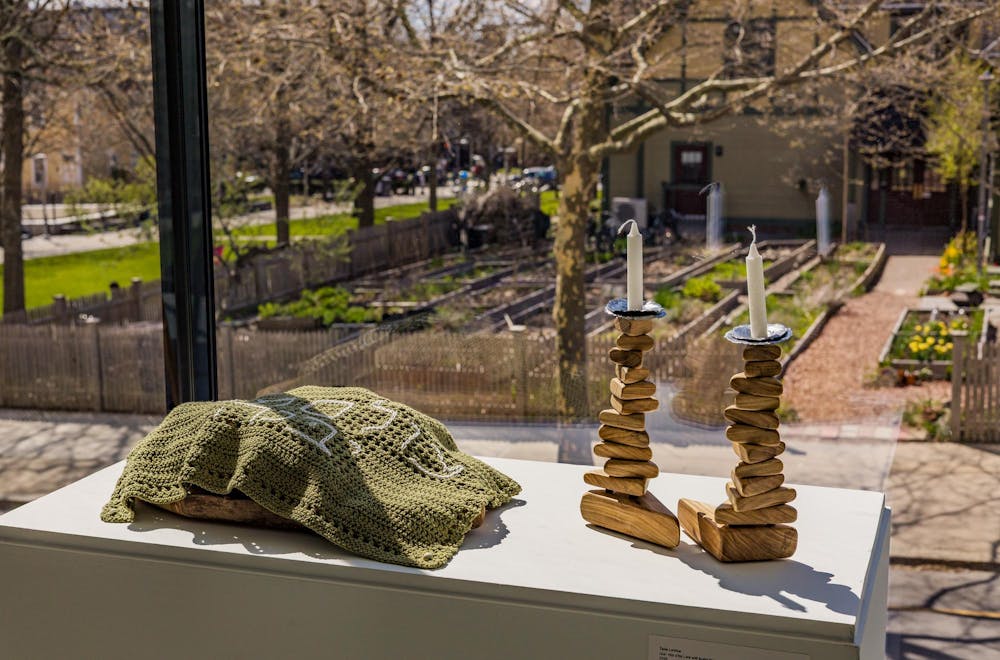
In May 2024, an American elm tree was cut down on the Main Green. Now, two years later, the tree’s wood is finding new life through pieces featured in the Brown Art Institute’s new “Point of Entry” exhibit, which is on display from April 23 through May 27.
Eiden Spilker ’24 — the exhibit’s curator — told The Herald that he wanted the exhibit to illustrate the diverse significance that the elm held for community members.
“I was spending so much time thinking about it. What’s its meaning? What’s the historic moment that this is happening at? And I just wanted to get it out of my own head (and) get it into different artists’ hands to see what they have to say with this,” Spilker said.
The exhibit features the works of 11 artists, including alums, Rhode Island community members and one student. According to Spilker, he and Professor of History Holly Case — the exhibit’s other juror — selected artists through an application process based on a conceptual proposal. Since the application did not require artists to present finished works, Spilker said that the selection process was very “meaning-heavy.”
Talia LeVine ’27 — a section editor for Arts & Culture at The Herald and the only student whose pieces were chosen for the exhibit — said that since the artists in the exhibit had started with a concept before creating their pieces, “every single sculpture” was “very immaculately thought-through in detail.”
LeVine’s pieces illustrate their experience as a student activist with Jews for Palestinian Liberation — formerly known as Jews for Ceasefire Now — in the 2023-24 school year. One of their sculptures depicts their interpretation of a student sit-in in November 2023 that resulted in the arrest of 20 Jewish students advocating for the University to divest from companies affiliated with Israel’s military.
A second sculpture, featuring spinning metal half-circles atop a cracked stump filled with beeswax, was inspired by the 2024 encampment, LeVine said.
The elm tree “was kind of the focal point of so much of the organizing that we did in the encampment,” LeVine said. “It was really a space of community and connection.”
Yasmine Hassan ’17, a part-time studio monitor at the List Art Center’s sculpture studio, was also fascinated by how much history the elm tree carried. “It’s just wild to me how much this elm has witnessed,” she said.
In her piece, Hassan used the tree’s live edge wood — wood that is unprocessed beyond being cut — to create a table with laser engravings on both sides. On the underside of the structure, a boy can be seen overlooking the rubble of the Lippitt Hill, a residential neighborhood that was demolished during the late ’50s and early ’60s. The other side of the table depicts two men destroying houses with armored military vehicles.
Through the piece, Hassan invites viewers to be curious about the places around them. She encourages viewers “to do their own research” about the history that came before, noting that “if we don’t know about history in general … we’re doomed to repeat the same mistakes.”
Hassan added that she was “impressed” by the diverse angle that each artist took when interpreting the elm. “It’s just crazy all of the different links that people found, personally and professionally, with this tree.”
An opening reception for the exhibit will be held on April 23 at 5:30 p.m.


