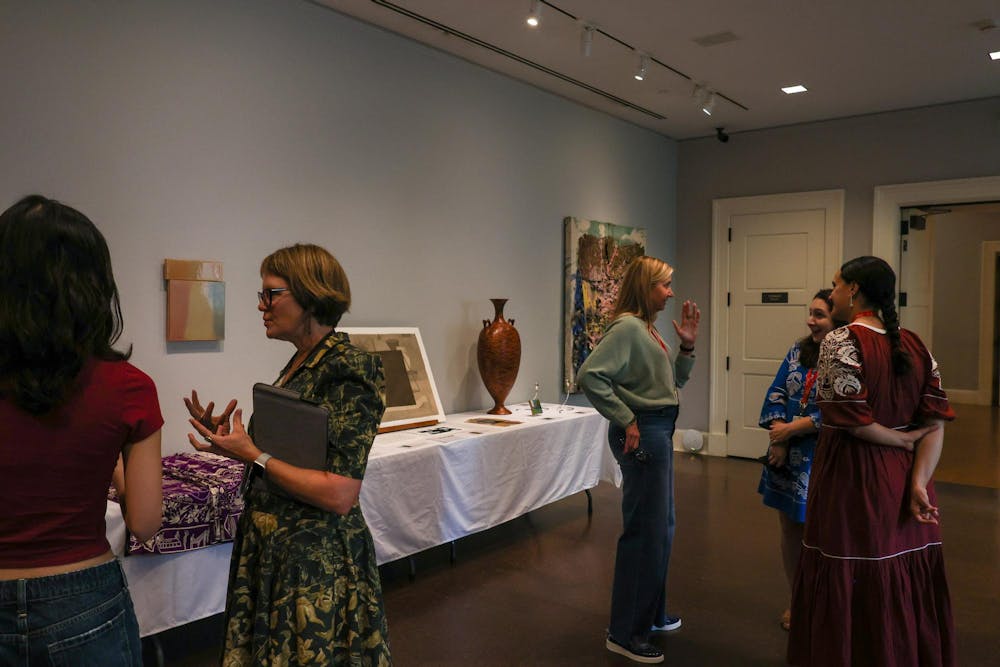
Surrounded by textile fabrics hanging from the walls beside inkblot paintings and portraits, dozens of people filed through the Rhode Island School of Design Museum’s Danforth Hall, exploring artworks that spanned genres — from cloth looms to blackout poetry to 19th-century portraits.
Visitors soaked in new art as the museum displayed its most recent acquisitions during a Wednesday viewing day. The limited opportunity allowed visitors to experience some of the over 100,000 artworks in the museum’s collection — many of which have not yet been displayed to the public.
“After today, all of these pieces are going back into storage,” María Fernanda Mancera, assistant curator of Indigenous art at RISD Museum, said at the event. “So this is a really good opportunity for members of the community to see them and get an understanding of how the curators are thinking about expanding their collection.”
Mancera specializes in worldwide Indigenous art and spoke at the viewing day about the complexities of working within that niche.
“The RISD collection has a very rich group of Andean textiles, but most of them are ancient, so they cannot be shown because of conservation or even cultural considerations,” she said. “We’re hoping to bring pieces from artists who are working in the present and can tell stories of continuity.”
Since RISD houses one of the most comprehensive art museums in southeastern New England, “it’s important that people not only from Providence but across the state see themselves represented here,” Mancera added.
Kate Irvin ’93, a curator and department head of costume and textiles, emphasized how “collaboration” and “connection” are important facets of her work with the museum.
In collaboration with Mancera, Irvin acquired “Los caminos de la presencia wichí” or “The paths of the Wichí presence” by Claudia Alarcón and Silät, a collective of artists from the Wichí indigenous communities of Argentina, who Alarcón, an Argentine artist, worked with to create the hand-woven textile loom composition.
Mancera noted the story of connection behind the textile piece, pointing out the “hidden knots” which act as “an indication where one (pair of) hands stopped and the other took over or vice versa.”
Irvin was also able to acquire a textile piece by two Brown-RISD dual degree alums. Yukti Agarwal ’25, a student of Irvin, and Ethan Hoskins ’24 developed a textile portrait piece on RISD’s own Jacquard loom, which employs an automated form of weaving that is controlled by a series of punched paper cards that operate much like binary code.
When Agarwal and Hoskins invited Irvin to a studio visit, the piece caught her attention. “It really made so much sense to have this work in the museum and to document this collaborative way of working that I think is so important to all of us right now,” Irvin said.
While curators are able to acquire some pieces through personal relationships and networks, other pieces required lengthy and careful negotiation processes.
Ariane Porter, the membership manager of the RISD Museum, spoke about a 19th-century portrait that was especially difficult to acquire. The museum had to work “very delicately and diligently to acquire this piece,” Porter said, since artwork owners sometimes have “emotional attachment” to works in their personal collection.
When acquiring artwork, money isn’t always the deciding factor, she added. It is not about “who can give me the most money … it’s more of the ethos, the mission, the values of said institution.”
“If they agree with that then they will be kind enough to either gift it or it’s a straight up purchase,” Porter said.
Alexandra Poterack, the director of academic programs at the RISD Museum, emphasized the importance of the museum as a learning opportunity for students.
Museums are a space “where multiple perspectives can exist, collectively and simultaneously, and I think that is more important than ever at this moment,” Poterack said.
Students are also able to request office hours with the museum’s curators to pull unexhibited pieces from storage for observation.
The RISD Museum is no exception, Irvin explained. She recalled walking through a gallery “with a RISD class, speaking to them” while on the other end of the gallery, “a group of first-graders were drawing circles on the rug.”
“Hearing glimpses of their response to big artwork in that space is really important,” she added. “I think there is joy there.”
Correction: A previous version of this article incorrectly stated that RISD's collection housed Indian textiles and that Ethan Hoskins was a student of Kate Irvin. Ariane Porter's name was also corrected. The Herald regrets the errors.