
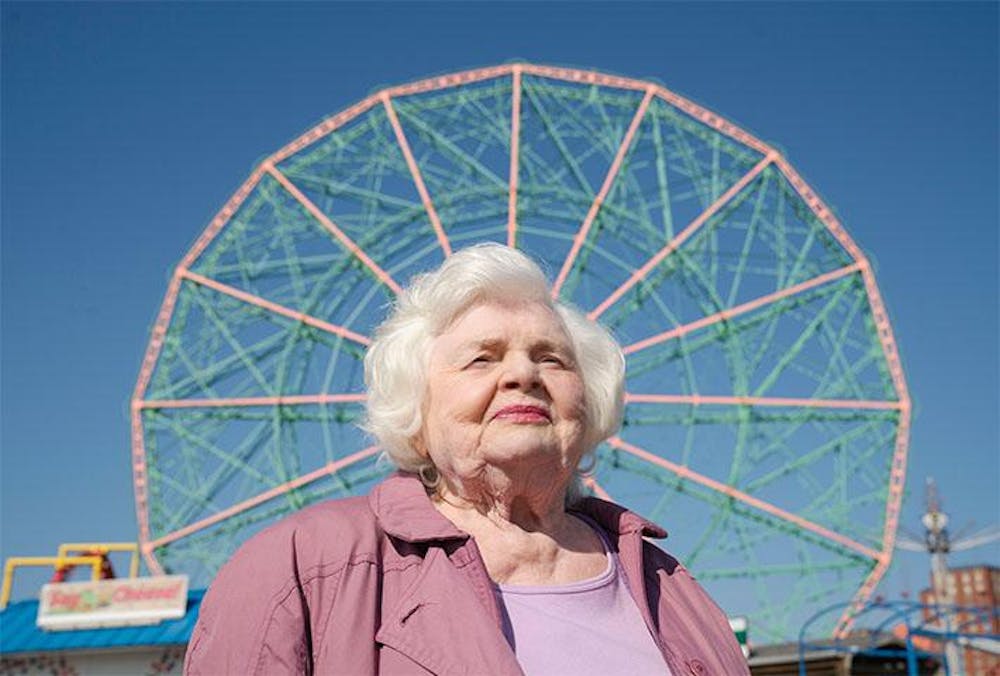
On Sept. 26, Scarlett Johansson made her directorial debut with “Eleanor the Great.” Based on a screenplay by Tory Kamen, the film explores themes of grief and loss through the eyes of 94-year-old Eleanor Morgenstein (June Squibb).
The film opens with the jarring death of Eleanor’s best friend Bessie Stern (Rita Zohar). A montage of the pair’s close-knit friendship cuts to a scene of Eleanor sitting alone on a bench, with the other side — where Bessie would have been — noticeably empty. While the suddenness of Bessie’s death doesn’t evoke much emotion, the cinematography of these montages, of which there are many, creates a warm environment that the viewer misses once Bessie is gone.
The rest of the film centers on Eleanor’s journey through loss, as she leans on her Judaism to cope with her grief. After accidentally ending up at a support group for Holocaust survivors, Eleanor tells the harrowing tale of Bessie’s escape from Nazi-occupied Poland as if it were her own, describing the deaths of “her” mother and brother and “her” time at the Auschwitz-Birkenau death camp.
After sharing this co-opted story, Eleanor is greeted with sympathy and support, but a key detail eats away at her: This experience was Bessie’s to tell, not Eleanor’s. Notably, Bessie had never even shared the story publicly before her passing.
The tale she tells ultimately gains the attention of student journalist Nina Rogers (Erin Kellyman), who is recovering from the death of her mother. Throughout the film, Nina and Eleanor form a friendship out of a shared sense of loss. The two grow closer, frequently getting breakfast, going to synagogue and sitting for pedicures together. In time, the audience watches as Nina begins to fill the hole that Bessie’s passing left in Eleanor’s life.
Johansson uses montages often to allow the viewer to fully experience emotions without the direction of a narrator. While many of these moments are healing for Eleanor, her never-ending lies begin to spiral out of control. The film includes Eleanor’s own bat mitzvah after she claims she never had one due to the Holocaust — even though, in reality, Eleanor only converted to Judaism after her marriage. The event helps her affirm her “devotion” to the Torah and justify her continued and objectively immoral deception.
As nearly all lies are, Eleanor’s deceit is ultimately exposed. The film’s resolution is a much-needed conclusion, given the immensity and insensitivity of her fabrication. “Eleanor the Great” excels with its emotional appeal, but the empathy gained from these scenes is only surface-deep when viewers are confronted with Eleanor’s lies about such a serious and sensitive topic. The film brings audiences through the journey of loss and how one copes with it — albeit without a sense of real consequence for Eleanor’s wrongdoings.

Alice Xie is a section editor for Science and Research from Los Angeles, California. She studies Applied Mathematics and Biology, and enjoys reading gut wrenching literature in her free time.


