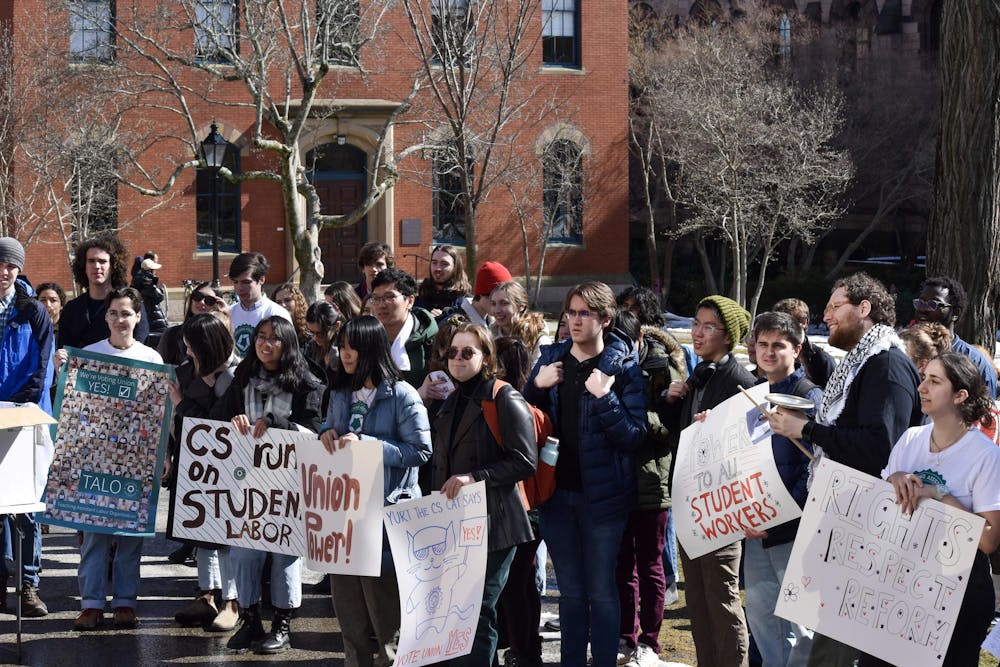
When Brown’s Graduate Labor Organization last signed a contract with the University in 2024, its members celebrated a roughly 20% raise over the span of three years.
Over the course of the next few years, GLO repeatedly used a federal complaint process to allege, more frequently than its Ivy League counterparts, that Brown was violating federal labor law.
But this spring, GLO will return to the bargaining table in a dramatically altered playing field, reshaped by a frozen national labor board and the University’s efforts to reduce a multi-million dollar budget deficit in the wake of federal actions.
Several experts told The Herald that the range of legal and procedural options available to student unions seeking to negotiate more favorable contracts and challenge the University is slimmer — and riskier.
A paralyzed NLRB and an unsympathetic White House
Since President Trump took office in January, student labor unions have had to navigate a shifting risk calculus when seeking to escalate bargaining disagreements or allege labor law violations, former National Labor Relations Board Chair Wilma Liebman told The Herald.
The NLRB has been effectively paralyzed since Trump fired Biden-appointed member Gwynne Wilcox, leaving the board unable to reach a quorum and setting off a legal battle that ultimately resulted in the Supreme Court ruling that the president could fire sitting board members.
Student labor unions may still file unfair labor practice complaints with the NLRB, according to William Herbert, executive director of the National Center for the Study of Collective Bargaining in Higher Education and the Professions.
But these complaints will not be taken up by the full board — a central premise of GLO’s previous strategy. These filings, called unfair labor practices, often take years to resolve, but GLO President Michael Ziegler GS explained that the union filed these complaints with a long-term goal of expanding student labor rights.
During Trump’s first term, the NLRB proposed a rule that would have effectively struck down the 2016 ruling allowing student workers to unionize at private universities. While the rule was withdrawn under former President Joe Biden’s NLRB, Trump’s return to the White House has created an atmosphere of fear among graduate students.
A ULP, if taken up by the NLRB during an appeals process, could bring about an unfavorable ruling that could have ripple effects for graduate labor protections.
As a result, GLO anticipates that a full NLRB under a second Trump administration is “not going to be a board that’s tailored to workers generally, but certainly not us,” Ziegler added.
After Trump took office, GLO withdrew all pending unfair labor practice complaints, according to publicly available NLRB data. Ziegler said the union does not plan to file more charges because the complaints, under a board less sympathetic to student labor rights, may inadvertently become a vehicle for rolling back current protections.
This leaves student unions like GLO with few legal alternatives to adjudicate disputes with the University.
“At the moment, I don’t see a legal venue,” Liebman said. Instead, unions may turn to “economic action, other publicity action (and) looking for leverage wherever they can hope to find it,” she added.
Negotiations hope to increase Brown’s financial transparency
According to Ziegler, GLO will be demanding greater transparency as Brown takes increasingly aggressive steps towards cutting spending.
“We’ll be trying to make the argument that the University needs to be transparent with us, but with the broader community as well, about the way that it’s been managing its finances,” Ziegler said.
Amid University-wide efforts to resolve longstanding budget deficits and mitigate the impact of federal actions, Ziegler said that Brown’s strongest argument in favor of spending cuts is transparency.
“If they really wanted to make their case, then they should be fully transparent about the University’s finances,” he said.
“While both economic circumstances and the labor landscape naturally evolve over time, our priorities in working with Brown’s labor unions remain consistent,” University Spokesperson Brian Clark wrote in an email to The Herald.
Clark added that the University is “committed to respect for the bargaining process, to transparent and inclusive decision-making, to positive relationships with both union and non-union employees and to sustaining the long-term financial health of the University in a way that supports Brown’s mission of education and research.”
Brown may also seek to offer GLO more favorable terms that aren’t related to compensation, Herbert explained.
“It is very common … to work on developing stronger language in a contract in exchange for the fact that there’s not more money,” he said. “That could be negotiations over language about issues that don’t have immediate monetary value, but are important for the grad students,” including parental leave and protections for international students.

Ethan Schenker is a university news editor covering staff and student labor. He is from Bethesda, MD, and plans to study International and Public Affairs and Economics. In his free time, he enjoys playing piano and clicking on New York Times notifications.