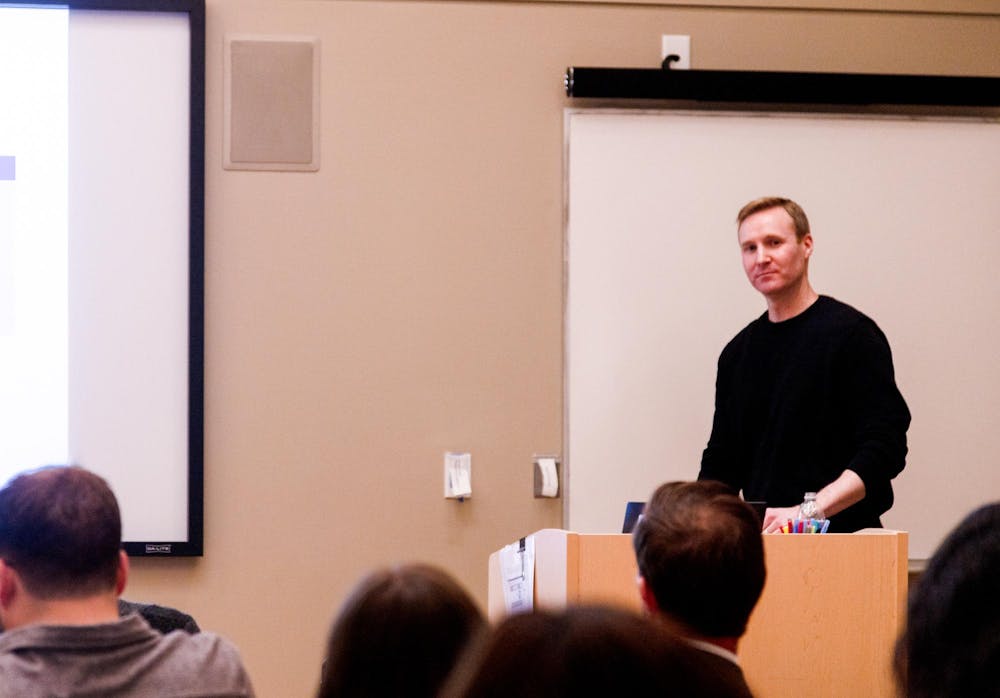
Contrary to previous research in the criminal justice field, informing judges of racial bias in their past decisions to release certain defendants ahead of trial does not change their behavior, Harvard professor Will Dobbie said at a Thursday talk.
Sponsored by the Population Studies and Training Center, Dobbie’s presentation was called “The Role of Beliefs in Driving Racial Discrimination: Experimental Evidence from the U.S. Pretrial System.” The talk was part of the PSTC’s Colloquia series, which hosts speakers from a variety of academic backgrounds to present on their research.
Dobbie began by describing the background and motivation for his study, referencing evidence that initially suggested that giving people more accurate information on an issue can help mitigate biases that drive discriminatory behavior.
“Coming out of all these papers, there (was) a lot of optimism that this was going to be the answer, finally, for how we can address discrimination,” Dobbie said.
He chose the U.S. pretrial detention and bail system as a setting to assess this solution to systemic injustice, noting its “incredibly high stakes” and fast pace. Judges make decisions with lifelong consequences in a matter of minutes, he said.
In the U.S. justice system, there exist large disparities between white and nonwhite detainees’ release rates while awaiting trial, Dobbie added.
For his research on racial bias in the criminal justice system, Dobbie conducted an experiment over five years.
First, Dobbie needed to determine whether the judges held “inaccurate beliefs” about potential racial disparities. The second task was to see if judges’ beliefs could be made more accurate “in a persistent and systematic way,” he said. The final question the research sought to answer was: If judges gain a more accurate perception of their release rates, “do we see discrimination get better?”
Using two court systems as case studies, Dobbie collected baseline and endline surveys to determine if judges were aware of the racial bias in their pretrial release rates of detained individuals. The surveys also collected information about judges’ perceptions of misconduct rates during the time between the initial detainment and the trial for white and nonwhite defendants.
After the baseline surveys, the researchers then provided the judges with training, accurate court statistics on racial disparities and accurate statistics on the judges’ own release rates.
Dobbie explained in his talk how a large share of judges misidentify and misperceive their own release rates and the racial disparities within these rates. But he found that even if correcting the judges changed their beliefs, their behavior remained the same, and the racial disparity between release rates for white and nonwhite defendants persisted.
According to Dobbie, previous ideas in the field had suggested that if judges’ beliefs were corrected, the racial disparities in release rates between white and nonwhite defendants would be ameliorated.
“We know a lot more about what misperceptions exist in the criminal justice system than at the start of the project,” he said. “We’ve learned we can largely correct those misperceptions.”
But he emphasized that the overall results indicate that real-world attempts to correct these misperceptions do not necessarily result in tangible change — despite previous lab-based models.
“Beliefs are not going to be the silver bullet” to minimizing racial disparities, Dobbie said.
After the presentation, Andrew Foster, associate director of the PSTC and a professor of economics, told The Herald that he found it interesting that even if “you change people’s minds, you don’t actually change their behavior.”
Some people believe that if people have the right information, issues of racial discrimination would be solved, Foster said. Dobbie has “shown, at least in this context, that that itself doesn’t work,” he added.
Raquel Badillo Salas, a doctoral student studying economics, found the talk “important” and “inspiring.”
She added that it is crucial for researchers like herself to “keep thinking on how to reduce discrimination” and “how to implement policies that are based on evidence.”
Rachel Wicker is a senior staff writer covering affinity and identity. She is from Athens, Georgia and plans on concentrating in English on the nonfiction track and International and Public Affairs. Outside of writing, she enjoys reading books of any genre and doing yoga.