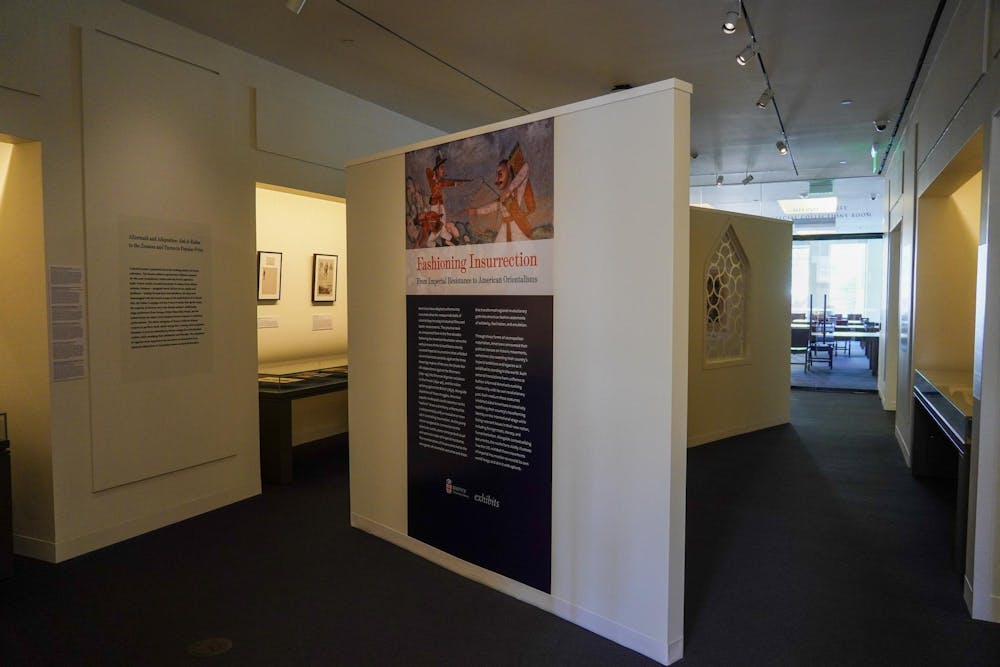
Those walking through the Harriette Hemmasi Exhibition Gallery at the John Hay Library can’t miss the V-shaped wall erected in the middle of the room.
The wall is just one feature of the gallery’s new exhibit, titled “Fashioning Insurrection: From Imperial Resistance to American Orientalisms,” that opened with a reception on Sept. 9. The exhibit is part of “American-Islamic Exchanges in the Long 19th Century,” a year-long research initiative launched by the Center for Middle East Studies.
The exhibit examines how 19th-century American engagement with the fashions and styles of insurrections in the Islamic world — such as the Greek War of Independence or the Algerian resistance to the French — shaped early American identity.
“We look at how Americans were paying attention to these events and how they were using not only the dress, but (also) many of the themes that were popping up to reckon with their own identity and their own relationship to their revolutionary past,” said Gwendolyn Collaço, the main organizer of the exhibit and curator of the Anne S.K. Brown Military Collection.
The idea for the exhibit was born from Collaço’s exploration of the uniforms in the Anne S.K. Brown Military Collection last year. While the collection is known for European and Western military history, Collaço strove to “bring a more global vision” to the exhibit, she said.
To highlight the relationship between geographical and gallery space, Collaço requested that a V-shaped windowed wall stand in the center of the room. The wall separates different geographical sections of the exhibit from each other, using a latticed window to emphasize the “distortion and transformation” of American adaptations of regional dress, Collaço said.
“The exhibit offers a stunning visual reminder that the nascent United States of America and societies of the Middle East, North Africa and South Asia in the 18th and 19th centuries were not isolated entities living in entirely separate worlds,” wrote Associate Professor of Modern Middle Eastern History Faiz Ahmed in an email to The Herald.
Initially, Collaço thought the exhibit would focus on “insurrection and revolution from a non-Western perspective,” she said.
But after examining the collection more deeply, Collaço realized the “collection’s old focus of uniforms has actually a really interesting story to tell” when brought into conversation with “wider society” and U.S. fashion, she told The Herald.
To demonstrate how uniforms impact present-day fashion, Collaço decided to feature a contemporary costume loaned from Minwoo Oh, a RISD apparel design student in the class of 2027.
At the opening reception, Oh joked that he is the only living artist whose work is included in the exhibit. “I’m sorry I was the only artist that could make it today to the gallery,” Oh recalled telling the audience.
Being included in the exhibit, Oh told The Herald, “reflects how much I was able to achieve within a short time.”
According to Collaço, each section of the exhibit has a connection to Brown.
The Greek section, for instance, features a portrait of Samuel Gridley Howe, a Brown alum from the class of 1821 who fought in the Greek War of Independence. The Algerian section showcases a sword that belonged to Rush Hawkins, who married Annmary Brown, the granddaughter of the University’s namesake Nicholas Brown.
The larger “American-Islamic Exchanges in the Long 19th Century” research initiative arose from a funding competition held by the CMES in the spring. Collaço, Ahmed and Karin Wulf, director of the John Carter Brown Library and history professor, submitted the winning proposal.
The proposal won because of its “wonderful mix” of activities, including art exhibitions and workshops, and because it showcases collaborations at and beyond Brown, according to Elias Muhanna, associate professor of comparative literature and history and the director of the CMES.
These collaborations beyond Brown include a Yale class on 19th century commercial painting that Associate Professor of Art History Holly Shaffer is co-teaching, as well as workshops with a Massachusetts Institute of Technology expert on Tunisian letterlocking, Collaço said.
Starting in January, the Fashioning Insurrection exhibit will have a sister exhibit located in the John Carter Brown Library that will take a “wider approach to the idea of revolution,” according to Collaço.
The Fashioning Insurrection exhibit “puts on display the greater riches of the collection for teaching and research,” said Joseph Meisel, University librarian and adjunct associate professor of history.
Beyond sparking new discussions and ideas, the initiative aims to “nurture new relationships and partnerships in the future — across differences and on terms of respect and equality — in the hope all of this might just help shape a better society and world for all,” Ahmed wrote.