As the year comes to a close, crowds of people across the country are boarding flights, hitting the roads and booking last-minute trains for their holiday travel. In past years, cost-conscious travelers may have turned to Amtrak for an affordable ride. But as train prices rise, some are turning to other options to get home for the holidays.
Thanksgiving is the busiest week of the year for Amtrak. Last year, more than 1.2 million passengers traveled on Amtrak during the Thanksgiving season. Ahead of the holiday, Amtrak announced that it had provided 34.5 million customer trips in fiscal year 2025, setting a record for both ridership and revenue for the second consecutive year.
But as demand for Amtrak rides has grown over recent years, many customers have seen an increase in ticket fares.
“Up until this Thanksgiving break, I used Amtrak,” said Adwoa Owusu ’26, who usually takes an eight-hour train on the Northeast Regional from Providence to Virginia for the holidays.
That line is a part of the Northeast Corridor, which serves the Northeast’s five major metropolitan zones — Boston, New York, Philadelphia, Baltimore and Washington, D.C. — the country’s most heavily trafficked rail area.
But Amtrak prices have “gotten gradually worse since my freshman year,” she added.
“I’ve noticed that Thanksgiving is definitely the worst pricing period during the year,” Owusu said. When a one-way ticket from Providence to Virginia was set at $430, she quickly began looking at other alternatives to make it home for the holidays.
“I know that people have taken the bus in the past, but to me, even though it’s cheaper, it’s even longer than the train,” she said. So Owusu decided to fly back home from T.F. Green International Airport, which cost $340 round-trip.
Others turn to more affordable intercity bus options. Nyah Bhat ’29 has taken the FlixBus from Providence to New York City several times throughout the semester, including for Thanksgiving, to save money. Round-trip tickets tend to fall between $50 to $90, she said.
“The first time I took the bus, I experienced some delays, but as I started taking it more and more (the trips have) been pretty smooth,” Bhat said.
But, other than the price difference, Bhat prefers taking the Amtrak since it is more reliable than the bus and allows for ticket flexibility, she said.
For their tickets, Amtrak uses a dynamic pricing model, a strategy that adjusts prices in real-time based on demand, travel times and customer behaviors.
As the departure date for a trip approaches, fewer seats are typically available on the train, and Amtrak will often raise prices “to try and make sure that they are sold to people who need that last-minute train and are willing to pay for it,” said Maddock Thomas ’26, a rail and transportation student researcher.
But “Amtrak is always broke” due to high fixed costs, said Professor of Economics Matthew Turner PhD’95. “If you’re Amtrak, you have to take care of the tracks, you have to take care of the train set, you have to take care of the stations — trains are just expensive.”
Amtrak did not provide a comment to The Herald by press time.
As a quasi-public corporation, the company also operates under what Turner called an “impossible mandate” to provide service nationwide even when it requires running unprofitable lines.
“If Amtrak was allowed to just run from D.C. to Boston, they’d be fine,” Turner said. “But they have to serve Kansas as well, and that is not super profitable.”
But a majority of intercity bus companies are privately owned, which allows them to focus on profitable lines as opposed to maintaining a national network, Thomas said.
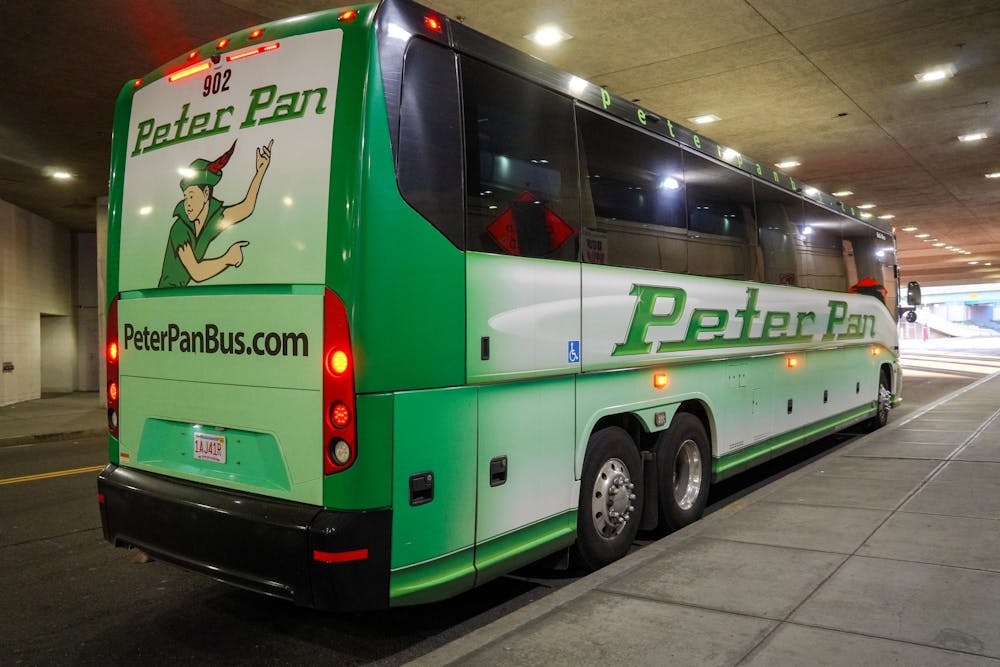
In the Northeast, some of the most popular intercity bus providers include FlixBus, Greyhound and Peter Pan Bus Lines. These are privately owned enterprises, with FlixBus and Greyhound together — under parent company Flix — facilitating the largest intercity bus network in North America.
“Buses offer a more affordable, flexible and convenient option than Amtrak, with frequent departures, direct routes to city centers and smaller towns and the ability to book last-minute without major fare spikes,” Ike Hajinazarian, a spokesperson for Flix, wrote in an email to The Herald.
In recent years, Flix has seen a “continued strong demand from college students” prompting the company to “purposefully design many routes to include colleges and universities,” Hajinazarian wrote.
Both FlixBus and Greyhound have seen a significant increase in bookings during this year’s Thanksgiving travel period, he added, which increased more than 30% from last year.
While many intercity bus companies use a dynamic pricing system, Thomas explained, fares are still often lower than Amtrak’s since companies often are not “paying for bus terminals” or “maintaining stations and tracks.”
While she cited FlixBus’s lower prices, Bhat also wishes that Flix would offer a flexible ticket option similar to Amtrak’s flex fare, which offers passengers a full refund with no fees if they cancel their trip before departure. If FlixBus riders cancel their reservation 30 days in advance, there is no cancellation fee. But, closer to the departure date, cancellation fees can rise to 80%.
“As college students, all of our plans are so easily subject to change, and the bus is very rigid in that respect,” she said.
To avoid having to take the bus in the future, Bhat has already started looking at Amtrak tickets to travel between Providence and New York for winter break and Presidents’ Day weekend.
Jonas Coats ’29 also plans to buy his Amtrak tickets in advance for his trips next semester. This fall, he has primarily used Peter Pan and Greyhound buses to travel between Providence and New York during weekends and holidays.
“I’m happy to buy an Amtrak ticket if it’s not significantly more expensive” than the bus, he said. But for Thanksgiving, “there were days when the Amtrak ticket was $300, and the bus was $60, so it feels wasteful to buy an Amtrak ticket when it’s that inflated.”
But Amtrak has one feature that makes the price worth it for some students.
“I like looking out the window on the Amtrak,” Coats said. “A lot of the time you’re going through very pretty countryside, whereas with the bus, you’re just on the highway the whole time.”
“If you really want to see New England,” he added, “Amtrak is a much better option.”

Sanai Rashid lives in Long Island, New York. As an English and Economics concentrator, she is passionate about storytelling and how numbers and data create narratives in ways words alone cannot. When she is not writing, you can find her trying new pizza places in Providence or buying another whale stuffed animal.