
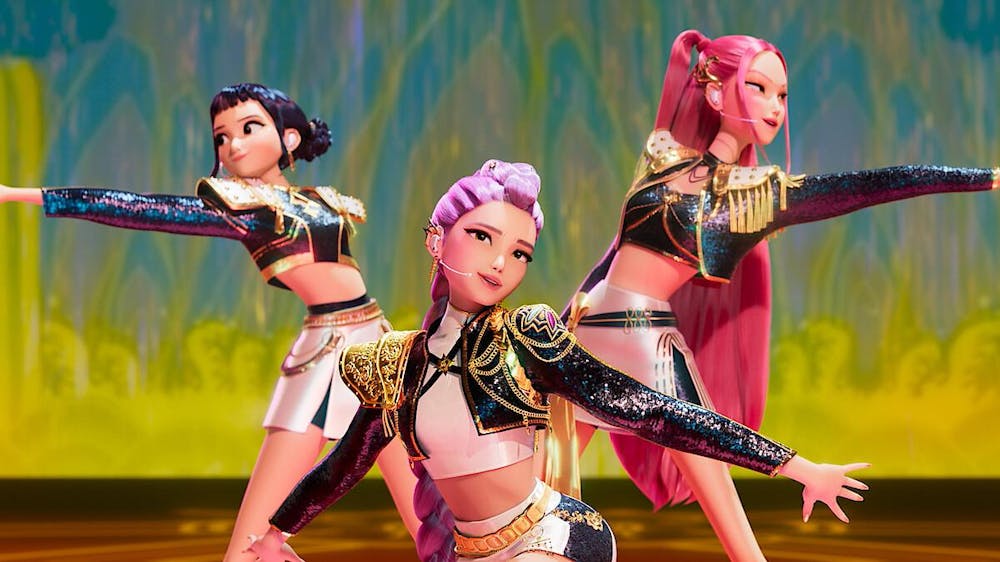
“KPop Demon Hunters” has dominated pop culture this summer, reaching far beyond the world of children’s animation. Released by Netflix on June 20, “KPop Demon Hunters” quickly became the platform’s most-watched film of all time. The movie’s original soundtrack has topped charts worldwide: Its lead single “Golden” currently sits at No. 2 on the Billboard Global 200, and the film’s cast holds the most spots on Spotify’s Top Songs Global. Summer camp counselors and elementary school teachers haven’t heard the end of it.
The film is undeniably engineered for success. Taking inspiration and content from one of the most showy, sensational genres of our time — K-pop, a South Korean musical genre — “KPop Demon Hunters” uses both traditional and cartoonish animation to create a shiny, snappy comedy packed with pop hits. It utilizes tropes that guarantee its success, like a group of three relatable female main characters and a forbidden romance.
The film follows Rumi (Arden Cho, EJAE), the lead singer of fictional girl group HUNTR/X, as she battles with her complex heritage. Meanwhile, Jinu (Ahn Hyo-seop, Andrew Choi) — a demon suffering from shame after abandoning his family for riches hundreds of years ago — aims to have the painful memories of his loved ones erased. In pursuit of his goal, Jinu remains a servant of the demon king, Gwi-Ma (Lee Byung-hun), who plans to destroy the world. This complex motivation for Jinu allows “KPop Demon Hunters” to disrupt the traditional dichotomy of good vs. evil in an original way.
The well-developed dynamics of the central HUNTR/X girl group are some of the most enjoyable parts of this film. “KPop Demon Hunters” is truly an ode to female friendship. While romance plays a part in the plot of the movie, the central conflict occurs between Rumi and her band members.
K-pop superstardom is a fitting medium from which to explore shame. The characters deal with the discomfort of constant media attention. Many key moments of the film occur onstage, mirroring the highly exposed lives of K-pop stars. Eventually, the fabric of reality literally tears apart due to HUNTR/X’s decreasing popularity — a metaphor for the importance of fans in the world of K-pop.
The film’s critique of pop culture fandom is insufficiently resolved by its glossy message of self-acceptance. It fails to properly honor meditations on the strain of stardom — while its characters are tired from media attention and always discuss “a break,” they never end up taking one. Instead, its stars ride high on the risky tide of beauty, fame and youth.
While Rumi’s personal arc climaxes in a confrontation with her maternal figure Celine (Yunjin Kim, Lea Salonga), the relationship between the two is woefully undeveloped and weakens Rumi’s personal development in the film. But the overall message of confronting and overcoming trauma remains surprisingly complex for an animated film targeted at younger audiences.
“KPop Demon Hunters” finds its greatest strength in refusing to take itself too seriously, pairing sparkling concert scenes with unglamorous moments from the HUNTR/X members’ daily lives. The film’s portrayal of its main characters’ quirks may elicit laughter from audiences, but it never shames their appearance or emotions. Its casual depiction of traditionally non-feminine behaviors rewrites tired narratives of female popstardom.


