
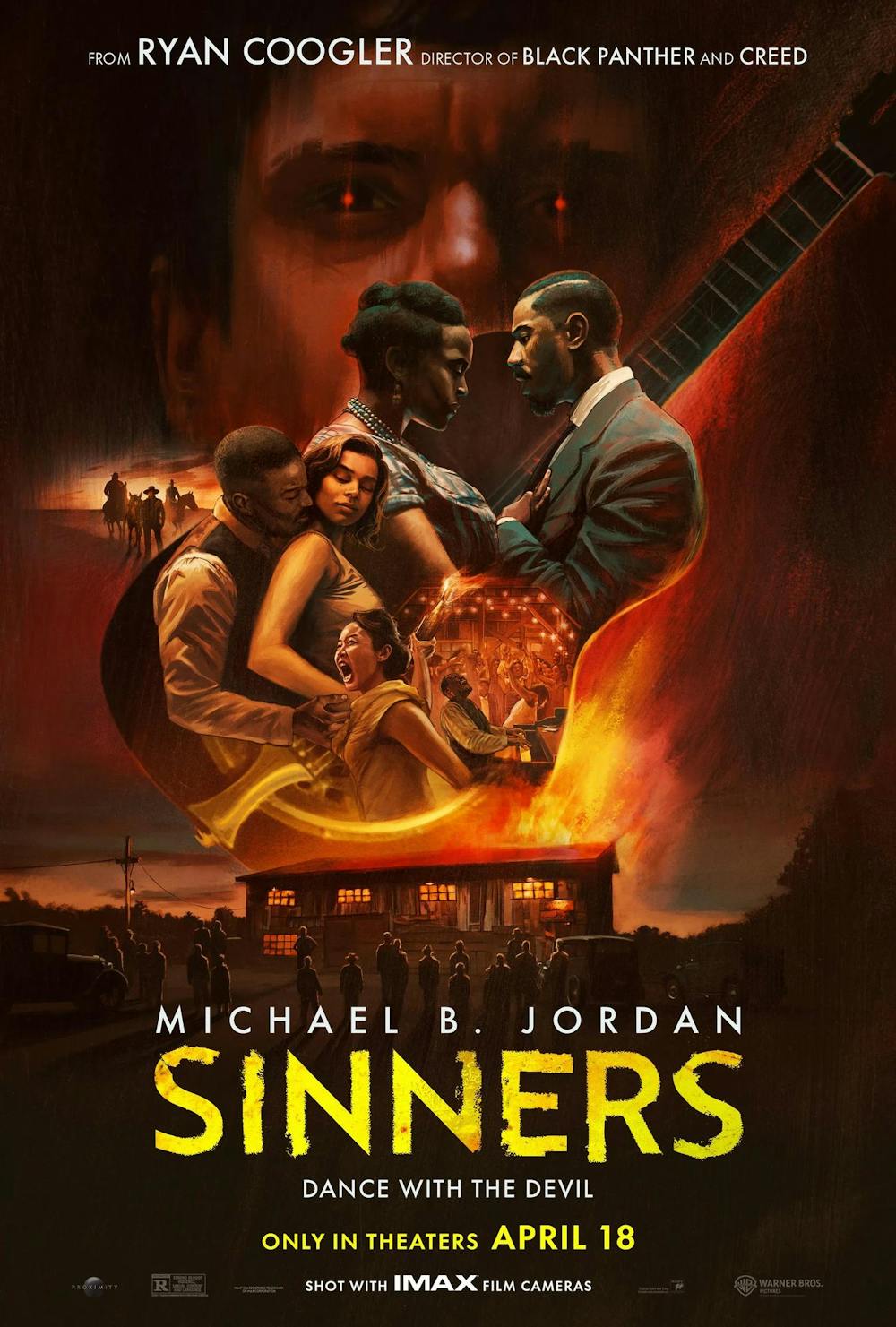
After raking in over $360 million at the box office, Ryan Coogler’s “Sinners” continued its streak of success as it dominated the awards season. With a whopping 16 Academy Award nominations, the film broke the previous three-way tie between “Titanic,” “All About Eve” and “La La Land.”
The film begins in the deep south and follows the identical “Smokestack Twins” — both played by Michael B. Jordan. Upon returning to the Mississippi Delta after seven years in Chicago, the twins, Elijah “Smoke” and Elias “Stack,” purchase a sawmill in the hopes of turning it into a juke joint. Yet in typical horror-movie fashion, the twins’ world quickly takes a turn for the worse.
From the beginning, it is clear that “Sinners” is not like any other horror movie. Each character is nuanced and real — they all have their own lives, struggles, desires and goals. Mary (Hailee Steinfeld) is not just Stack’s former lover, but a woman navigating the complexities of her multiracial identity. While Sammie (Miles Caton) is the twins’ cousin, he is also their new hire at the juke joint, exploring a music career against his family’s wishes.
In fact, Sammie’s opening performance calls the the film's vampires into the joint. Despite the involvement of the supernatural, the film is rarely scary. The discrepancies between the movie’s marketing — which promote an action-packed film — and the actual product — with predictable jump scares — is disappointing. Even the traditional horror-movie gore is saved for the latter third of the movie. But this unique take on the horror genre may very well be one of the reasons the film has received such acclaim.
The scarier parts of the film instead lie in the ability of “Sinners” to portray evil in all of its forms. In addition to supernatural evils, the film touches on the human evil embodied in the Ku Klux Klan members that stroll around the town. Some of these human evils — such as Sammie’s father’s inability to accept his son’s musical dreams — are frustrating, while others — such as the twins’ ability to use their illegal funds to create a night of song and dance — are satisfying.
This movie reinforces the notion that evil exists on a large spectrum, one that every individual constantly moves across. It highlights that evil is not absolute or permanent, but rather sits in a murky gray area, encouraging the audience to realize that, they too, lie somewhere in this universal spectrum.
Timothy Ro is a senior staff writer covering arts and culture.


