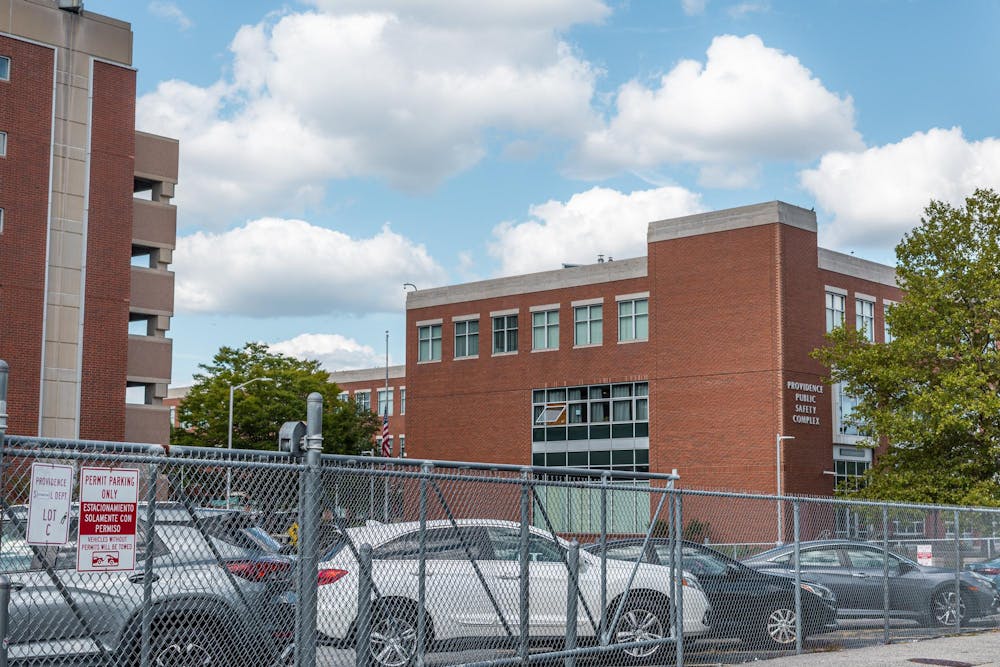
Providence is now home to the state’s first Real-Time Crime Center, aiming to support the city’s policing efforts with real-time surveillance technology and data, Providence officials announced last month.
But the new center — which uses public and registered private security cameras, license plate readers and 911 call data to monitor crime — has drawn criticism from the American Civil Liberties Union of Rhode Island, an individual rights advocacy group.
On Aug. 21, the ACLU R.I. made public a letter addressed to Mayor Brett Smiley and Police Chief Oscar Perez, describing the center as “an all-encompassing surveillance system” and expressing concerns about the lack of explicit privacy safeguards on the data collected for the center.
In their letter, ACLU R.I. wrote that they had reviewed the center’s standard operating procedures and determined that “it possesses no semblance of a meaningful privacy policy.”
The RTCC “is designed to improve response times, expedite investigations and make every Providence neighborhood safer,” City Press Secretary Anthony Vega wrote in an email to The Herald. The system allows the police to immediately tap into over 100 live cameras in response to incident reports around the city.
Providence businesses and citizens can opt to integrate their private cameras with the center, giving the RTCC access to real-time footage. So far, 13 businesses and one citizen have chosen to share surveillance footage, Vega wrote.
According to the Providence Police Department’s website, only trained and authorized personnel have access to the center’s data and video feeds, and “the retention of data depends on the technology associated with the camera system it was recorded on.”
Data retention limits and usage auditing also aim to reduce misuse of camera footage, city officials wrote in the announcement.
In their letter, ACLU R.I. called for stronger departmental policies and municipal legislation to ensure privacy protections. The message also described the center as an “Orwellian threat,” arguing that the system’s standard operating procedures allow the cameras to be used in unspecific “incidents involving suspicious behavior.”
A city ordinance and strengthened department policies would “protect individuals from inappropriate and unlawful surveillance,” wrote ACLU R.I. Policy Associate Madalyn McGunagle in an email to The Herald. The organization has yet to receive a response from city officials, she added.
Vega noted the center will adhere to local, state and federal laws. It is supported by $1 million in federal funding secured by U.S. Senator Jack Reed (D-R.I.).
According to the PPD website, data collected is “used to inform policing strategies and improve response effectiveness — not for surveillance.”
The RTCC has “already contributed to faster response times and more effective investigations,” Vega wrote. He added that the center has played a role in investigations, including one related to a July double-shooting and another related to a stolen suitcase at Kennedy Plaza, which led to “arrests within minutes,” Vega added.
The center does not conduct 24/7 live surveillance and sharing private camera footage is voluntary, Vega explained.
“Shared footage is used only to respond to active criminal incidents or public safety emergencies,” he wrote.
According to McGunagle, the center is a local example of a national expansion of surveillance technology, which she finds “troubling.” There are over 300 real time centers across the country, according to the National Real Time Crime Center Association website.
“These expansions are often used to justify and normalize even deeper intrusions into personal privacy,” she said.

Annika Singh is The Herald’s tech chief and a metro editor from Singapore. She covers crime, justice and local politics, but mainly she stands in line for coffee and looks up answers every time she attempts a crossword.