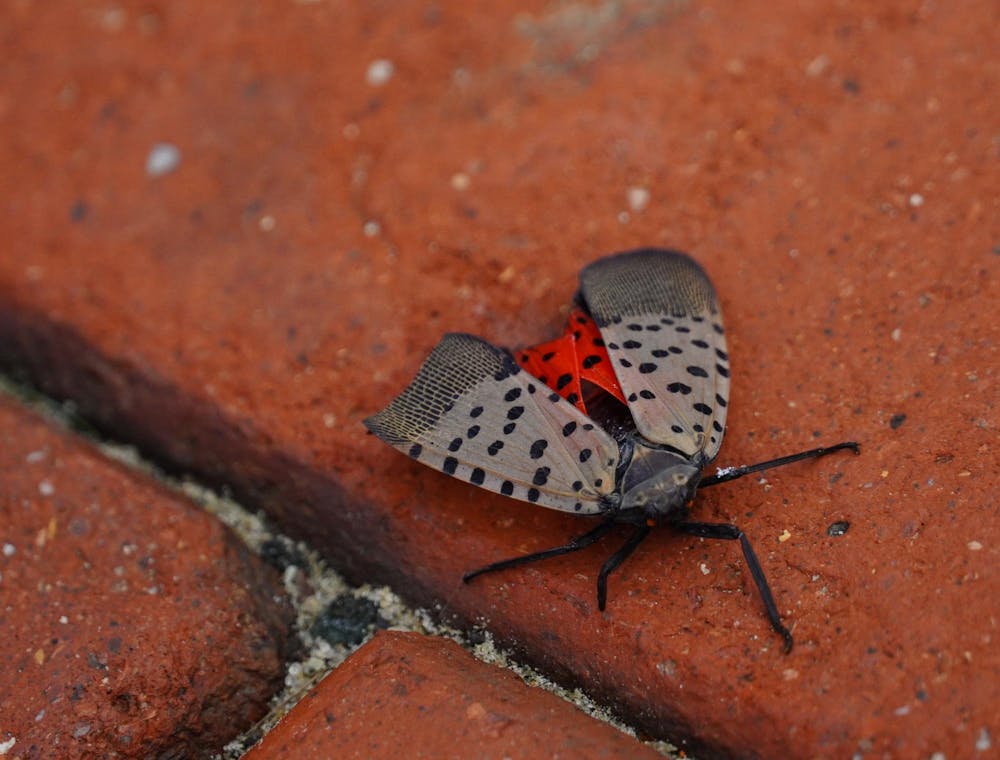
The spotted lanternfly, an invasive insect indigenous to parts of China, India and Vietnam, has now infested Providence County and several other areas in Rhode Island, according to the Rhode Island Department of Environmental Management.
The red-winged bugs were first spotted in R.I. in August 2021, but relatively warm temperatures last winter caused the population to rapidly grow this year, said Cynthia Kwolek, a senior environmental scientist at RIDEM. Local sightings have also spiked since June, she added.
According to RIDEM’s sighting map, Providence has reported the most spotted lanternfly sightings across the state.
These bugs often spread through high-movement areas like bus stations, rails and highways, Kwolek told The Herald. Because of this, they are more commonly found in urban areas, she added.
Spotted lanternflies pose a “relatively high” threat to agricultural production, Dov Sax, a professor of environment and society and ecology, evolution and organismal biology, wrote in an email to The Herald.
This is because spotted lanternflies feed off sap from young trees and vines, which may harm or kill plants, Kwolek said. They also excrete a waste product called honeydew, which can cause mold infestations.
Spotted lanternflies also pose a major threat to vineyards and pick-your-own fruit farms throughout the state. Recently, farmers have had to apply more pesticides and put nets over trees to combat the dire threat, Kwolek added.
But these insects are not expected to harm timber production. According to Robert Verrier, the president of Rhode Island Wood Operators’ Organization, spotted lanternflies rarely affect the large and healthy trees best for timber production.
Kwolek anticipates that the state will never be free of spotted lanternflies again, but emphasized that RIDEM has hope for biological control methods that could reduce the current need for pesticides. Local predators may also adapt to control the population, she added.
RIDEM currently works with partners in 20 other states to prevent the spread of invasive species, said Tee Jay Boudreau, RIDEM’s deputy chief and state forester. The U.S. Department of Agriculture is also running trials to use parasitic wasps, the spotted lanternfly’s native predator, to control the population. Unlike yellowjackets, these wasps would not string or bother humans, Kwolek said.
The department’s current goal is to contain the insects in the cities, where they can do less harm. “We’re just trying to do what we can to protect our agricultural areas at this point,” she said.

Talia is a metro section editor covering the health and environment and community and culture beats. She is a sophomore from Bethesda, MD studying history and international and public affairs. In her free time, she enjoys exploring Providence one wrong turn at a time.