
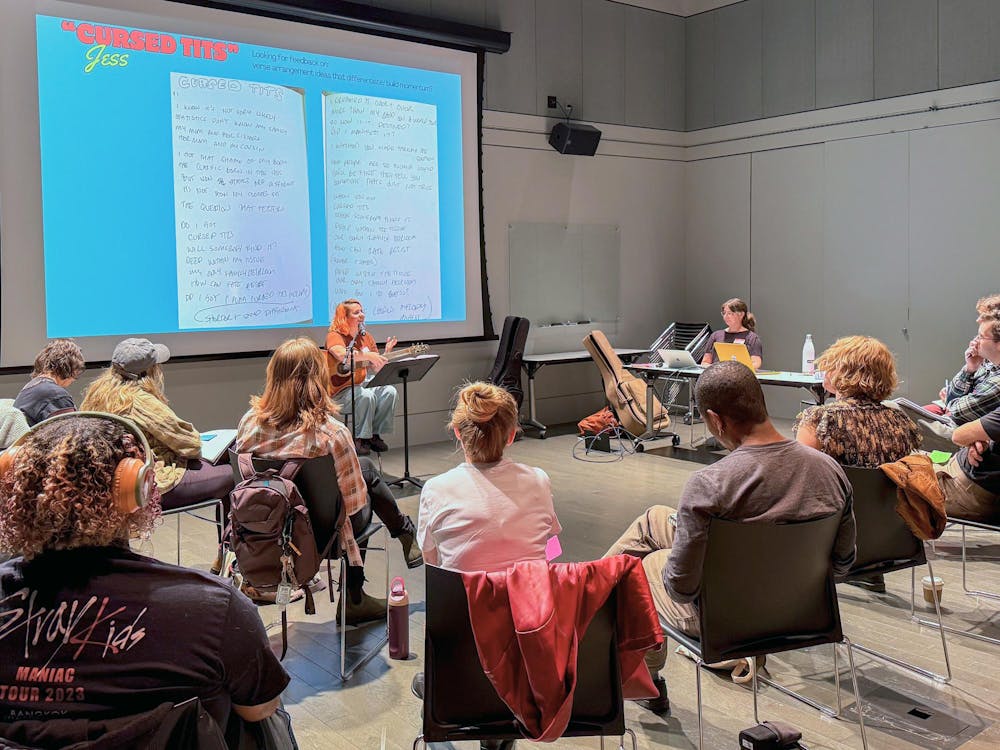
This fall, the Brown Arts Institute has added a new offering to its annual workshops — a Teaching Artists Studio where local residents and Brown community members can explore arts education on a weekly basis.
The Director’s Forum and Songwriting Workshop — which explore Providence’s performing arts and music scene, respectively — will both be returning to the BAI this fall.
“Each workshop has been developed in response to stated interests and needs from students and Providence community members,” wrote Sophia LaCava-Bohanan MA’15, the BAI’s associate director of partnerships and engagement, in an email to The Herald.
The Teaching Artists Studio aims to help participants at various experience levels build community and hone their arts teaching skills, explained LaCava-Bohanan, adding that the workshops “may lead to more confidence and ease working in K-12 environments in Providence and beyond.”
The new studio is facilitated by Nicole Simpson, director of fine and performing arts for the Providence Public School District. Simpson said the program grew from her observations that artists who come to teach at schools often lack pedagogical training.
Simpson added that the lab hopes to equip artists with the skills to “plan and execute their lesson the best they can the first time out.”
The first workshop brought together 16 participants — a group that ranged from Brown undergraduates to educators with several years of classroom experience.
Simpson emphasized that for participants, mindset matters more than experience. “I like folks who are flexible, who understand children don’t need to be grateful for an experience,” she said. Educators “need to be there for the right reasons and not expect anything in return from a child.”
For Simpson, the program also addresses the lack of arts exposure in under-resourced schools. “Exposure and connection and experience is how kids learn,” Simpson said.
For Morgan Johnston, co-facilitator of the Songwriting Workshop, the sessions are just as much about community as they are about craft.
“The more that community is built, the more participants are able to feel safe sharing songs,” Johnston wrote in an email to The Herald. “Community enables vulnerability, and vulnerability in turn strengthens that community.”
Participants in the Songwriting Workshop possess a wide range of musical backgrounds —while some are first-time lyricists, others are experienced musicians. Johnston described it as a space of exchange, where “a music or writing major at Brown may introduce techniques to a self-taught community member, while a community member may bring Brown students into the Providence music scene.”
Johnston called this exchange “nothing short of magical,” adding that experienced songwriters could give beginners advice about releasing their music, while new songwriters, in turn, could remind them of “why they started writing those same songs to begin with.”
Josh Short, founder and artistic director of the Wilbury Theatre Group, described the Director’s Forum as a flexible space, functioning almost like a “support group” for directors. In the theater world, directors are “expected to have all the answers all the time,” he said.
“I wanted this space to sort of acknowledge that it’s okay to not have all the answers all the time. It’s okay to ask for help when you’re not sure how to approach a particular scene,” Short added.
Last year, the Director’s Forum drew a mix of participants — Brown students, retired high school theater directors, intimacy coordinators and theatergoers, said Short. He added that this variety is one of the program’s strengths, since each participant brings “their own lens” to the group.
This type of dynamic is exactly why the BAI has prioritized opening its workshops to both Brown affiliates and local artists.
“The inclusion of students, staff, faculty and (Providence) creatives allows for an incredible mix of experiences and expertise,” LaCava-Bohanan wrote. “Everyone enters the space on equal ground, both an expert and a student in their own ways.”
Simpson noted that the Teaching Artists Studio could deepen ties between Providence schools and the city’s creative ecosystem. “Selfishly, I hope that more teaching artists are interested in coming into Providence Public Schools and sharing their talents,” she said.
LaCava-Bohanan added that the workshops fit squarely within the BAI’s broader mission of fostering collaboration and exploration.
“Artists have played strong roles in shaping Providence and Rhode Island for decades,” she wrote, adding that the workshops “catalyze” that relationship.
The stakes of arts education in schools feel especially high amid rapid technological change, Simpson said.
“We love when people know how to have empathy and be vulnerable and share their experiences in a respectful, professional way,” she added. “These are the skills that the arts teach, and they’re more important now than ever.”


