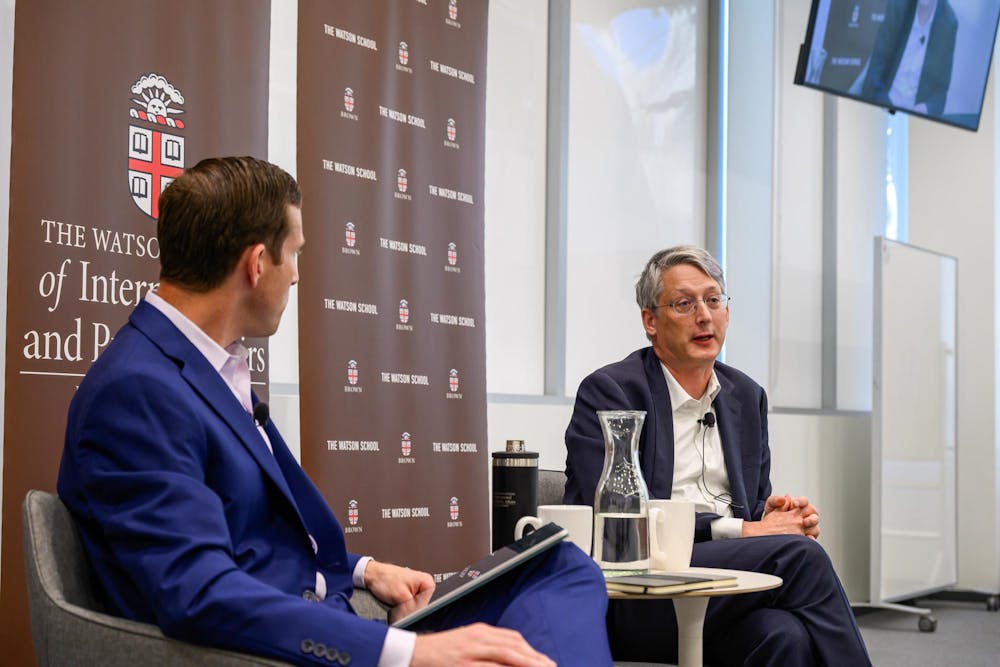
On Tuesday, the Watson School of International and Public Affairs hosted a conversation between former Under Secretary of Education James Kvaal and Dean of the Watson School John Friedman. The discussion encompassed the future of higher education, the Department of Education’s successes and failures, the Trump administration and rising tuition costs.
As a leader in the Department of Education under former President Joe Biden, Kvaal helped lead efforts to forgive student loans and rework the Free Application for Federal Student Aid. Prior to that, he served three years as deputy director of domestic policy under then-President Barack Obama.
The Trump administration’s attacks on higher education dominated the conversation. Beyond needing “to do a better job of articulating what’s at stake when these institutions are attacked,” Kvaal said that schools should reflect on why “the right-wing populist critique of universities seems to resonate more broadly.”
Kvaal also discussed the Trump administration’s dismantling of the Department of Education, saying that the administration’s tactics have not effectively increased the efficiency of the department.
President Trump first signed an executive order aiming to dismantle the Department of Education in March. By July, the Supreme Court overruled a federal judge who ordered the administration halt its efforts to break up the department.
Kvaal added that it seemed disingenuous that much of the administration’s cuts have centered on postsecondary financial aid, while most conservative critiques of the department focus on the federal government’s role in K-12 education.
He also admitted that the department under his leadership was not perfect. He acknowledged that the rollout of the reworked FAFSA form in 2024 was “extremely frustrating for students, families and college administrators.” Despite the budgetary and organizational challenges in the rollout, he said that the federal student aid program had a greater number of people enrolled and receiving aid compared to 2023.
As for the future of the department after the Trump administration, Kvaal said that “the answer is not to tape together what we had before.”
He added that more federal investment needs to be made in colleges and universities, despite increases in tuition that have outpaced inflation. When pressed by attendees about such increases, Kvaal said that only a small minority of institutions charge high tuition prices, and that these prices are driven by student demand and competition for talented faculty.
Not all attendees were satisfied with Kvaal’s answers. William Feng MD’82, a retired cardiothoracic surgeon, believed the conversation was “missing something.” He said that allowing supply and demand to drive tuition prices “disregards complexity and human values.”
Susan Peterson, a retired Providence resident with a Ph.D., had recently completed a master’s degree at the University of Liverpool, where she paid $9,000 per year for tuition. She said that if the United Kingdom “can subsidize higher ed like that, why can’t we?”
Talia Sherman ’26, a concentrator in linguistics and English, said her takeaway from the discussion was that “the Democrats are failing.”
Some attendees, like Emily Walshin GS, a student in the Watson School’s master’s in public affairs program, were more positive. She said Kvaal made her think about how investment in education can be “reimagined” to be more accessible to those in need.
During the discussion, Kvaal was also optimistic about the future of higher education, emphasizing that they teach critical thinking and learning skills that “propel people to the upper rungs of our society.”
“Our lead institutions are still worth it,” he added.