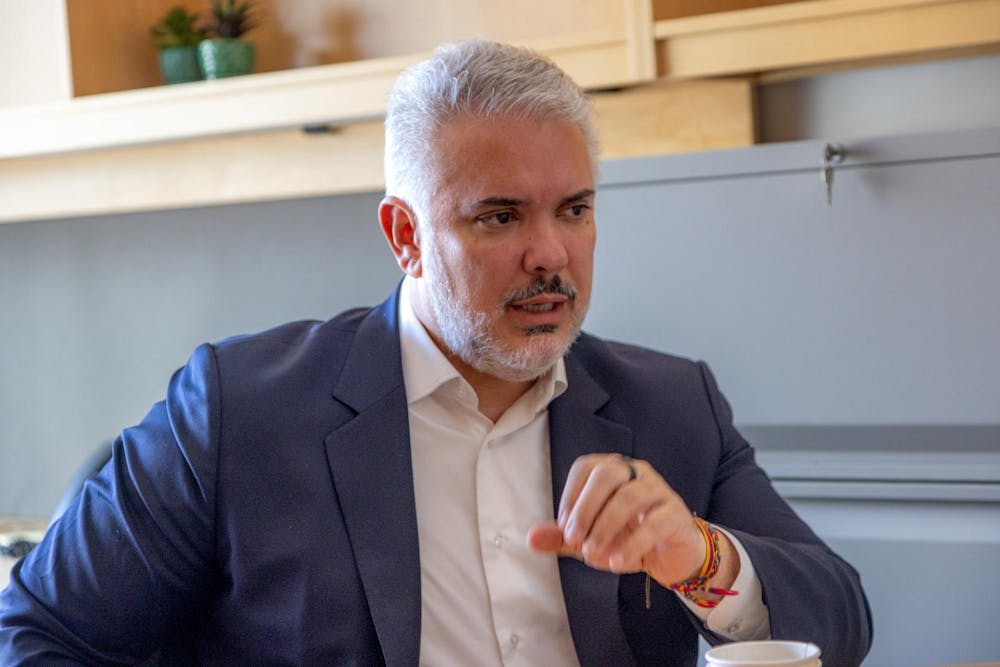
Former President of Colombia Iván Duque spoke about immigration and U.S. intervention in Venezuela at a Thursday event hosted by the Watson School of International and Public Affairs.
Duque, the youngest elected president in recent Colombian history, has been a proponent of strengthening diplomatic ties between the United States and Colombia and has criticized left-wing approaches to Colombian governance.
Duque sat down for an interview with The Herald before his talk, which was titled “Colombia, the US and the Future of Latin America: An Evening with President Iván Duque.”
A ‘moral necessity’: U.S. intervention in Venezuela
As Duque sees it, the arrest of Venezuelan President Nicolás Maduro by American forces in early January was a “moral necessity.” In his talk, he called the operation a “humanitarian intervention” — similar to the arrest of former Serbian President Slobodan Milošević at the turn of the 21st century and the tactical assassination of terrorist Osama bin Laden in 2011.
“It’s the triumph of good against the most evil and cruel dictatorship that we had in Latin America,” Duque told The Herald.
At the talk, Duque praised the United States for a militarily “perfect operation” to “put an end to a genocide,” claiming that Maduro has killed and tortured many Venezuelan citizens.
Some American politicians and Venezuelan opposition leaders have lodged claims of genocide against Maduro. In recent years, the United Nations has found that high-level Venezuelan leaders have committed crimes against humanity.
Duque claimed in an interview with The Herald that the intervention in Venezuela was “lawful,” citing indictments against Maduro in the United States. Maduro was indicted by the United States Department of Justice with charges including narco-terrorism and drug trafficking.
But much work still needs to be done to stabilize Venezuela before the end of 2026, Duque said at the event.
“2026 should end with at least a new call for free and fair elections in Venezuela,” Duque said at the talk. He also called for a “re-engineering of the Venezuelan army.”
Duque also said that Venezuela’s acting President Delcy Rodríguez, who served as Maduro’s vice president, “doesn’t have any legitimacy.”
“The recovery and the transition to democracy cannot be led by Delcy Rodríguez because she symbolizes the worst of the corruption and brutality of the regime,” he told The Herald.
The Venezuelan government did not immediately respond to a request for comment.
‘Boundaries are established in the law’: Immigration, refugees and deportations
Under Duque’s administration in 2021, Colombia granted temporary protection to Venezuelan refugees, allowing the refugees to live, work and access social services in Colombia for up to 10 years.
According to Duque, he was inspired to implement this initiative because the United States took similar measures after Hurricane Mitch hit Central America in 1998, Duque told The Herald.
Duque believes that the United States is acting lawfully with its recent mass deportations of migrants lacking permanent legal status.
“The boundaries are established in the law,” he told The Herald. “I think that also proves the necessity for the U.S. to return to the idea of having a bipartisan, comprehensive migration bill.”
This bill should have a “clear route” to citizenship for people already in the United States and “temporary visas” for certain classes of workers, but it also must have “mechanisms to prevent the influx of non-legal migrants,” he added.
Duque also criticized his successor, President Gustavo Petro, for what he saw as a “reckless” clash with President Trump over the deportation of Colombian nationals early last year.
Duque said that Petro’s argument with Trump was “hypocritical,” pointing to the large numbers of Colombian migrants who were deported under former President Joe Biden in 2024.
“He put in danger a bipartisan and bicameral, 200-year lasting relationship between Colombia and the U.S.,” Duque said.
The White House did not immediately respond to a request for comment.
‘The most damaging drug in the world’: Narcotrafficking
Duque also criticized Petro for policies countering narcotrafficking and terrorism that Duque suggested are too lenient.
“People don’t understand that the most damaging drug in the world against the Amazonic landscape, against the tropical forest landscape, is cocaine,” Duque said at the event, citing the environmental ramifications of the drug’s production.
Duque added that the Colombian government does not bear sole responsibility for mitigating the drug crisis. In his view, the United States should also work to develop policies to combat cocaine consumption.
Duque also said that he was not against the U.S. strikes on fishing boats in the Caribbean that were allegedly linked to drug trafficking, adding that the strikes are “now producing results” and have decreased drug trafficking along those routes. Some of these strikes have killed Colombian nationals.
‘More intense and coordinated relationship’: Future of Colombian politics and U.S. relations
Looking to the future, Duque said that he hopes that the next president of Colombia will further support and grow the country’s relationship with the United States.
“A more intense and coordinated relationship with the U.S. will improve Colombia’s security in the fight against narcoterrorism, will mobilize more investment and will also have — in trade — an element that creates constant and permanent opportunities for many Colombians in the rural areas,” Duque told The Herald.
Duque did not have a specific candidate that he supported, but he said that the next president needs to address the “time bombs” that he claimed Petro is leaving behind.
“He destroyed the health care system, he destroyed the energy system, he destroyed the fiscal system,” Duque said in an interview with The Herald, claiming that Petro has increased the country’s debt and weakened its security and international relations.
At the event, Duque said that he appreciates the one-term limit for the presidency of Colombia because it allowed him to sometimes make unpopular decisions — for example, his implementation of the Temporary Protected Status program for Venezuelan migrants and his decision to try to expand the income tax base — a move that sparked protests across the nation.
“The biggest satisfaction that I have when I look to the people, when I go to bed, when I look at my children, is that I am certain that in every single policy decision that I had to make,” Duque said, it was for “the benefit and the interest of the Colombian people.”

Ian Ritter is a university news and science & research editor, covering graduate schools and students. He is a junior concentrating in chemistry. When he isn’t at The Herald or exploding lab experiments, you can find him playing the clarinet or watching the Mets.