
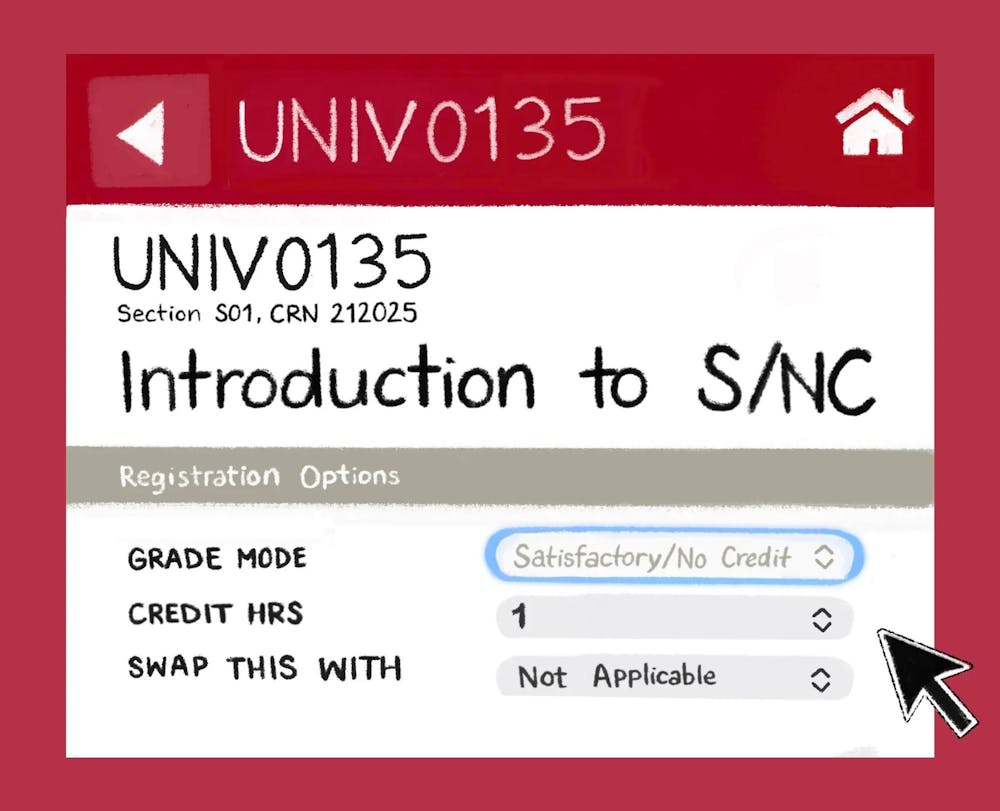
As students finish their first midterms of the semester, some exams and papers carry more weight than others. For students taking a course Satisfactory/No Credit — which converts a typical letter grading system to pass/fail — big assignments this semester might not seem as daunting.
While students are often hesitant to take courses S/NC, administrators say that doing so typically has little effect on their career outcomes, although it may not be recommended for certain graduate programs.
The S/NC grading option, which was implemented along with the Open Curriculum in 1969, promotes “educational exploration and risk-taking,” wrote Gilda Mossadegh, deputy dean of the College for academic advising, in an email to The Herald.
“The hope is that our students are prioritizing learning the course material over actual grades and the underlying pressure that they may feel to always earn an A,” she wrote.
In the 2023-24 academic year, 63% of students received As. The share of A grades given has largely increased since 2007, The Herald previously reported.
Matthew Donato, executive director of the Center for Career Exploration and an associate dean of the College, said it seems like students feel they should take a class S/NC if they don't think they will receive an A.
He added that he discourages students from taking a class S/NC if they think “it will be easier or save them time.”
“That probably means you’re not learning as deeply as you could, and it might mean that you know it’s not a course you should take in the first place,” Donato said.
As first-year students consider the merits of taking a class S/NC, they often turn to their Meiklejohn peer advisors for advice. Camila Murillo ’26, a Meiklejohn peer advisor, said she typically advises students based on their individual goals and expectations for the semester.
Electing to take a course S/NC “takes the pressure off” and allows students to enjoy “the process of a class,” she said.
As a general rule, Murillo recommends that her advisees take concentration requirements for a grade. She said this can look better on resumes and that the pressure of letter grades can simulate a better work environment.
“If you’re studying something that you’re probably going to work on later, it's better to take it for a grade and decide if it’s something that you like or not right away,” Murillo said.
When Sena Williams ’29 was deciding whether to take a class S/NC, she turned to her Meiklejohn for advice. Although the course — POLS 0400: “Introduction to International Politics” — is a requirement for a concentration she’s considering, Williams ultimately made the decision to take it pass/fail because of its difficulty.
“Even before I decided to S/NC, obviously I was trying as hard as I could,” she said, adding that she only decided to change her grade option when she “realized maybe ‘as hard as I can’ will still not be enough to get a good grade.”
While Williams puts in the same amount and quality of work as she would if she were taking the class for a grade, the decision has helped relieve her stress.
Tessa Gumberg ’29 is taking the same class for a grade. When she started at Brown, she told herself she wouldn’t take any classes in her concentration S/NC. Gumberg, who is on the pre-law track, said she is worried about how S/NC may affect how law schools look at her transcript.
“I don’t know if that’s going to look particularly good for law school,” she said. “So that’s maybe why I’m being a little bit more conservative with my use.”
Mossadegh said students applying to graduate school may be required to earn a letter grade in specific classes. Medical schools, for one, place importance on students taking pre-requisites for a grade, according to Donato.
But Donato added that while students often think they should avoid taking classes S/NC because it could “look bad” to graduate programs or employers, that is usually not the case.
Taking a class S/NC can still contribute to a student’s eligibility for Phi Beta Kappa, an academic honors organization that recognizes the top 12% of students in any graduating class who fulfill certain chapter requirements. Mossadegh said course instructors can award students an “S with distinction” — a grade equivalent to an A for students taking the course S/NC — which would count toward eligibility requirements for Phi Beta Kappa and College honors at graduation.
“I don’t think it affects your preparation at all, as long as you are learning in your courses,” Donato said.
Clarification: This article has been updated to better reflect how Matthew Donato has seen students think about S/NC.
Rachel Wicker is a senior staff writer covering affinity and identity. She is from Athens, Georgia and plans on concentrating in English on the nonfiction track and International and Public Affairs. Outside of writing, she enjoys reading books of any genre and doing yoga.


