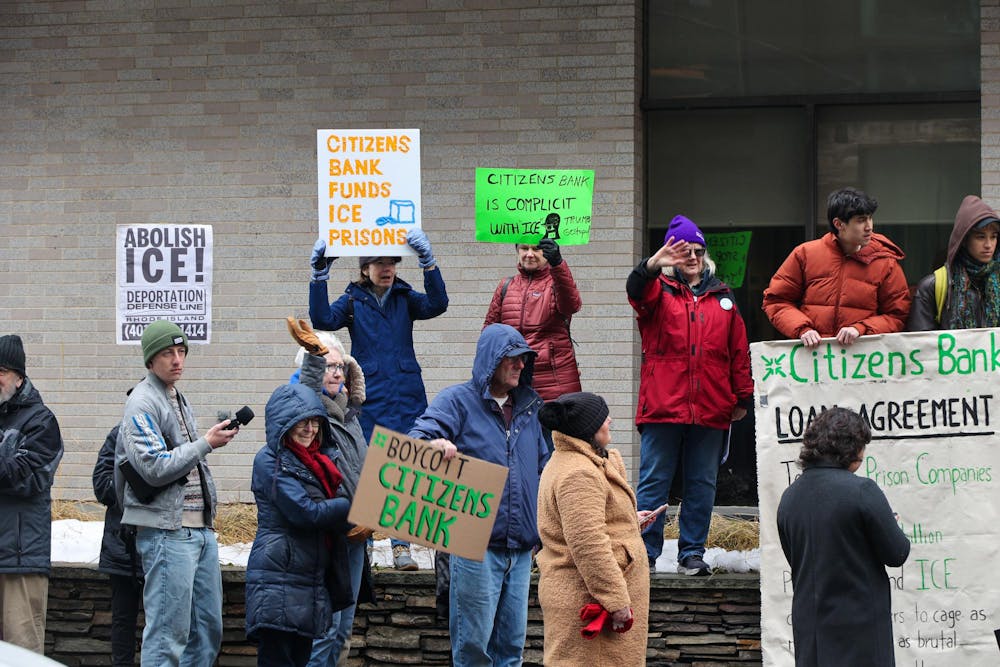
On Saturday morning, approximately 50 community members gathered in front of Citizens Bank on Waterman Street to protest the company’s alleged financial ties with the two largest private prison organizations in the United States, CoreCivic and the GEO Group.
For years, the two companies have helped operate the U.S. Immigration and Customs Enforcement detention centers.
The rally was organized by Brown Rise Up, De-ICE Citizens Bank Coalition and a collection of local activist groups. There were 64 coordinated protests planned across the northeast, according to a press release from Brown Rise Up.
“ICE doesn’t operate in isolation,” Brown Rise Up member and Herald opinions contributor Raya Gupta ’29 said to the crowd on Saturday. “These private prison companies that Citizens Bank finances are key parts of the deportation industry.”
In an email to The Herald, representatives of Citizens Bank declined to comment on the bank’s alleged ties to the two organizations.
Many organizers and protesters noted that because Citizens Bank is headquartered in Rhode Island and has fifty branches throughout the state, local activists’ demands have a stronger potential for success.
“It means that we can have a lot of visibility and we can target it straight at the decision makers,” said Karen Rosenberg, a member of the Rhode Island Resistance Coalition who attended the rally. “They should feel some awareness of how the community feels about hosting them as a corporation in our state.”
Peyton Fleming, a spokesperson at the De-ICE Citizens Bank Coalition wrote in an email to The Herald that “Citizens Bank says it is dedicated to fostering strong communities and social responsibility, but its long-standing support to prison companies and ICE detention centers is exactly the opposite.”
“We need to hold the bank accountable,” Fleming added.
The Rhode Island De-ICE coalition held its first protest in January at a Citizens Bank branch in Cranston, R.I, wrote Kristen Lancaster, a member of the Lil’ Rhody Visibility Brigade, one of the activist organizations in the coalition. On Saturday, the group protested the bank at four of its Rhode Island locations, including in Providence, Narragansett, Wakefield and Westerly, Lancaster added.
Michaela Keegan, an organizer with Indivisible Metro Rhode Island, grew up in Rhode Island. Opening a bank account at Citizens Bank as a 16-year-old “felt like the Rhode Island rite of passage,” she said at the protest.
“Citizens Bank was a staple in our communities, a place families trusted,” Keegan told the crowd. “But let me be clear about something: a Rhode Island staple does not fund ICE terrorism.”
Keegan urged the rallygoers to take action against the bank by writing letters, sending emails, calling corporate headquarters, posting on social media and starting petitions. As a last resort, she encouraged account holders to transfer their money to another bank. “Our money should never be used to put human beings in cages,” she said.
Jeneane Lunn, an organizer of Cranston Forward, another local activist group, told the crowd that she recently closed her account at Citizens Bank, adding that although it was a “little thing,” it is “going to make a difference.”
“Money talks, and we’re talking now,” Lunn said. “And when money talks, banks listen.”
Eli Smith ’29, a spokesperson for Brown Rise Up, noted that ICE activity on college campuses has fueled the cause’s urgency as it has become “a matter of student safety.”
“The headquarters of Citizens Bank is about 10 minutes walk away from campus,” he said in an interview with The Herald. “Where we are located, right near the bank, we have a really strong voice.”
Multiple speakers said that past activism efforts have successfully forced companies to no longer finance the operations of private prisons.
Eight of “the country’s largest banks,” including JP Morgan, Chase and Co. and Barclays, cut ties with the private prison industry “in response to grassroots activists and shareholder pressure,” said Adelaide Dicken, an organizer with Jewish Voice for Peace Rhode Island, which is also part of the De-ICE Coalition.
“By organizing account holders to move their money and with all of us putting pressure on (Citizens Bank’s) leaders together, we can end their complicity in ICE violence,” Dicken added.
In his speech at the protest, Brown Rise Up co-president Levi Kim ’29 emphasized the power of the community coming together around a cause, citing January’s city-wide rally against ICE activity.
“We have the power to shut this down,” Kim said. “It is only through the power of the people that you can win.”

Zarina Hamilton is a university news editor covering activism and affinity & identity. She is sophomore from near Baltimore, Maryland and is studying mechanical engineering. In her free time, you can find her reading, journaling, or doing the NYT mini crossword.