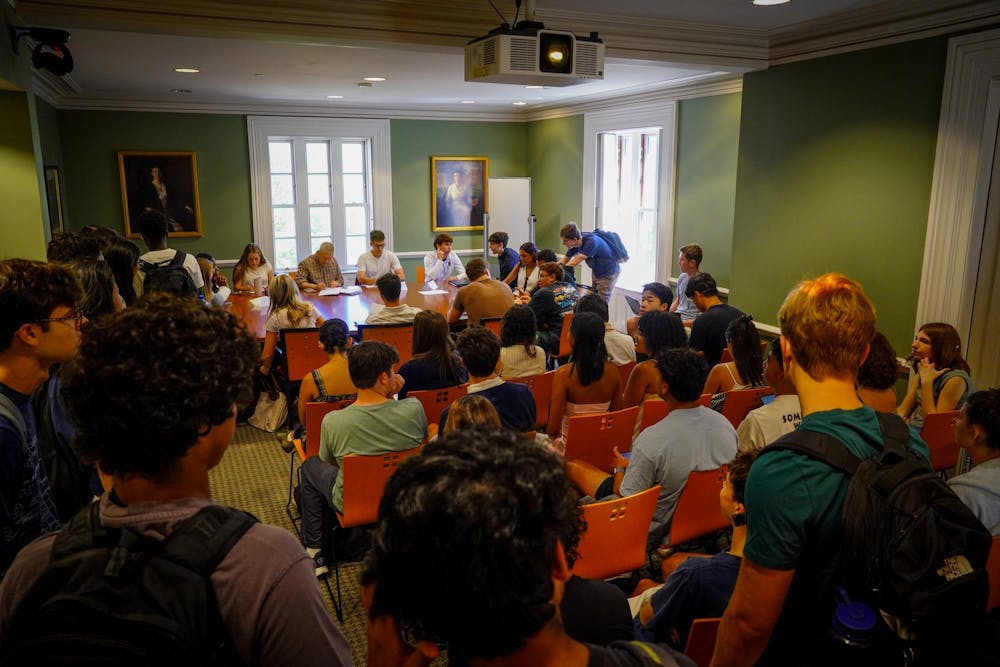
Every semester, students from all class years scramble to secure a seat in many of Brown’s smaller seminar courses. But there’s one course that stands out above all others — ENGL 0930: “Introduction to Creative Nonfiction.”
Of the students in the classes of 2022, 2023 and 2024, 764 Brunonians took the course during their time at Brown — making it the humanities course with the highest enrollment over that period.
The course aims to help students perfect creative nonfiction prose by exploring different styles of writing and honing their editing skills. Although it is offered by the Department of English, ENGL 0930 attracts students from a variety of academic backgrounds: 29% of those 764 students studied life sciences, 29% physical sciences and 32% social sciences. In fact, more computer science concentrators took the course than English concentrators.
For those three graduating classes, the course’s enrollment level was 48% higher than that of any other course in the English department — in part because the course offers so many sections, according to Robert Ward, assistant professor of the practice of English.
Ward is one of six professors currently teaching a section of the course. All six professors lead their section differently, he said. On some days, Ward’s class heads to the nature lab. On others, students engage in various writing exercises to isolate specific details of a story.
Ward has been teaching since he arrived at Brown in 2010. Since then, the course has changed “dramatically,” he said.
“The more I stayed here, the more I realized that students were open to different styles of teaching,” Ward said.
His syllabus opens with E.B. White’s quote stating that writing is “an act of faith.” This quote, Ward said, guides how he teaches his classes.
Assistant Teaching Professor of English Grace Talusan, who teaches another section of ENGL 0930, said she begins every class with 30 minutes of writing.
“It transitions us into the space of being writers,” Talusan said. She hopes that by taking the course, students will “cultivate a relationship with their own voice.”
Talusan starts each semester by asking her students how their family makes rice. In listening to their answers, she learns just as much as if she had asked students to describe their families outright, she said.
For her, the best part of the course is watching students transition from a “tentativeness on the page” to “writing in a voice that feels like” their own, she said.
Assistant Professor of the Practice of English Ed Hardy, who also teaches ENGL 0930, said one of his favorite elements of the course is the variety of the pieces that students submit.
Hardy’s version of the course features full-class workshops that largely take place towards the end of the semester.
“Everybody’s gonna be in a situation where you have to come up with something from nothing, and this is the kind of class that teaches you how to do it,” he said.
Hardy, Talusan and Ward all integrate community-building activities into their curriculum. But in their experience, students often bond because of the nature of the writing, they said.
“Everyone ends up knowing everyone in the class,” Ward said.
All three professors noted that most of their students are seniors, some of whom have tried repeatedly to get into the class throughout their time at Brown. Of the students currently taking the course, nearly 60% of them are seniors, according to Courses@Brown.
Hardy added that some students who take the course are preparing to write personal statements for medical school or law school.
For Ward, those enrolled in his course aren’t just there to learn — they’re there to teach, too.
Originally from Wales, Ward used the word “dysgu” to describe those enrolled in his section. In Welsh, the word means both student and teacher. In his class, he said, there is no difference between the two.

Hadley Carr is the senior editor of digital product and technology of The Herald's 136th Editorial Board.