
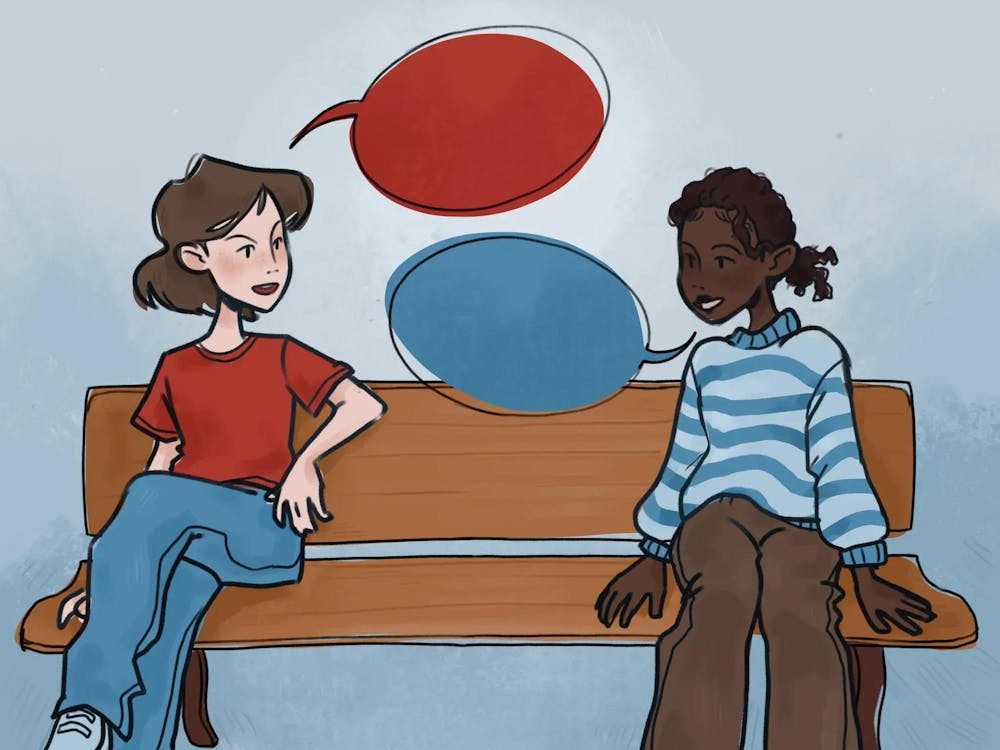
“Stranger, danger.”
Many of us were raised on this cautionary phrase rooted in sensationalist 80s media: Avoid anyone you don’t know, don’t make eye contact with random people on the street and definitely don’t smile or wave. Anxious parents, well-intentioned teachers and nearly all the adults in our lives embedded this idea into our young minds.
But for the first week of New Student Orientation at Brown, this norm felt like it was flipped upside down. Everyone talked to everyone. I remember being approached by students I’d never met before in the breakfast line at the Ratty, or getting texts from people I’d only known for a few hours asking to get lunch. The only pretext for these connections was that we were all first-year students and looking for new friends. The fact that most of us were entering the uncharted territory of college without our close friends and miles away from our families temporarily suspended our hesitancy to go up to strangers and strike up a conversation.
A month has passed, and in some ways, it already feels like many, including myself, have reverted back to our old patterns of behavior. Friend groups have begun to solidify, group chats have been made and there is a feeling of inflexibility that has come with settling into college. This is to be expected. The predictability of having a set group of friends with whom to eat meals and the same familiar faces to sit next to in class has eased the transition into college.
But should it be like this? Talking to strangers, though it can be scary, makes us happier. And we should continue to do so even if we are content with our social circles.
A recent study by researchers at University College London found that there is a correlation between higher “relational diversity” and increased happiness. Relational diversity refers to both the richness — the number and variety of people you interact with in a given day — and the evenness — the breakdown of how much time you spend in each type of interaction — of our relationships. Well-being is improved when we interact in a wide variety of social settings and when we divide our time evenly among them.
We also underestimate the importance of what psychologists call “minimal social interactions.” They are the types of conversations we have with a stranger on an airplane or with the barista at Starbucks. They may seem fleeting and unimportant, but much evidence suggests these small interactions make their participants generally feel more positive about their commutes, coffee-ordering and other social experiences.
Talking to new people isn’t easy. Even once we overcome social anxiety and the fear of saying the wrong thing, modern life has been constructed to keep us from interacting with new people. We can order all of our products online and get our food delivered directly to our door. Even just a few years ago, this wasn’t the case — when people were bored in line, they may have looked around, sat with their thoughts for a minute or two and maybe even started talking to the person next to them. Now, we put our heads down, put our AirPods in and scroll on our phones. We receive a cheap replica of connection through words or images on a screen that don’t compare to real social interaction. In this way, we close ourselves off to the potential benefits of starting up unexpected conversations with strangers.
At Brown, we are uniquely positioned to maximize our relational diversity. Brown’s campus facilitates interactions with strangers. Take a stroll around the Main Green and you’ll see that it is the best place to run into someone or sit with a new group of faces, while big communal tables in our dining halls are engineered to force students to grab a meal with an array of strangers.
We should all continue to introduce ourselves to that random person and say hi to someone just because they seem cool. Sit next to someone new in class, go to a club meeting you haven’t been to before and visit your professor’s office hours — especially in a big lecture class. It’s time we stop thinking of strangers as “dangers” and start viewing them as potential friends.
Max Mooney ’29 can be reached at max_mooney@brown.edu. Please send responses to this column to letters@browndailyherald.com and other opinions to opinions@browndailyherald.com.


