
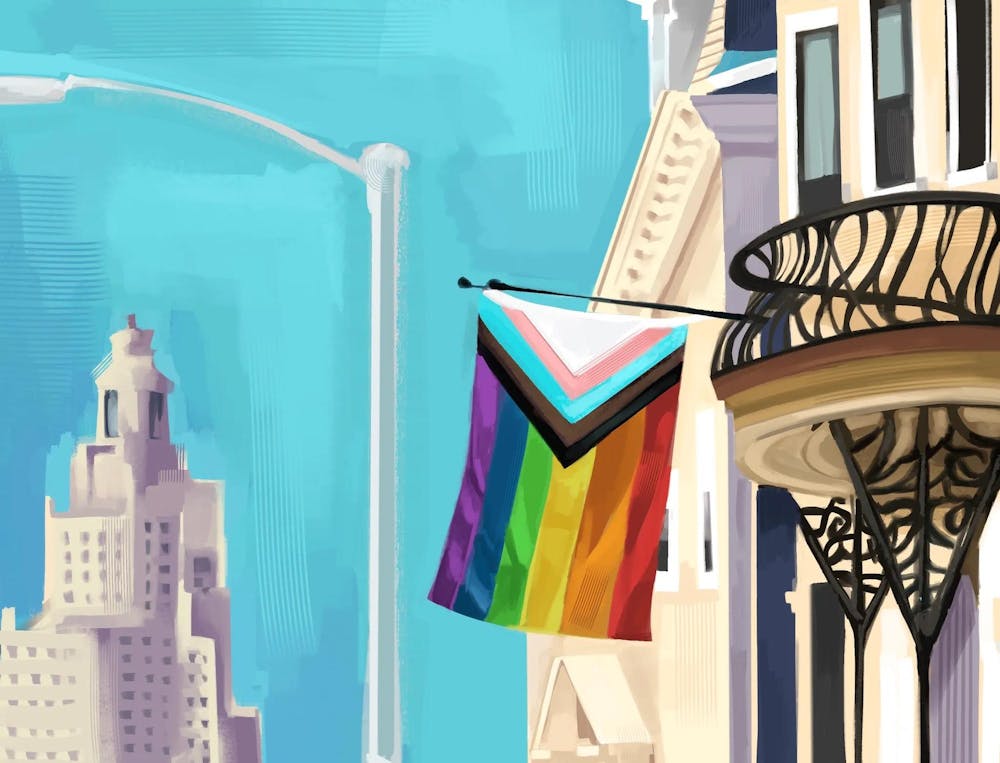
Since I first set foot on College Hill, I’ve relished the gayness of Brown’s campus. In stark contrast to my rural high school, nearly 40% of Brown’s undergraduate student body doesn’t identify as straight — more than four times the national average. Although being at Brown does not completely shield gay students from the harsh realities of homophobia, gayness is uniquely normalized on our campus.
But allowing ourselves to get too comfortable in an environment like Brown risks disarming and fracturing the LGBTQ+ community at a critical moment in American and global politics. In the current political climate, conversations about the rights of genderqueer youth are commonplace, but the pendulum of public opinion could easily swing against gay people once again — in fact, it has already begun.
Even in an age where being gay at Brown doesn’t feel like it has to define our college experience, gay men have a responsibility to construct queer alliances rooted in our identity — not only because relying on our current social clout and acceptance is a precarious foundation for our own political protections, but because we owe it to the rest of the LGBTQ+ community.
When being gay is not a big deal, it is much easier to let yourself forget about it completely. There’s a very rational temptation to let our sexuality become a very small part of our lives — in essence, you can shed the collective queer identity.
In some ways, this is a good sign — there is less of a common enemy to unite against in a fight for basic rights. But in the current political landscape, no gay Americans should feel so secure in their social and political standings. Not only have groups organized to overturn the landmark Obergefell v. Hodges decision, but a general resurgence in conservative social conventions is sweeping across younger generations. Gen Z support for gay and lesbian marriage dropped more than 10 points between 2021 and 2023, lowering youth support below millennials and practically on par with Gen X.
But beyond the threats these social swings pose to us, gay people have an obligation to the rest of the queer community. Being able to simply exist as someone who happens to be gay is a privilege that cannot go unwasted. The fight for gay liberation began with the uprising of all different types of queer people. The Stonewall Inn — the iconic site of the Stonewall Riots which marked the beginning of the gay liberation movement — didn’t limit its membership to certain queer identities. It offered refuge to all who needed it. For gay men to use our newfound social standing to leave others behind is not only impractical, but a betrayal of those who have supported us the most throughout the last half-century.
The fragmentation of the LGBTQ+ community is not a natural divergence, but an intentional political ploy that demonstrates a global shift toward right-wing sociopolitical agendas. Alice Weidel, the most prominent member of Germany’s far-right party, has continuously downplayed her own lesbian marriage to fit her party’s anti-gay agenda. In the U.S., organizations like Gays Against Groomers intentionally pit gay people against trans members of our community, encouraging us to reject gay “propaganda” and restrict pride to adults.
These political stunts — like many efforts of the extreme right — rely on ignorance to succeed. A five-minute deep dive into the 20th-century gay rights movement would show how the culture and freedom of gay and trans people can never be disjoined. Below the current successes of the gay community, there is a foundation of a queer movement based in communal struggle — a movement that preached radical acceptance for all who were rejected by society.
Without recognizing historical and cultural context, we forget our long history of unity and lose the ability to collectively protect ourselves from threats to our freedoms. We can honor our roots by consuming media from the era of gay liberation, which is not only artistically profound but a crash course in resistance. “Paris Is Burning,” a documentary that follows the origins of ballroom culture in New York City, shows us where terms like “realness,” “shade” and “voguing” come from: an urban subculture that was built to guard its members from racism and homophobia. It is fun to watch “RuPaul’s Drag Race,” but nothing can supplement the history from which queer culture originated.
The community we build doesn’t have to be based in collective fear. Drag and other forms of queer art were born out of a desolate political reality, but LGBTQ+ artists found strength in hosting events that were fun and joyful. We can build this kind of unity on and off campus: attending info sessions and art exhibitions, volunteering at the countless Providence-based nonprofits aimed at queer activism or even just discussing identity and culture with our peers. Implementing lessons from our forebearers allows political awareness to persist without pessimism.
We can’t ignore the genuine political challenges that demand strategic action — there are tough conversations that are needed now more than ever. But the question can’t be if we support each other, but how we can. This isn’t an easy question to answer, but it is easy to love one another regardless. Pragmatism is essential, but it’s less effective without a basis of unconditional camaraderie, no matter who is cool or politically advantageous.
If nothing changes, the queer community will have no meaningful defense against oppression because we will not have each other.
CJ Lair ’28 can be reached at craig_lair@brown.edu. Please send responses to this column to letters@browndailyherald.com and other opinions to opinions@browndailyherald.com.

CJ Lair is an opinions editor at The Brown Daily Herald. He is from Gettysburg, Pennsylvania and plans to study Political Science at Brown. This is his second year writing for a publication, and is especially interested in political developments and their impacts on the Brown community.


