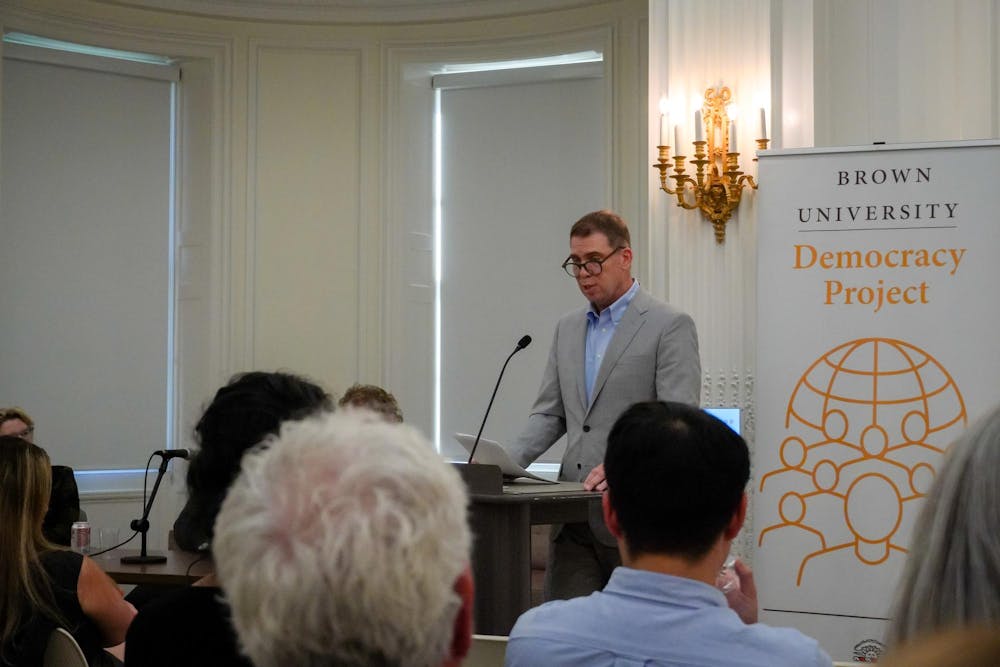
At an event titled “Academic Freedom: What Remains?” hosted by Brown’s Democracy Project on Friday, four panelists discussed the current state of academic freedom at U.S. universities as they face threats from the federal government, administrators, donors and board members. They also discussed the role academic freedom plays in protecting democracy.
The Democracy Project — an initiative hosted by the Brown Center for Philosophy, Politics and Economics — was launched in 2022 to promote the study of democratic values, norms and practices.
According to Juliet Hooker, professor of social sciences and co-director of the Democracy Project, one of the main goals of the project is to “interrogate the politics and conditions of equality in democratic settings” by creating “collective spaces of reflection and action where we can have important conversations as a campus community,” she wrote in an email to The Herald.
The Democracy Project chose academic freedom as the focus of its latest panel because it “plays a key role in ensuring that universities remain independent pillars of civil society that foster critical thinking and civic skills central to democracy.” The topic is especially relevant in light of recent national debates surrounding free speech and academic freedom, Hooker wrote.
The panel consisted of academic freedom experts from beyond College Hill in addition to faculty members and administrators from the University to offer a diverse array of perspectives.
At the event, Isaac Kamola, professor of political science at Trinity College, said he believes that U.S. higher education is facing an existential threat.
Drawing on his experience as director of the Center for the Defense of Academic Freedom for the American Association of University Professors, he characterized academic freedom as “the oxygen that makes it possible for our work to exist.”
According to Kamola, threats to academic freedom are coming from every direction — online trolls, right-wing governments, foreign governments, donors and more.
“We are living through a multi-decade moral panic that’s been manufactured against higher education,” he said.
Jacob Levy, a professor of political theory at McGill University, acknowledged that academic freedom has not been completely eroded. Professors can still dictate their own syllabi and academic departments can make their own decisions, he said.
The ability of universities to “live under academic freedom is a matter of robust rules,” Levy said.
But he believes that, since the start of this year, there has been a growing skepticism about the government’s willingness to uphold and abide by these freedoms.
Levy called the current crisis against academic freedom and higher education “genuinely terrible,” and hopes that “if we make it through somehow to the other side, that we will do better,” he said.
Amanda Anderson, professor of English and humanities and director of the Cogut Institute for the Humanities, focused primarily on the “Compact for Academic Excellence in Higher Education” that the Trump administration sent Brown on Oct. 1.
If signed, the University would receive benefits including “substantial and meaningful federal grants” in return for complying with a list of demands. The demands include limiting grade inflation, capping international undergraduate enrollment and requiring applicants to take standardized tests, among others.
“This letter contains demands that are a direct attack on University autonomy and academic freedom,” Anderson said at the event. She believes the demands are not something the federal government should be exerting control over.
Matthew Guterl, vice president for diversity and inclusion and a professor of Africana studies and American studies, gave examples of attacks on academic freedom from his experiences as professor of American studies at Indiana University Bloomington.
Guterl pointed to the story of Dunn Meadow, a 20-acre green space located within IU’s campus, and the protests that took place there, which led university administration to restrict access to the once-open area.
He also discussed the elimination of degrees, specifically the African American and African Diaspora Studies program at IU, as an example of “how academic freedom died and was buried at one of the country’s greatest flagship public universities.”
Shan He, a RISD sophomore, attended the event because they believe that it is a “rather existential stage of time for academic freedom.” He was there to understand the beliefs and critiques the panelists had on academic freedom.
He thought the event was “very provocative,” as the speakers contributed diverse opinions and rhetorical styles. Regarding academic freedom, He believes “the intellectuals have been speaking too much and doing too little,” while “the activists have been doing too much and speaking or thinking too little.”
Hooker hopes that attendees gained “a better understanding of what academic freedom is and why it is a vital principle for us all to defend.”
“Just as a free press is vital to democracy, so too is the independence of universities to pursue knowledge free of state interference,” she added.

Roma Shah is a section editor covering University Hall & Higher Education and Admissions & Financial Aid. She's a sophomore from Morgan Hill, CA studying neuroscience. In her free time, she can be found doing puzzles, hiking or curled up with a book.