
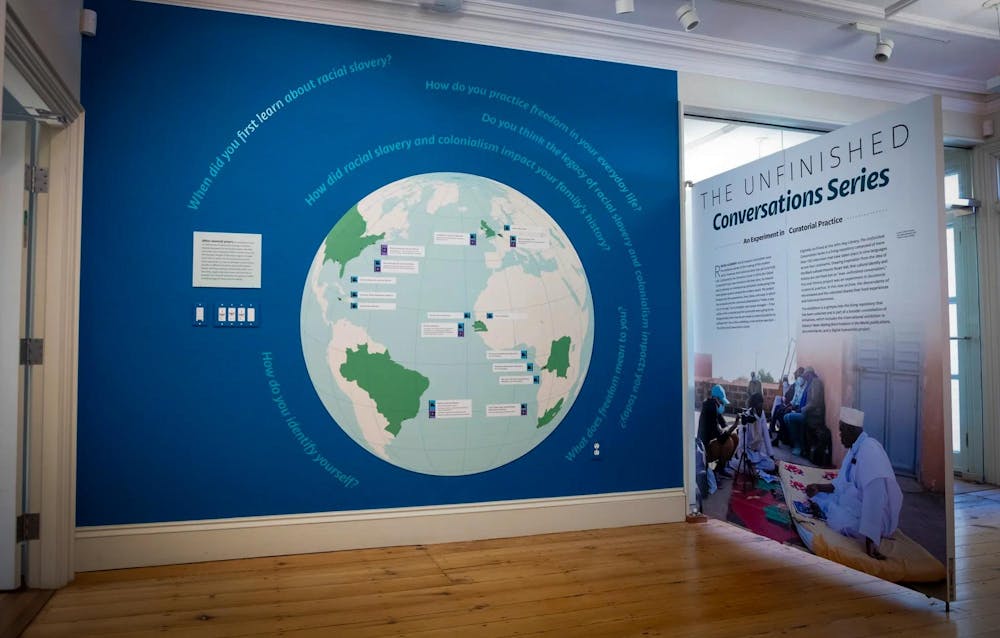
On May 23, the “Unfinished Conversation Series” exhibit opened in the Ruth J. Simmons Center for the Study of Slavery and Justice. The exhibition, which will remain on display until Dec. 12, uses recordings of interviews from descendents of those who were enslaved and colonized to piece together the modern legacy of European colonialism and the experiences of those who suffered under it.
The physical exhibition is only a microcosm of the full “Unfinished Conversation Series” project, which includes a digitally archived collection at the John Hay Library. The project contains over 150 interviews in more than nine languages recorded across eight different countries, each providing a unique perspective on how slavery and colonialism shaped the lives of the interviewees and their ancestors.
The physical exhibit brings attention to this larger archive, focusing on the common threads between the collection stories, said Yannick Etoundi GS, the exhibit’s lead contributor and a fifth-year PhD student in the Department of History of Art and Architecture.
The Global Curatorial Project — a collection of partners and institutions brought together through the Simmons Center — was the primary organizer of the “Unfinished Conversation Series” archives, according to the exhibition catalog. The digital archive was born out of a wish to foreground the “experiences, lives, ideas and ways” of “the enslaved and the colonized.”
In an interview with The Herald, Etoundi said his participation in the project goes back over three years to when he was a member of the student group that helped build the digital archive. He traveled to other countries and conducted interviews for the collection. While working on supplementary projects, such as documentaries and the physical exhibit, he traveled to other countries and conducted interviews for the collection.
Reflecting on his time interviewing in Jamaica, he noted that at first there’s a “certain nervousness” as the interviewees are put in front of the camera. But as they continue to speak, he said it becomes evident that it may be the first time “their story was given the credit that’s due.”
Interviews have “been a part of this whole process of turning to the community to understand their histories” and figuring out how to “incorporate their histories within these institutions, at Brown and different museums,” Etoundi added. “The importance that (is) given to those stories, I think that’s really special.”
Two years into Etoundi’s involvement, the opportunity to develop an exhibit came about. In the offer, he saw a chance to “translate all these different aspects of the project for a larger audience” of both the Brown and Providence communities, he said. He referred to the exhibition as the “first unveiling phase” of the digital archive that he hopes people engage with it in “different capacities,” whether that be using it for their own work, as a teaching aid or simply to better educate themselves.
Additionally, Etoundi emphasized that the making of the “Unfinished Conversation Series” was “a collaborative project from start to finish,” adding that University archivists, librarians, faculty and staff members were integral in bringing the digital archive to life. According to the exhibition catalog, Hay librarians helped connect the different film crews and partner institutions involved in the project.
Bianca Pallo, the project’s archivist at the Hay from 2022 to 2024, “arranged over 26 terabytes of digital objects” collected in the process of recording these histories, according to the exhibition catalog. Students at Brown — some of whom provided their own testimonies for the collection — also helped in the curation process of the “Unfinished Conversation Series.”
Etoundi hopes visitors gain an understanding that the people interviewed “still grapple with the legacies of racial slavery and colonialism in their daily lives.” The collection also elucidates the ways in which people are “carving their own sense of freedom at different scales,” both as individuals and a collective, he added.
Beyond its digital component, the “Unfinished Conversation Series” is a part of a greater initiative to shed light on the untold histories of European colonialism — alongside the archive, documentaries and publications were produced with an upcoming digital humanities website.
The series was also vital in the curation of the travelling exhibition, “In Slavery’s Wake: Making Black Freedom in the World,” previously housed at the Smithsonian National Museum of African American History and Culture and is set to be displayed in the Museu Histórico Nacional in Brazil.
The “Unfinished Conversation Series” project was funded by both the Abrams Foundation and the Wyncote Foundation. In addition to the exhibition and the digital archive, supplemental materials from the project are available to the public through the Special Collections Reading Room at the Hay.


