
Nov. 4 wins in New Jersey, New York City and Virginia, as well as staggering blue margins across the country, have given the Democrats a gift that we have yearned for since the beginning of the Trump administration: a rebuke to the president’s cruel agenda that gives reason for the Republican caucus to take pause before continuing to follow Trump in lockstep. Governors-elect Mikie Sherrill and Abigail Spanberger both outperformed Kamala Harris’s presidential run last year. Democrats flipped Trump voters, regained Hispanic support and have found messages that land with voters.
At Brown, the wins from last Tuesday were celebrated across campus, with pictures of candidates scattered across countless Instagram stories. But their posts struck me as less about the victories themselves and more about being seen celebrating them — a quick, public nod of political belonging rather than any sign of genuine involvement.
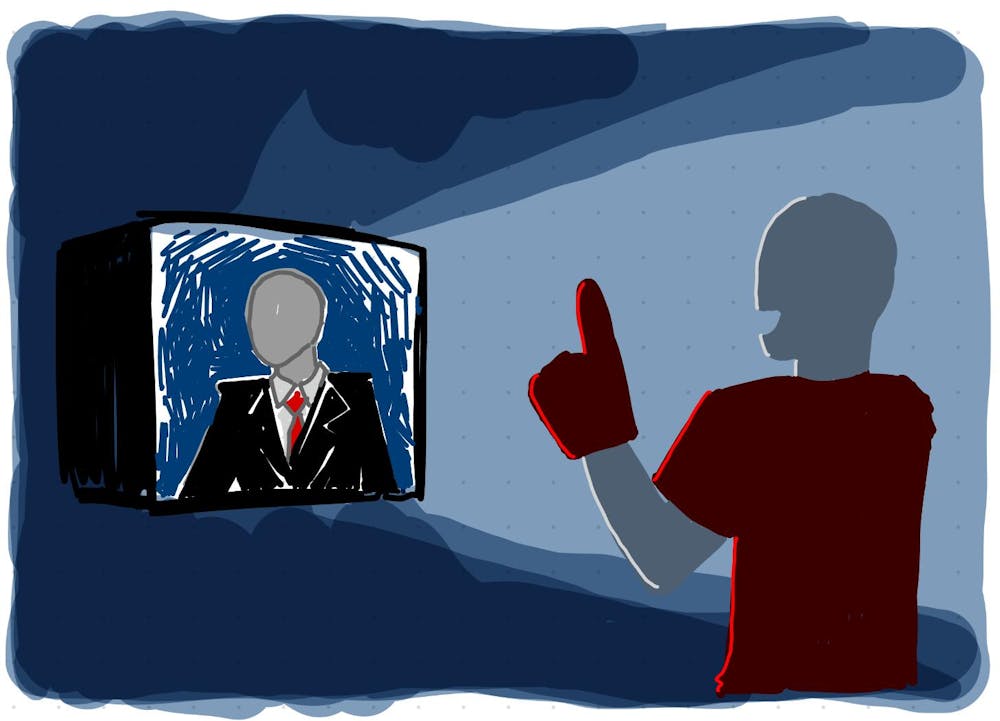
Often, students treat politics as a spectator sport, where we cheer from the sidelines for our favorite candidates and policies, but fail to substantively advocate for these causes ourselves. Eitan Hersh, a political scientist at Tufts University, defined this phenomenon as “political hobbyism,” or treating politics like entertainment by digesting political news like gossip and spreading political messaging without action.
On College Hill, the empty celebration plastered on Instagram stories are carbon-copy examples of how political hobbyism has infested students at Brown. Several factors could be driving this habit at Brown, but the most significant is our academic environment. With thought-provoking readings, lectures and guest speakers filling our daily schedules, it feels as though we are drinking from a fire hose of information. But while students are presented the opportunity to engage with this information, often this “engagement” boils down to mere inspection. This leads to a culture where the end result of “engagement” is merely viewed as consumption as opposed to implementation of the ideas we are exposed to.
This academic attitude seeps into actionable political engagement. On our campus, being “engaged” often simply means knowing the most, not doing the most. We can be lulled into thinking that immersing ourselves in the daily political news and compulsively checking polling averages is doing something more than fulfilling our self-pleasure and egotistical needs.
In the classes I’ve taken thus far, inquiry has stopped at the theory behind policy ideas, never extending into their feasibility and application. This form of teaching cultivates students who have strong views of what reforms our system may need, but leaves them high and dry when it comes to overcoming the challenges of our political environment. In subjects like English, philosophy and history, informed discourse with professors and peers at Brown may meet all criteria for “full engagement,” but politics is different. A meaningful understanding of politics that provides you with the capacity to make substantive change cannot be gleaned without descending from our ivory tower and participating in persuasion and mobilization ourselves.
Political hobbyism at Brown has dire ramifications for our discourse and democracy writ large. Politics is not a spectacle to be followed or game to be observed: It is a constant struggle for power to improve the institutions and communities around you. When political hobbyists across campus project an image of political expertise, it stymies those who wish to contribute, yet feel intimidated by those who consume more. Politics should be pluralistic — there must not be a barrier to entry for getting involved. Everyone who wants to effect change should not have to meet these arbitrarily constructed prerequisites of being sufficiently knowledgeable in order to wield power. Political spectators that proliferate at Brown reinforce the idea that politics is exclusionary and power is not for everyone.
With so much for college liberals to be hopeful about, we must take these wins forward in order to inspire a new type of political engagement at Brown: A practice where we not only engage with literature surrounding the best redistributionary fiscal policies, but also use this knowledge to persuade and build political power. Let Tuesday’s results serve as a call to do more: Have a conversation with your friends who hold differing viewpoints, encourage your neighbors to vote for a certain candidate or even plan to join a campaign in 2026. Regardless of your prior political experience, there is a place for you in politics and power is yours to take. We lose when we feel no agency to determine our own future, but we win when we step into the power that is rightfully ours. Politics is not for spectators — it’s for all of us who dare to believe we can shape something better.
Tommy Leggat-Barr ’28 can be reached at thomas_leggat-barr@brown.edu. Please send responses to this column to letters@browndailyherald.com and other opinions to opinions@browndailyherald.com.


