
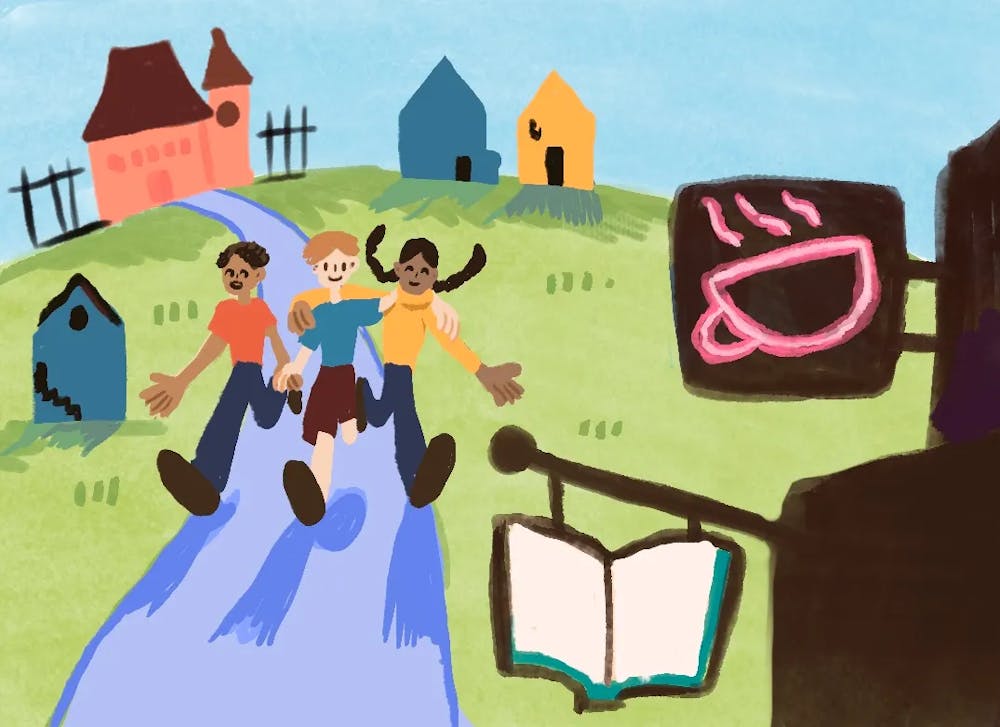
College introduces us to a hectic version of life. In the bubble that is being a university student, our social lives are often smushed together with the academic and domestic spheres of college. This results in a lack of spaces purely dedicated to voluntary and informal social gatherings — also known as third places.
While it might seem impossible to separate the academic and domestic from the social in our cramped college lives, there is one type of third place on campus which can be overlooked. As a starting point, participating in non-preprofessional and non-academic clubs at Brown can offer students the type of third place which might be missing from their lives.
In his book “The Great Good Place,” sociologist Ray Oldenburg lays out the importance of having distinct third places, first places, such as one’s home, and second places, such as work or school. Third places let people put aside the concerns that come from home life and work, allowing for much-needed, stressless social interaction. Some of Oldenburg’s examples of such places include bars, coffee shops, general stores and youth recreation centers.
But college muddles the boundaries between first, second and third places. The library becomes a gathering spot where work mingles with social interaction. Dorms are a place literally surrounded, upkept and provided by an academic institution. The people in each place are, to an extent, also inseparable — your classmates may be your neighbors, who may also be your greatest source of regular social interaction.
Amid a growing mental health crisis among college students, it is crucial for us to make room for third places in our daily lives. When we allow schoolwork to leak into social interactions, it’s easy for academic stressors to become overwhelming. Likewise, it’s easy for social pressures to become distracting when the library is a social watering hole and students’ homes are surrounded by their social circles.
Brown’s third places are stunted by their academic proximity. The Blue Room, for example, is a social epicenter of campus, but also home to a sea of faces hidden behind laptop screens. The Main Green, as well, provides students with a place to toss a frisbee and chat, but is similarly covered by those seeking a sunnier spot to study.
At Brown, participation in non-pre-professional and non-academic student organizations can provide us with a part of our routine solely dedicated to casual socializing. There are countless organizations on campus which might provide us with this needed third place, from the Cooking Club to the Outing Club and beyond. These types of clubs provide students with an activity that lends itself to casual socializing.
Hobby-based clubs, while a good place to start, should not be seen as the end all, be all. After all, the third places they create are still mostly on campus. And while they might introduce you to individuals different from your classmates and dormmates, they’re still completely composed of Brown students. For further separation between the social and academic, one might look down the Hill toward the wider city of Providence. There are plenty of nearby cafes and bars that facilitate informal social interaction. Even if you go with your friends, these destinations can still provide you with an opportunity to engage socially off campus.
Brunonians might not have a perfect third place, but putting in the effort to carve out small pockets of separation matters. Whether it be through fun clubs or treks down the Hill, these spaces give us some much needed room to breathe.
Zeke Tesler ’29 can be reached at zeke_tesler@brown.edu. Please send responses to this opinion to letters@browndailyherald.com and submit other op-eds to opinions@browndailyherald.com.


