
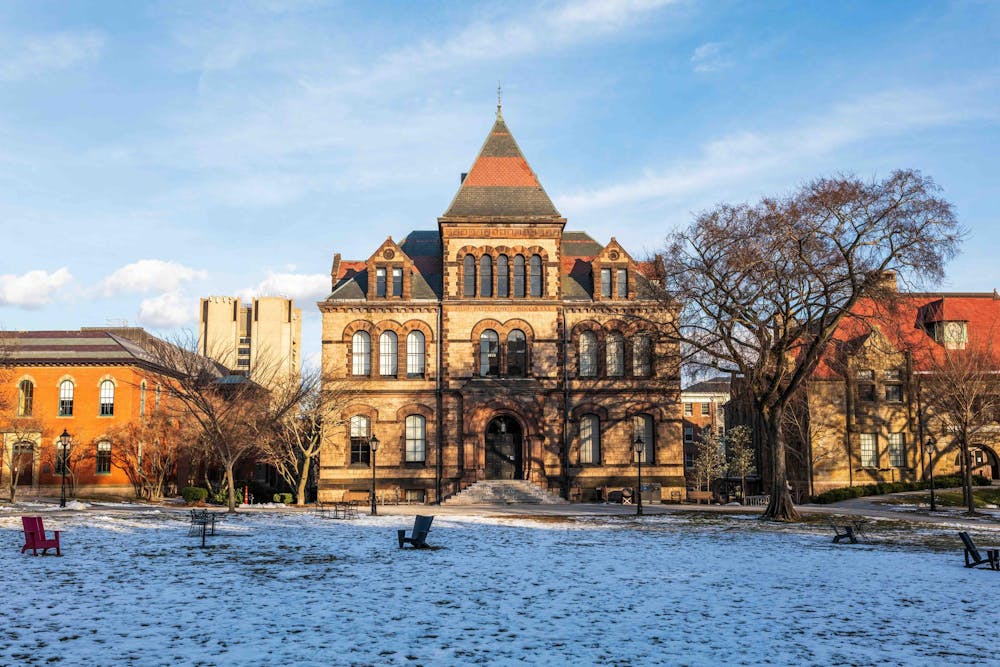
On Wednesday evening, Brown welcomed 890 of 5,406 early decision applicants to the class of 2030 “as the campus works to heal” from Saturday’s mass shooting, according to a University press release.
Decision notifications were previously going to be released on Monday afternoon, but were postponed following the Dec. 13 shooting that left two students dead and nine others injured.
“While Brown continues to mourn the loss of two beloved students and support the healthy recovery of other community members impacted, University leaders said they recognize that admission decisions mark a very important day for the many talented applicants to Brown,” the University press release read.
With 16.5% of prospective students admitted, the class of 2030 has a slightly lower acceptance rate than last year’s 17.9%. The class of 2027 saw the lowest early decision acceptance rate at 13%.
The University did not share the number of applicants that were deferred, rejected or who withdrew their applications.
The total number of early decision applications for the class of 2030 increased by nearly 400 from the class of 2029. This year’s cohort of admitted students is smaller than the 906 new Brunonians admitted early decision for the class of 2029.
This year’s admitted students exemplified “a commitment to collaboration, the self-motivation to be architects of their own education and a desire to solve problems and make a difference in the world,” said Associate Provost for Enrollment and Dean of Undergraduate Admissions Logan Powell in a press release.
The class of 2030 is the second class to apply with reinstated mandatory standardized test requirements in place and the third to apply after the Supreme Court’s ban on race-based affirmative action. Black and Hispanic student enrollment for the class of 2028 plummeted following the decision, but rebounded for the class of 2029, according to data from The Herald’s class of 2029 first-year poll and Brown’s Office of Institutional Research.
Fifty-two students were admitted through the QuestBridge program for low-income and first-generation students, a decrease from the class of 2029’s 90 accepted Questbridge scholars. The number of students admitted through QuestBridge dropped for the first time in over a decade.
Brown’s Program in Liberal Medical Education, a combined eight-year undergraduate and medical school program, admitted 23 students.
Of the Brunonians admitted to the class of 2030, 453 attended public schools, 333 attended private schools, 100 attended religious schools and four were homeschooled.
First-generation students — those who are the first in their family to attend college — make up 16% of this year’s class of students admitted early decision, a slight decrease from last year.
Domestic students were accepted from 46 different states, the District of Columbia and Puerto Rico. Applicants most commonly hailed from New York, California and Massachusetts.
The University did not share the number of countries students were admitted from, or the most common home countries for accepted international students.

Roma Shah is a section editor covering University Hall & Higher Education and Admissions & Financial Aid. She's a sophomore from Morgan Hill, CA studying neuroscience. In her free time, she can be found doing puzzles, hiking or curled up with a book.

Ian Ritter is a university news and science & research editor, covering graduate schools and students. He is a junior concentrating in chemistry. When he isn’t at The Herald or exploding lab experiments, you can find him playing the clarinet or watching the Mets.


