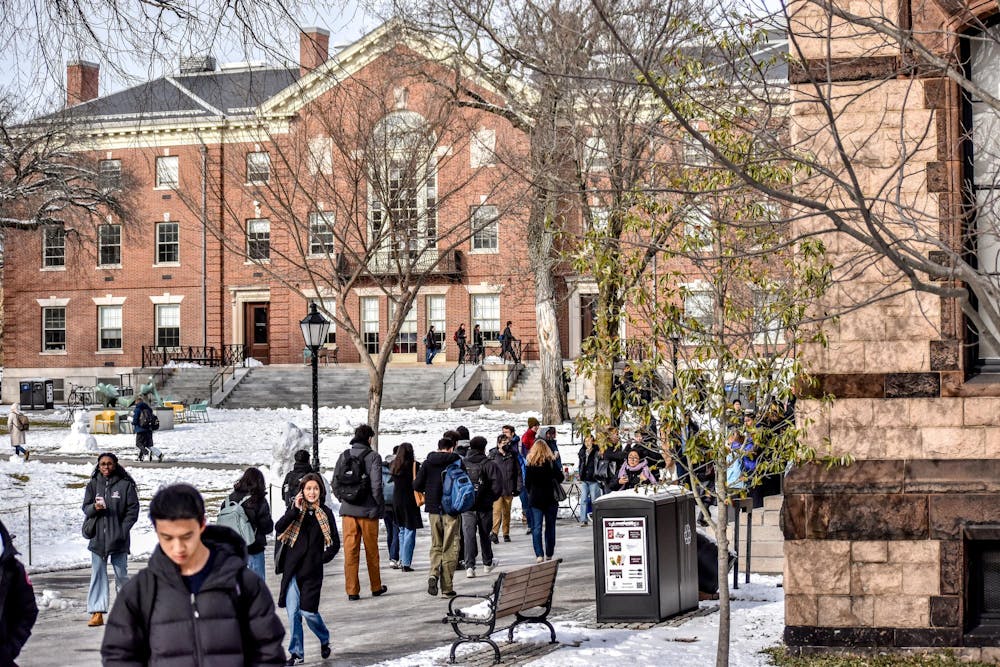
When Eva Skelding ’28 returned to campus Tuesday evening, she found her dorm room still disheveled from the barricade she built during the Dec. 13 shooting.
Although returning to campus “will definitely be difficult,” Skelding wrote in a message to The Herald, “I’m so glad to be back because I think the most important thing is to be able to grieve and process with the rest of the community.”
Like Skelding, many students are grappling with a mix of emotions as they settle back into campus life. One student, Don Shumbusho ’28, told The Herald that they are looking forward to getting back to Brown but also recognized the strangeness of the experience.
Shumbusho added that “it’s going to be weird to just be walking around” Barus and Holley, where one of his classes is taking place.
Although the transition comes with uncertainty, Jimmy Kaplan ’28 “feels ready to go back to campus,” he said. “It’s this weird feeling of wanting everything to go back to normal but knowing it’s not really possible for that,” Kaplan added.
Aaron Tiong ’28, who was on the seventh floor of Barus and Holley during the shooting, said that the experience was “a wake-up call” to “how precious life is.”
Tiong believes and hopes that “there will be a sense of community once we do get back,” he added. “We should move forward and really help each other.”
The shooting punctuated the first semester of college in the United States for Sophie Sun ’29, an international student from Beijing. “Part of me questions the safety of America as a country,” she said, noting that she feels that many of her international student peers chose to attend Brown for its relative safety.
“This is our first semester,” she said. College “just began, and this is how the semester ended.”
According to an email to the Herald from University Spokesperson Brian Clark, Brown is continuing to maintain a series of enhanced security measures, including “increased and visible public safety presence,” expanded swipe access and investments in infrastructure “such as additional blue light phones with integrated cameras” across campus.
The Herald previously reported that the University has already implemented security enhancements, including additional cameras and door alarms, in Barus and Holley, the Engineering Research Center and the Lassonde Innovation and Design Hub.
“I definitely think the cameras will make people feel more safe as everything will be recorded,” Shumbusho said. But they added that “seeing the increase in DPS on campus, having to swipe into all your buildings now, might be a constant reminder of what happened.”
Tiong hopes that with increased ID swipe requirements, the University will give students “24/7 access to every building.” Currently, the University has stated that most academic buildings will be open to students between 7 a.m. and 8 p.m. with some exceptions, The Herald previously reported.
Even though “buildings at night usually get locked,” Tiong hopes the University might expand access for students looking to study since the spaces will be locked to those without Brown ID swipe access.
Amid some fear and uncertainty, many students looked forward to returning to their friends and a shared community.
“Seeing Brown again, and that community, is going to be really healing,” Kaplan said.
“It’s hard to replicate the deep sense of understanding that comes from talking to people who went through the same situation,” Skelding wrote. “I think this tragedy has revealed how close we all are as a student body and how valuable that bond can be when we need it the most.”
The University also launched Brown Ever True to support community healing and recovery efforts, The Herald previously reported. According to Clark, “students have access to a broad set of supports, including 24/7 care through the Administrator on Call and the Department of Public Safety and Emergency Management” and accessible Counseling and Psychological Services appointments.
Clark added that “beginning Jan. 20, clearly marked tables staffed by trained personnel and mental health professionals will be available to students in multiple locations across campus.” These will be accompanied by a range of additional services, “from acu-wellness and pet-assisted therapy sessions to virtual and in-person community gatherings in affinity centers and residence halls,” he wrote.
For Kaplan, Brown Ever True is “not just important, but essential.”
“It’s good to know that those resources are there and that the University is providing us options,” he said, adding that he will recommend them to people he feels might need the support.
“The few days after the event, I was feeling really unsettled personally and I kept thinking back to what happened,” Sun said. “It’s through initiatives like (Brown Ever True) that we are able to normalize the experience that we go through after traumatic events.”
Clark emphasized that healing is different for everyone. “Recovery is a gradual process,” he wrote. “Brown is committed to meeting students where they are and working to move forward together with care, patience and compassion.”
Some students are concerned about how the campus culture may be affected. Shumbusho worries that Brown’s open campus culture will be diminished, which “might be a sacrifice we need to make for safety,” but can also “completely shift how open we are to having people on campus or allowing people to walk around freely.”
Sun said that safety-wise, she feels comfortable returning to campus. She is more concerned about the mental status of her peers.
“I fear that it will make people more distant because they may feel uncomfortable in this situation,” she said. But Sun added that the tragedy has “matured” students, which places “more importance” on their remaining time at Brown.
“It makes me want to give back more to the community and to hold the people around me tighter,” she said. As Class Coordinating Board Freshman Vice President, Sun hopes to “organize any events that can bring people together and make them feel better about the recovery.”
Shumbusho hopes the path forward will center solidarity and collective strength. “You are not powerless,” he said. “Nobody took your power away from you. Community is our power.”