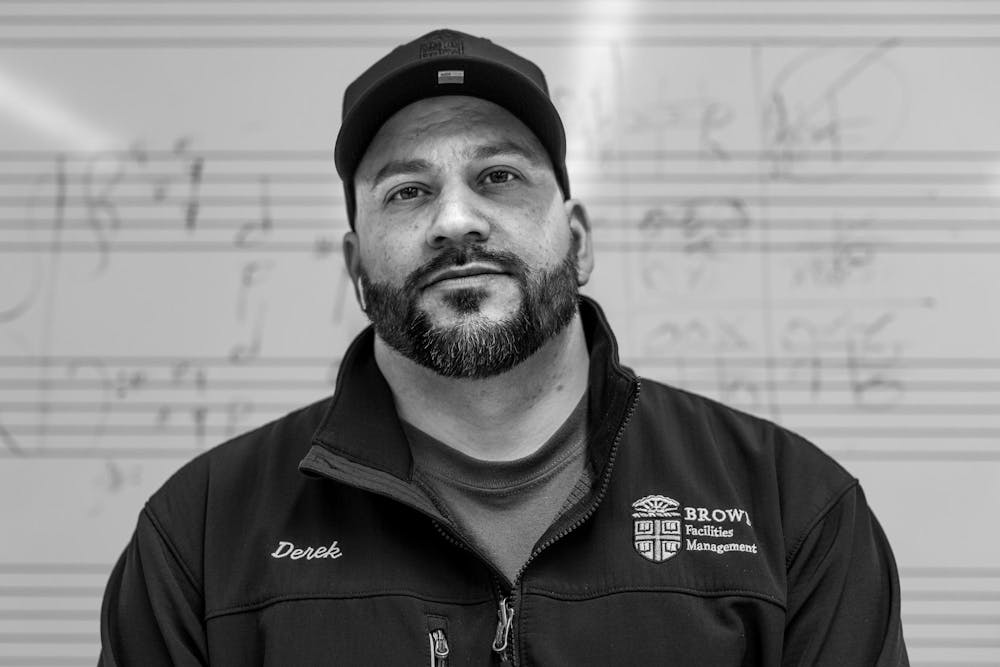
On Tuesday, Derek Lisi, a custodian who works in the Engineering Research Center, returned to his normal duties in the building for the first time since the mass shooting on Dec. 13.
While Lisi is focused on returning to his job, he is still feeling the shock of December’s tragedy: “You try to keep moving on and you’re like, it really happened here,” he said.
Lisi said he witnessed shooting suspect Claudio Neves Valente casing Barus and Holley — a building connected to the ERC — throughout November and early December.
Lisi, who said he has worked at Brown for 15 years and in the ERC for five years, noted that “there’s always random people going in and out of the building,” but that the man he believes was Neves Valente “stood out.” The man always wore a blue surgical mask and walked with a limp, he said.
The man was always by himself, Lisi said. “He didn’t interact with anybody, and every time I would see him he would kind of like walk fast and run away,” he said. Lisi added that he had seen the man “peeking into classrooms” around Room 166, the lecture hall where the shooting occurred, but he never saw him cross from Barus and Holley into the ERC.
Lisi said that he last saw the suspicious person in the first week of December, before his vacation began on Dec. 6. According to Lisi, the person “ran away into the bathroom across from 166.” That prompted Lisi to tell a staff member who worked under Event Staff Services — a third party security vendor Brown employs for campus events — about the suspicious individual. Lisi said the staff member did not investigate the incident further.
“They’re supposed to check Brown IDs,” Lisi said. “I thought if anything, he would have went up to the guy and asked for his ID.”
“Our role is strictly to assist with on campus events — sporting events, concerts, speaking programs — to check IDs, search bags and ensure a room doesn’t go over capacity,” David Madonna, the president of ESS, wrote in an email to The Herald. “Our role is not an investigative one, and the individual was told to provide that information to Brown Police.”
But according to Lisi, the ESS member never told him to report the suspicious individual to DPS.
Madonna said he heard from an ESS staff member who recalled speaking with a custodian about a suspicious person in early December, the Boston Globe reported. Madonna declined The Herald’s request for comment on that interaction.
Though the suspicious person gave Lisi a particularly “odd feeling,” he said that many people who come into the building look suspicious, “but some people just don’t like to talk to people.”
Lisi added that he did not have a clear understanding of the ESS staff’s responsibilities and that he had not received training on reporting suspicious people from his department.
Vice President for Facilities and Campus Operations Michael Guglielmo declined to comment on whether facilities employees are trained on how to report suspicious people.
After the shooting on Dec. 13, Lisi called the tip line provided by Providence Police at 11:14 p.m. after seeing footage of the person of interest and recognizing his gait. He said he called nine more times before the department answered his tenth call, made at 11:50 p.m., and received his tip.
Two days later, on Dec. 15 at 7:37 p.m., Detective Matthew McGloin of the Providence Police Department left Lisi a voicemail saying he was “following up on a tip that was provided.”
“They were probably getting blown up with spam,” Lisi said. “But I just felt like maybe if they would have followed up on it right away, they would have tracked him sooner.” The affidavit states that Lisi helped investigators identify an “individual matching the general description as the suspect” in security footage from Dec. 1.
“During the course of this Brown shooting investigation, law enforcement received an extremely high volume of tips, with more than 1,000 tips coming in during that week alone,” Providence Department of Public Safety Chief Public Information Officer Kristy dosReis wrote in an email to The Herald. “While some tips were ultimately determined not to be credible, each one was first evaluated before that determination was made, and none were ignored.”
When Lisi met with police and described his encounters with the alleged shooter, he said he advised them to “look at the camera going back two months, (because) that guy was around.”
Shooting suspect Valente recorded videos before his death on Dec. 16. In one of the videos, Valente said he had planned the shooting for six semesters and “had plenty of opportunities” before but “always chickened out.”
Lisi returned to work in late December, and prior to students’ arrival, Lisi said that “mentally, it’s tough” to be at Brown. “I was going to go out on leave, but I’m trying to go through it … I want to see how it is when the kids are back.”
Even on bad days, “it’s always some of the students that appreciate what you do,” Lisi added.
Since returning, Lisi said that the ERC “just has a whole different feeling.” He added that additional security has made him feel safe, but it has also led him to question the safety of the building prior to the incident.
“I understand you’re not going to have a detail every day, but where was it before?” Lisi asked.
In an email to The Herald, University Spokesperson Brian Clark wrote that the University is conducting an after-action review, which “includes a complete assessment and evaluation of campus safety in the period leading up to the tragedy, the preparedness and response on the date of the shooting and the emergency management response in the aftermath.”
“We have heightened security on campus considerably in recent weeks, and we are conducting a large-scale systematic security review of the entire campus,” he wrote. “We know we live in a different time.”

Emily Feil is a university news and metro editor covering staff & student labor and RISD. She is from Long Beach, NY and plans to concentrate in English and international & public affairs. In her free time, she can be found watching bad TV and reading good books.