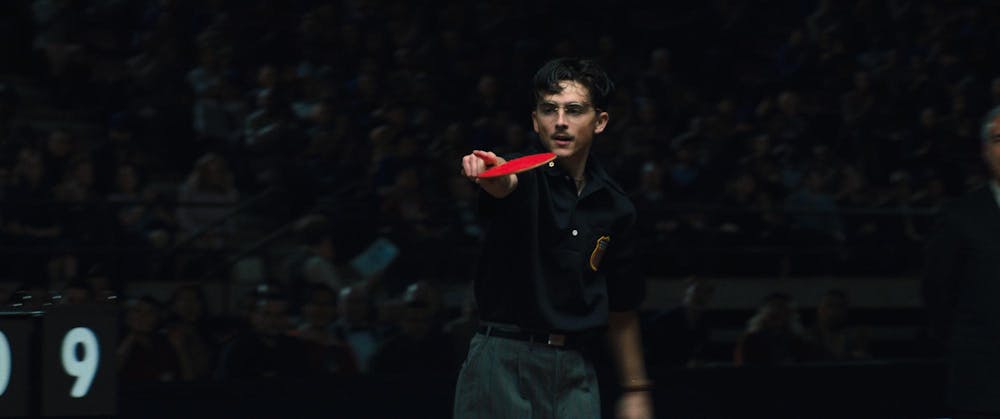
In the film “Marty Supreme,” the sport of table tennis — a game of quiet, calculated moves — is transformed into a loud and unsettling study of ego, obsession and human failure.
Set in 1950s New York City, the film stars Timothée Chalamet as Marty Mauser — a hustler and professional table tennis player driven by his desire for greatness, rather than a love of the game. While Chalamet has already won Best Performance by a Male Actor in a Motion Picture in the musical or comedy category at the 2026 Golden Globes for his performance as Mauser, the film is continuing its streak with a whopping nine Oscar nominations.
“Marty Supreme” seems designed to stress its audience with erratic filming and illogical decisions that traps Mauser into his demise. The film is less of a sports drama and more of a psychological spiral, capturing the destructive power of unfettered ambition.
Chalamet portrays Mauser as insecure and increasingly unbearable — a man who is willing to compromise anything in exchange for an ego boost. His cockiness is almost comical — when asked what he would do if his dream of winning the world championship didn’t come true, he responds, “That doesn’t even enter my consciousness.” The role is one of Chalamet’s most unsettling performances yet.
Josh Safdie, the film’s director, has a talent for making the mundane feel catastrophic. His reputation for refusing to reassure viewers and forcing them to sit with discomfort is apparent in “Marty Supreme.”
Throughout the movie, the camera remains uncomfortably close to Mauser’s face. This visual technique forces audience members into close proximity with Mauser, requiring them to acknowledge his most unbearable traits — arrogance, jealousy, desperation and delusion. Mauser is deeply flawed, and the film’s intentional videography refuses to let viewers ignore it.
The videography also mirrors Mauser’s own internal conflict. The film’s frantic editing, overlapping dialogue and oppressive sound design creates a sensory overload that mimics the stressful environment felt by Mauser at his tournaments. Even his training scenes seem like a form of self-harm — offering elevated pressure, isolation and noise rather than genuine fulfillment of the sport.
The film’s realism creates discomfort, yet viewers remain hooked as they wonder whether Mauser’s ambition can finally lead to his character development.
By the time Mauser reaches the international stage, he is forced to confront his own weaknesses of cockiness and delusion. His overconfidence is tested during a match with Koto Endo (Koto Kawaguchi), Mauser’s greatest opponent of the film. Mauser is forced to confront the truth he has spent the entire film outrunning — that wanting greatness does not make one great.
Yet Safdie refuses to give this realization any redemption. The film ends where it began, with Mauser still chasing his ambition and neglecting his personal life.
This bleakness is not accidental. “Marty Supreme” is a film about the downfalls of human nature and how the desire to be exceptional can destroy what makes life worth living. Lacking a true resolution, the film rejects comfort and instead provokes deeply uncomfortable personal reflection: If ambition costs us everything else, what is it ever worth?