
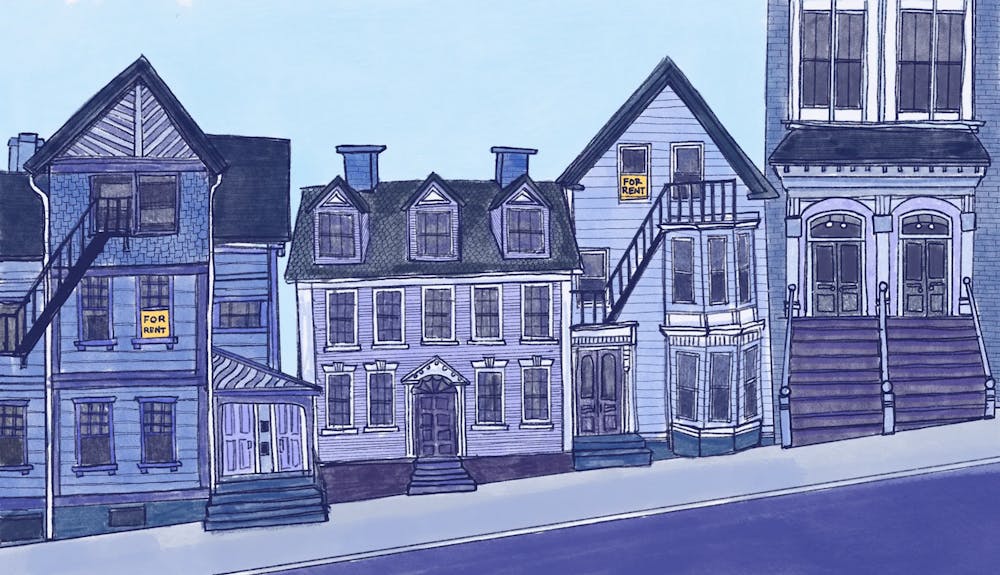
At a Jan. 22 meeting, the Providence City Council introduced a rent stabilization ordinance, which would cap annual rent increases at 4% in an attempt to control the city’s rental prices. Mayor Brett Smiley has promised to veto the ordinance.
Providence City Council President Rachel Miller (Ward-13) and President Pro Tempore Juan Pichardo (Ward-9), along with six other councilors, have co-sponsored the ordinance, but with Smiley’s impending veto, its passage through committee will depend on affirmative votes from two additional city council members.
“Rent stabilization means renters will no longer have to rely on luck or hope to stay in their homes,” Miller wrote in an email to The Herald. About half of Providence renters are housing-cost burdened, according to a 2025 City Council report. Many Providence renters have found themselves priced out of homes after property owners raised rent prices, Miller added.
“Mayor Smiley has stated he would veto the ordinance as written,” wrote the Mayor’s Press Secretary Anthony Vega in an email to The Herald, mentioning concerns that rent controls would destabilize a housing market that is subject to property tax and insurance fluctuations. Another concern is the rent stabilization’s impact on new housing production, Vega added.
The ordinance grants a 15-year grace period before newly constructed housing prices are controlled. Other exemptions aim to protect transitional housing and institutional buildings that include educational or religious properties.
In addition, the ordinance establishes the newly-appointed Rent Board to mediate landlord disputes and petitions, enforce tenant protections and allow for the registration of tenant unions. Landlords who fail to comply with the Board’s mandates may face penalties, including fines.
Unlike a fluctuating cap based on each year’s rate of inflation, the ordinance's flat rate doesn’t require back-and-forth negotiations with the Rent Board, Miller wrote. “Four percent accounts for the regular inflationary costs of a healthy housing market,” she wrote. “It doesn’t require more than the calculator on your phone to know how much you can charge for rent or what your rent might be.”
A study conducted by Redfin last year found that Providence is the least affordable city for renters, The Herald previously reported. Since 2020, median rent prices have increased 40%.
A general decrease in federal funding for public housing, compounded by slow housing construction and strict zoning regulations, has led to rising prices and short supply, according to Brenda Clement, the director of HousingWorks RI, a research and policy think tank focused on housing affordability.
In addition, Providence attracts renters from adjacent cities who can easily commute from Providence to work in neighboring states like Massachusetts and Connecticut, narrowing housing opportunities for Providence residents.
“The Boston market has expanded south into Providence, so the people who can’t afford the really astronomical rents in Boston have moved down to Providence,” said Providence College Professor Eric Hirsch, who also leads the Rhode Island Homeless Advocacy Project. “That demand, by relatively well-off people, has increased the rents in Providence.”
City Councilor Jill Davidson ’89 (Ward-2), another co-sponsor of the ordinance, said in a statement shared with The Herald that the city councilors did “years of research to ensure we didn’t replicate mistakes,” acknowledging the mixed results of rent control in other cities.
The ordinance is part of a larger range of efforts to equalize the housing market, from funding the city’s Affordable Housing Trust and home repair program to converting vacant offices into living spaces.
“No single policy will end Providence’s housing crisis,” wrote Miller. But she described the ordinance as an “essential part” of the councilor’s three-part strategy of increasing housing supply, protecting current housing stock and stabilizing rent.
For many council members, the ordinance tackles an issue that hits close to home.
“I spent almost my entire life as a renter, and I know exactly how fragile that life can feel,” City Councilor Justin Roias (Ward-4), who co-sponsored the ordinance, said in a statement shared with The Herald. For Roias, “rent stabilization is about keeping Providence livable for the people who call it home now.”
But some remain skeptical of whether rent stabilization will address the underlying problems of housing scarcity and affordability.
“Providence is using every available and nationally recognized strategy to address the housing shortage,” Vega wrote. “The Mayor’s focus has been on tackling the underlying problem by building more homes at every price point … and expanding targeted protections and support for residents who are at risk of displacement.”
Hirsch believes that the exemptions should be sufficient to sway the ordinance’s opponents. “They did every conceivable thing that they could to make sure that none of the problems that are supposedly associated with rent stabilization are going to happen,” he said.
But Rhode Island Coalition of Housing Providers Director Shannon Weinstein, who is also a realtor with experience in property rentals, cautioned that even with exemptions, rent stabilization can produce bottlenecks in housing supply.
She added that cost-burdened landlords of owner-occupied units, also exempt from the 4% cap, would still suffer because the drop in surrounding property values would force them to lower their prices to compete in the market.
Jeffrey Hamill, a senior policy analyst at the Rhode Island Public Expenditure Council, which published a study against rent controls with the Providence Foundation earlier this month, observed that rent stabilization policies fail to address the central problem that apartment prices are already too high.
He added concerns that the resulting decline in property values would bring less tax revenue to the city’s public budget, potentially pressuring the city council to “raise property tax rates on single-family homes to offset the revenue gap and maintain essential services.”
Hirsch acknowledged that rent stabilization is not enough to fix the housing crisis when many residents cannot afford capped rental prices. But the ordinance will help renters threatened by eviction due to nonpayment, he said.
A city council committee will review the ordinance before the full city council conducts the first vote.
“Rents are definitely too high,” Clement said. “I’m grateful for the city council putting together the ordinance because…it makes all parties come to the table to talk about it.”
Ava Rahman is a senior staff writer covering housing, infrastructure and transportation.


