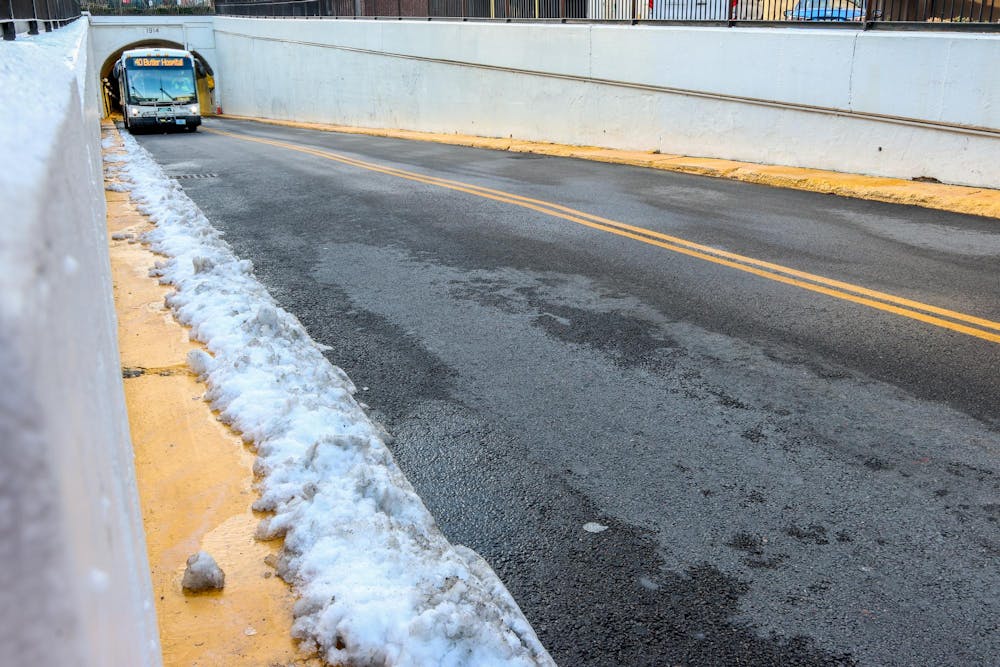
Pro-transit advocacy coalition Save RIPTA released the “2025 Service Cuts Impact Report” earlier this month, documenting a decline in ridership following service reductions to 45 routes implemented by the Rhode Island Public Transit Authority in September.
According to the report, RIPTA routes with service reductions saw, on average, a 14% decrease in ridership from November 2024 to November 2025, equating to an average of 4,033 fewer daily riders.
The cuts to RIPTA routes included reduced service frequencies and the termination of some service hours. The RIPTA routes faced a total loss of 113,684 annual hours of service, according to the report.
Amy Glidden, co-coordinator of Rhode Island Transit Riders, another pro-transit advocacy group, has voiced concern over an increase in crowded buses since the cuts to services. According to Glidden, 70% of drivers say they have left passengers at the bus stop at least once a week due to a lack of bus space.
“There was one day where I was passed by four full buses, and it took me an hour and a half to travel just a little over two miles,” Glidden said, adding that her commute has now become “a gamble.”
Community College of Rhode Island student Jax Martin said he has resorted to joining appointments virtually due to the bus’s unpredictable schedule. “It’s now so spaced apart that I can’t get to the appointments in person because I’m an hour early or an hour late,” Martin said.
Lourdes Sam, a nursing student at Rhode Island College, also said she can no longer predict her commute time.
Before the cuts, Sam said she could assume there would be space on the next bus if one was full. Now, “the buses stay full for a longer time until they fully fizzle out,” she said.
The buses are sometimes so crowded that “there’s no real room to stand — there’s no room to even sit,” Martin added.
Melissa Benevides, a special education teacher, helps run a program for students to get on-site job experience in the Providence community. Since the cuts were implemented, she has had to adjust the times that students go to their job sites.
“We’re at the mercy of the buses to get them to work,” Benevides said.
State Representative Karen Alzate (D-Pawtucket, Central Falls) said she has heard similar complaints from her constituents. “When we’re not in session, it’s constant emails or calls (saying) ‘this bus didn’t show up’ or ‘it’s taking too long’,” she said.
The service cuts were enacted despite efforts to alleviate RIPTA’s fiscal year 2026 budget deficit, which sat at $32.6 million before the Rhode Island General Assembly granted RIPTA additional funding.
While the report did not include information on the total effect of the cuts to RIPTA’s fiscal year 2026 budget, the document cited a 29% increase in the hourly operating cost of bus service.
“At this time, it’s too early to calculate the full revenue impact,” RIPTA spokesperson Cristy Raposo Perry wrote in an email to The Herald.
Raposo Perry added that the agency remains “committed to continue finding ways to improve ridership” through cost-saving reduction measures of both administrative and underperforming routes and an ongoing “fare analysis” to boost revenue.
In his State of the State Address, Gov. Dan McKee promised to close the RIPTA’s remaining $14 million deficit in fiscal year 2027.
“We are grateful to Governor McKee for fully funding RIPTA in the FY27 budget,” read a statement sent to The Herald from RIPTA CEO Christopher Durand. “Thanks to investments by Governor McKee and the General Assembly, we do not see a need for further reductions to service.”
Alzate is currently co-sponsoring legislation to add an additional $5 million to RIPTA’s budget. The $5 million proposal is based on “what we’re hearing from advocates,” Alzate said.
Alzate’s bill is part of Save RIPTA’s proposed legislative package, alongside additional legislation that would increase the RIPTA’s budget through re-allocated funds and taxes.
Alzate said she remains cautiously optimistic that lawmakers can pass an additional $5 million, but that “it’s too early to tell” if the bill will pass.
“Getting sustainable funding that RIPTA can use year after year, in a sufficient amount to reverse the cuts, is our top priority,” Glidden wrote. “We will work to create a first-class transit system.”
Ava Rahman is a senior staff writer covering housing, infrastructure and transportation.