Often considered the most prestigious honor in music, the Grammy Awards are cultural crowning achievements given to a small selection of talented musicians. On Sunday, viewers tuned in from around the world to watch the 68th Grammy Awards live from Los Angeles.
Hosted by Trevor Noah for the sixth and final time — because, in his words, he believes in term limits — the show was funny, apart from the painfully scripted teleprompters. With a dig at Nicki Minaj and an impression of Trump, Noah brought humor that sustained the show, which lasted more than three hours.
Every year, the award show manages to be quite the spectacle, with performances from the year’s standout artists. This year, the ceremony also served as a platform for artists to make explicit political commentary. From speeches calling for the abolition of U.S. Immigration and Customs Enforcement to stars donning black and white pins saying “ICE OUT,” the state of the nation was an ever-present theme.
After music legend Carole King presented Billie Eilish and Finneas O’Connell the award for song of the year for “Wildflower,” Eilish focused her speech on condemning ICE.
“No one is illegal on stolen land,” she said.
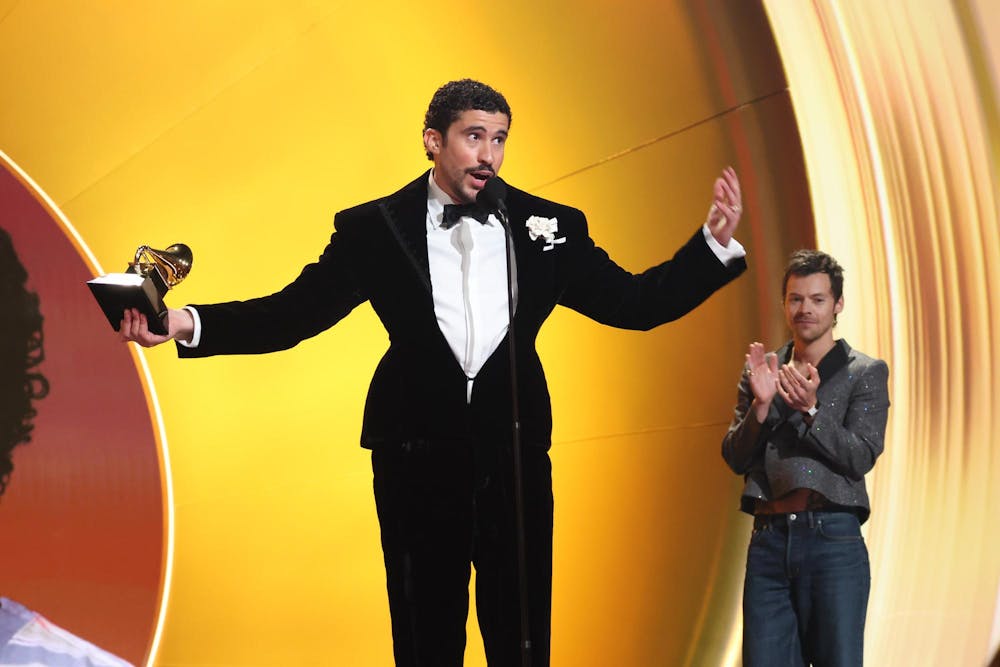
Continuing the political theme of the night, when accepting the award for best música urbana album for “DeBÍ TiRAR MáS FOToS,” Bad Bunny, who is Puerto Rican, began his speech by speaking out against ICE. “We’re not savage. We’re not animals. We’re not aliens. We are humans and we are Americans,” he said.
Bad Bunny also took home the award for album of the year for “DeBÍ TiRAR MáS FOToS,” making it the first Spanish-language album to win the award. In the last moment of the night, he delivered most of his acceptance speech in Spanish, which was the perfect note to end on.
The best performance of the night was by Tyler, The Creator, whose set was the perfect combination of political, aesthetic and sensual. With a clear passion for performing, Tyler, The Creator used the Grammy stage as it should be used: to make a statement. That statement was accentuated by an actual explosion onstage that reportedly took over 10 stagehands to clean up.
While Tyler, The Creator was nominated for six Grammy awards, including best rap album, the coveted title ultimately went to Kendrick Lamar. In winning, Lamar became the most-awarded rapper in Grammy history. He also took home record of the year for “Luther” with SZA.
But Tyler, the Creator was not snubbed — he became the first-ever winner of the brand new award for the best album cover for CHROMAKOPIA.
Olivia Dean, who took home the title of best new artist — one of the night’s most coveted awards — gave the audience the performance they needed. Her performance, while simple, was a testament to her vocal talent. Her love for music emanated from the Grammy stage to screens across the globe.
Among the big names in music, Supreme Court Justice Ketanji Brown Jackson — who was nominated for best audio book, narration and storytelling recording — was also in attendance. While she didn’t win, her presence did not go unnoticed, with Noah joking that “if you lose a Grammy, you can appeal directly to the Supreme Court.”
Toward the end of the evening, Lauryn Hill, who has won eight Grammy awards — more than any other female rapper — performed a beautiful tribute to the late musicians D’Angelo and Roberta Flack, who both passed away last year. The touching performance featured many other artists, including Jon Batiste, who was awarded an honorary doctorate at Brown’s commencement in 2025.

Talia LeVine is a section editor covering arts and culture. They study Political Science and Visual Art with a focus on photography. In their free time, they can be found drinking copious amounts of coffee.