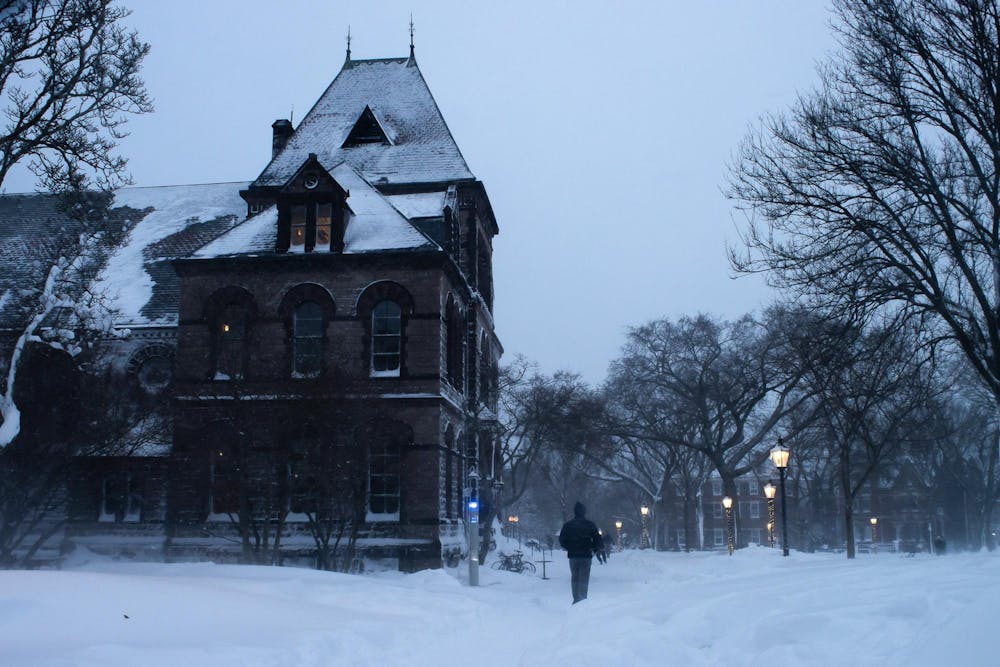
Starting on Sunday night and lasting well into Monday, the Northeast was hit by a record-breaking blizzard, with total snowfall surpassing three feet in the Providence area causing both University and statewide shutdowns.
When a snowstorm hit Providence on Jan. 25, Brunonians had the day off and a citywide parking ban was implemented for about two days. But for this week’s blizzard, school has been canceled or moved online at the discretion of the instructor for four days straight. The parking ban, which went into effect Sunday afternoon, was still in place Wednesday night.
The difference in impact between the two events mirrors the distinction between blizzards and snowstorms.
According to the National Weather Service, a blizzard is a weather event defined by large quantities of snow, heavy winds of over 35 miles per hour and visibilities less than a quarter of a mile for at least three hours. But “a snowstorm is just the snow,” Amanda Lynch, a professor of environment and society and Earth, environmental and planetary sciences, wrote in an email to The Herald.
The definition of a blizzard goes beyond that, though, according to Maria Luìsa Rocha GS, a graduate student in the Department of Earth, Environmental and Planetary Sciences. Snowfall does not necessarily need to occur for there to be a blizzard, she wrote in an email to The Herald.
“Strong winds can pick up snow that is already on the ground and create whiteout conditions” without there being additional falling snow, Rocha wrote.
“In short, all blizzards are snowstorms, but not all snowstorms meet the criteria to be classified as blizzards,” she added.
This distinction is important, Rocha noted, as blizzards “are generally more dangerous” than snowstorms due to the lack of visibility, dangerously low temperatures and snow drifting. Understanding these differences, “helps communities respond appropriately to the level of risk,” she wrote.
Darren Austin, a meteorologist for the Rhode Island Department of Environmental Management, highlighted that because blizzards reduce visibility, they can slow efforts by the state to manage snow.
“Roads are improving (and) once it’s plowed, you’re good,” Austin said. But “when there’s travel bans, which the governor issues … heed those warnings.” he added.
Austin also noted that this week’s blizzard was particularly risky for community members because of its extreme wind speeds. “We had a hurricane force wind gust at T.F. Green Airport of 73 miles an hour,” he said.
The blizzard also had wet snow, which Austin described as a “different kind of animal,” as it can stick to surfaces and weigh down trees, roofs and power lines. This, in addition to wind, is the reason why “Rhode Island Energy was forecasting over 100,000 power outages,” he added.
Mark Searles, the chief meteorologist at NBC10, noted the importance of having “enough food, water and provisions in the event you are stranded for days.”
“Make sure that after the storm your vents are clear around your house,” he added, as “carbon monoxide poisoning is real and excessive snow piled up around furnace vents can be deadly.”
To stay informed, Austin said residents should keep up with weather reports, as well as communication from Brown’s emergency management staff. He noted that forecasts can be unreliable up until roughly 48 hours before storms.
Four days before this blizzard, one European model called for zero inches of snow, Austin explained. “It can be a matter of only 100 miles, and you can have a miss as opposed to a beating,” he said, noting that Rhode Island’s coastal location means that a predicted snowstorm could go “right offshore.”
Austin said it’s important to stay alert and watch out for falling snow from buildings. “Look out walking around the city,” he warned.
Additional reporting by Alice Xie.